Last week Montgomery Fix posted a video on social media showing an open field of tall grass on Cashell Road near Olney. It's an 18.5-acre parcel purchased by Montgomery County Public Schools in February 1965 for a planned junior high school that never happened. The land has remained undeveloped for more than 60 years.
The video sparked comments from viewers across the county who mentioned similar parcels in their communities, likewise unused for decades. Some pondered why MCPS owns so much land, and others wondered why it hasn't sold or repurposed it. With the school system facing a multibillion-dollar maintenance backlog, those are questions worth exploring. But there's another intriguing possibility. Could some of those empty fields help solve the county's teacher housing shortage? We did the research. Here are the answers.
How Much Land Are We Talking About?
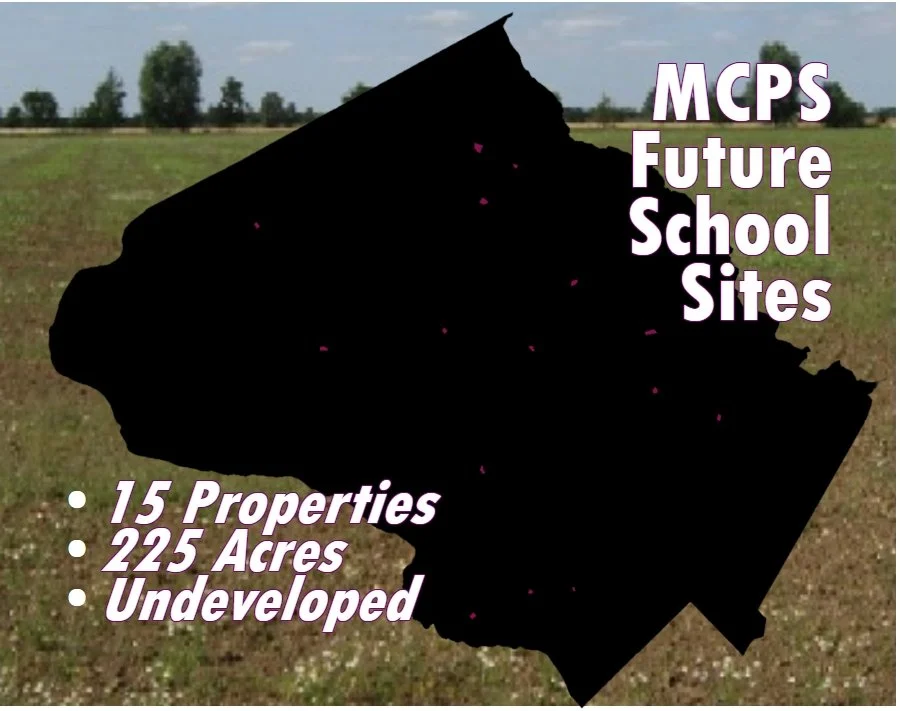
Beyond its active schools, programs and centers, MCPS holds a substantial real estate reserve. According to the district’s capital planning inventory, the Board of Education owns 16 "future school sites" covering more than 250 acres. Fifteen are undeveloped, and one, the new Wootton High School at Crown Farm in Gaithersburg, is under construction. The undeveloped parcels total roughly 225 acres.
On top of that, the school board owns two more properties, nearly 41 acres combined in Briggs Chaney and near Batchellors Forest Road, that are permanently protected under environmental easements and cannot be developed for schools. Eight additional future school sites, totaling roughly 35 acres, are earmarked in county master plans but are still owned by developers or other third parties.
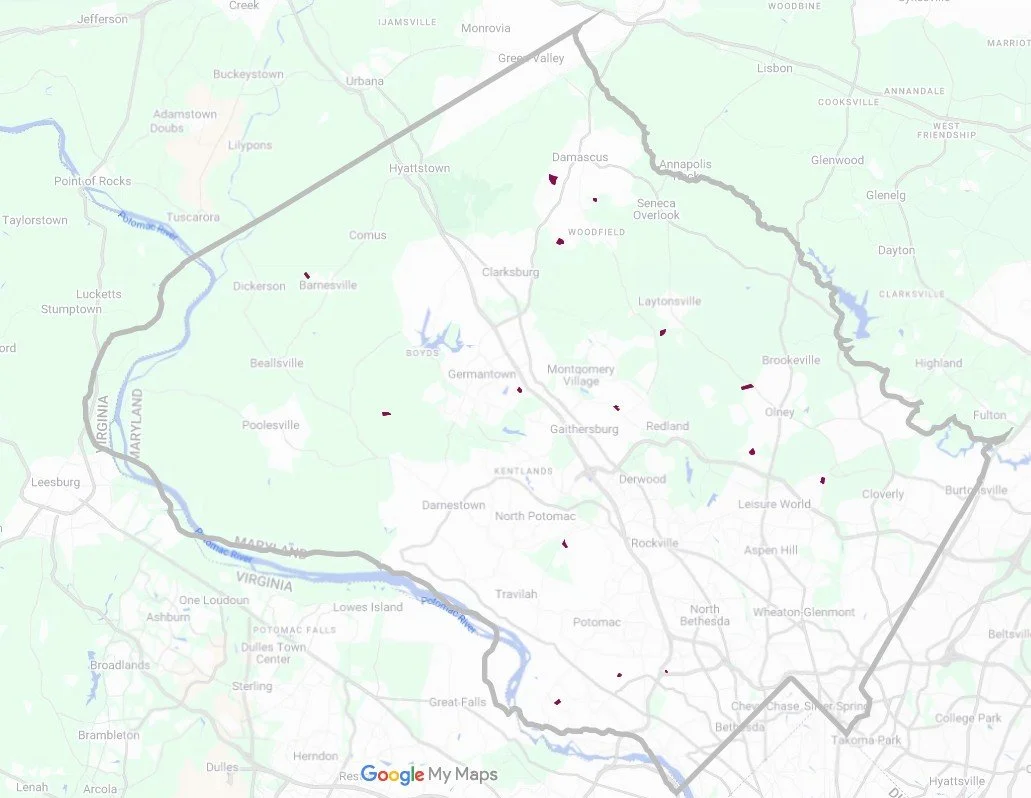
MCPS’s 15 system-owned, undeveloped future school sites
Where Are All These Properties?
Most of the large, undeveloped school-owned tracts sit in the upcounty and outer suburbs, many acquired decades ago when planners anticipated continued suburban growth. By contrast, most of the smaller sites still held by third parties are located in more densely developed areas. Here is how the entire reserve breaks down across the county.
Undeveloped Sites Owned by the Board of Education (15 Sites)
Damascus has three separate tracts totaling nearly 57 acres, including Kings Bridge MS (30.33 acres on Founders Way), Hawkins Creamery Road ES (13.55 acres) and Oak Drive ES (12.99 acres).
Laytonsville has the Laytonsville MS site (22.74 acres on Warfield Road).
Potomac has two sites, Brickyard MS (20.00 acres on Brickyard Road) and Kendale ES (10.53 acres on Kendale Road).
Rockville and Gaithersburg have two sites, Oakdale MS (18.49 acres on Cashell Road) and Woodwards Road ES (11.05 acres on Emory Grove Road).
Dickerson has the Monocacy MS site (17.35 acres on Barnesville Road).
Olney has the Sherwood ES No. 6 site (17.10 acres on Wickham Road).
North Potomac has the Wootton ES No. 7 site (12.10 acres on Cavanaugh Drive).
Silver Spring and Layhill have the Northwest Branch ES site (11.41 acres on Layhill Road).
Germantown has two sites, Northwest ES No. 8 (12.70 acres on Schaeffer Road) and Waring Station ES (9.99 acres on Waring Station Road).
Bethesda has the Amalyn ES site, formerly WMAL Property ES (4.30 acres on Sanvitalia Street).
Active Construction and Permanently Restricted Sites (3 Sites)
Under Construction is Wootton HS at Crown Farm in Gaithersburg (31.10 acres on Fields Road).
Protected Under Environmental Easements are Briggs Chaney Road MS in Cloverly (20.96 acres on Good Hope Road) and the former William H. Farquhar MS site in Olney (20.00 acres on Batchellors Forest Road).
Master-Planned Sites Still Owned by Third Parties (8 Sites)
Boyds has the West Old Baltimore Road ES site (9.30 acres on Seneca Ayr Drive), designated for the Clarksburg school cluster.
Rockville and Gaithersburg have five sites, Great Seneca Science Corridor ES (6.00 acres), Jeremiah Park ES near Shady Grove (4.00 acres), King Farm MS (3.00 acres), King Farm ES (2.50 acres) and Fallsgrove ES (2.33 acres).
White Oak and North Bethesda have two sites, White Oak Science Gateway ES (4.21 acres on FDA Boulevard) and White Flint ES (3.50 acres on the south side of the former White Flint Mall property).
Why Not Build on It?
Simply put, the student boom those fields were bought for is moving in reverse. Preliminary enrollment for the 2026-27 school year fell by more than 4,000 students in a single year to 151,967, and MCPS projects it will drop by roughly 14,000 more students over the next decade. Instead of building brand-new suburban schools, MCPS launched a study in October 2026 to consider closing and consolidating existing elementary and middle schools, with changes potentially beginning in fall 2029.
Right now, the district’s budget is focused on fixing the schools it already has. Of the 126 schools built or last renovated before 2000, about three-quarters need repairs or have unreliable systems. Even when MCPS needs temporary space for major renovations, it is leaning on existing campuses rather than empty fields. For example, the current Thomas S. Wootton High School building is expected to serve as a temporary holding school while Springbrook and Sherwood high schools undergo yearlong HVAC overhauls. Still, the district hangs onto unbuilt parcels that could provide options if an aging school eventually needs replacement or temporary space.
Why Can’t the County Just Sell It?
Even if officials decided that a field wasn't needed, selling school land in Maryland is anything but a quick real estate transaction. First, the school board has to formally declare the property no longer needed for school purposes and get approval from the state superintendent of schools. The board must then notify the county, which has 30 days to respond. Depending on the circumstances, the county may claim the property, and provisions involving public charter schools may also apply. When state construction dollars were involved, additional approvals and financial obligations may be required.

The land doesn't simply go onto the private market. Properties transferred to Montgomery County Government must go through the county's review and disposition procedures before they can be sold or repurposed.
Factor in the neighborhood debates that pop up whenever new ideas are floated, like past proposals to put affordable housing or a solar array on the Brickyard Road site, and it’s easy to see why these fields have remained undeveloped for decades. Thanks to a new Maryland law, however, that could change.
New Law Allows for Teacher Housing
A new Maryland law that took effect July 1, 2026, gives MCPS another option for its unused properties. Under House Bill 168, school boards can classify affordable housing for teachers and other school system employees, excluding certain administrators, as a school purpose. That means MCPS could retain a property for employee housing rather than declare it surplus and transfer it to the county. The law also makes school boards eligible for state housing development loans and gives priority to certain projects that include educator housing.
To put the law into practice, the Board of Education would have to identify a suitable property, approve a housing proposal, arrange financing and determine who would build and manage the development. Accessing low-interest loans through the state's Housing Innovation Fund would require partnering with a housing developer. The project would still have to comply with applicable zoning, land-use and construction requirements.
With an existing housing shortage and long waits for affordable housing assistance, it is not unthinkable that MCPS might enter the housing business. Theoretically, its 15 undeveloped properties, totaling nearly 225 acres, could accommodate approximately 3,000 to 4,500 housing units, depending on density, environmental constraints and development approvals. That's potentially enough to house 25% to 38% of the county's nearly 12,000 public school teachers, or a substantial portion of the more than 5,000 educators who currently live outside Montgomery County. Developing all 15 properties for housing may be unlikely, but even using a portion of that land could make a significant dent in the county's teacher housing shortage.