Don't Ignore The Canary in the Coal Mine: Oppose Bill 33-26
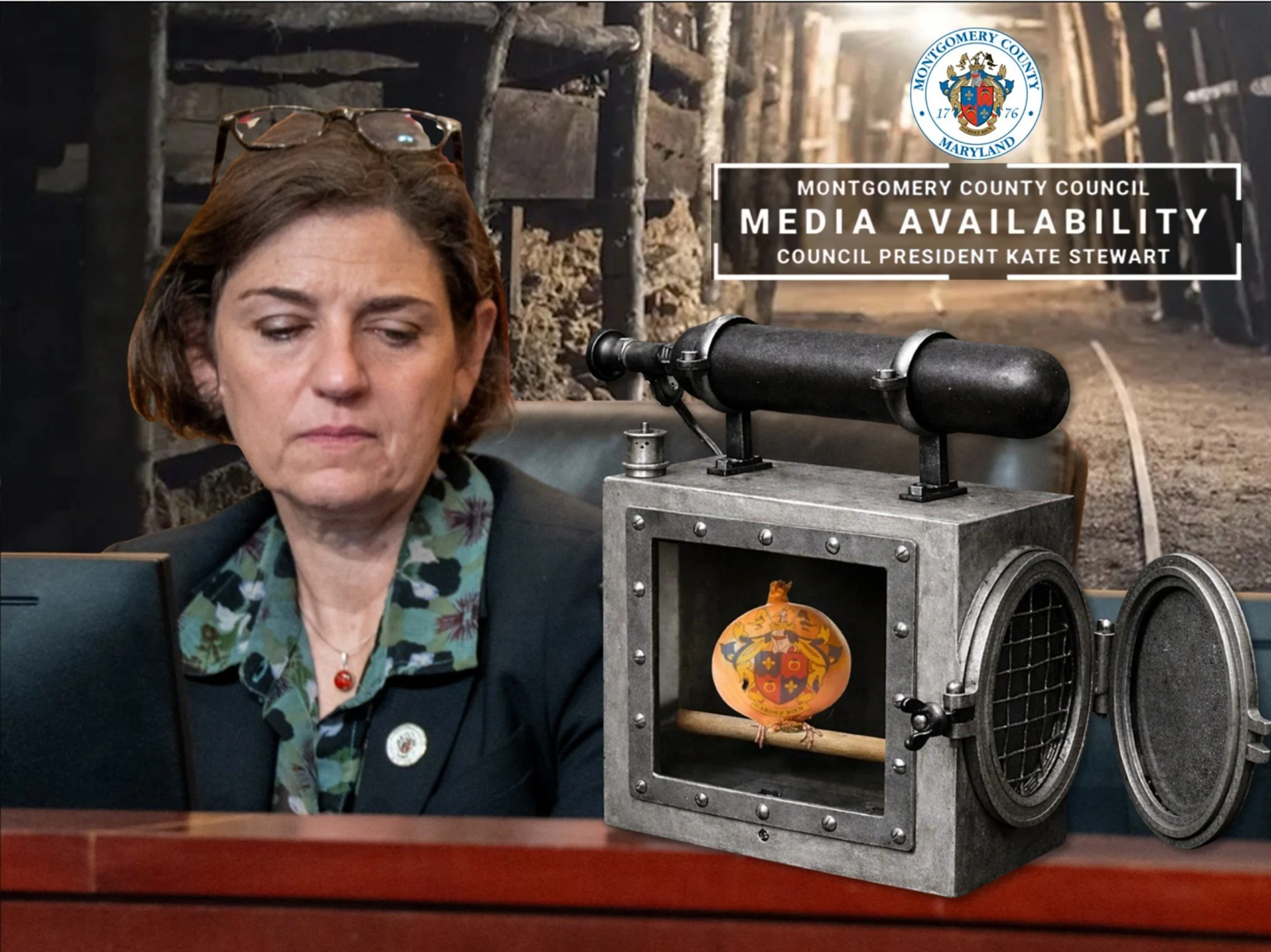
Image Credit: Photo composite by Montgomery Fix, no artificial intelligence used
ROCKVILLE, MD — For generations, miners carried canaries into coal mines as an early warning of poisonous gases. Today, the “canary in the coal mine” is an idiom understood to mean a sentinel warning of imminent danger.
Last year in Montgomery County, I was the canary. No one heard my song. Now the danger is growing, but I still have some breath, and I hope you're listening.
Montgomery County Councilmember Kate Stewart has introduced Bill 33-26, legislation concerning community media organizations that contract with Montgomery County. The bill would impose new governance requirements, including requiring at least one board member nominated by the County Council and at least one nominated by the County Executive. It also would impose public-records, open-meetings and ethics requirements and require covered organizations to adopt racial equity and social justice policies acceptable to the county. Stewart is lead sponsor, with Marilyn Balcombe, Sidney Katz and Shebra Evans as co-sponsors.
Stewart has said the bill protects editorial independence because it requires programming and scheduling to be determined independently and without government interference. In other words, she wants you to believe that dictating ethics policies, holding as much as 28 percent of board seats, plus holding the purse strings, won't open the door to undue influence. That's a load of crap. Stewart wants the government to regulate how organizations receiving public resources select their boards, structure their governance, and meet accountability standards because she wants the government to control the media. Her record proves it.
The Canary's First Warning
Last year, while Kate Stewart was president of the Montgomery County Council, I was denied access to her press briefings despite being engaged in a number of journalism projects directly related to county policies and events. Her justification for the ban changed as the dispute continued. At various points, the Council’s attorney pointed to use of satire, tags and labeling, disclosure requirements, journalistic standards, individual articles, objectionable photographs and captions, and even my automotive side hustle, as reasons to bar the door where an elected official was answering questions from the press. At the time, it was easy to regard the dispute as a spat between a satirist and a politician. It was much more, but with the notable exception of I Hate Politics podcaster Sunil Dasgupta, even the mainstream media ignored it.
As it turned out, my restriction wasn't the main storyline. The rules governing Council press access themselves, and their creation, were the root of these First Amendment and press-freedom injustices. A 2023 Council policy establishing written requirements for access to Council President press briefings appeared out of nowhere a few weeks into Evan Glass's year as president. The policies were never announced, but Glass's office later said they codified existing policies and incorporated practices from other jurisdictions. When asked via a Maryland Public Information Act request for records concerning how the policy had been created and approved, Council attorney Christine Wellons said there were none. In other words, one council president's office established subjective press-access criteria and treated them as policy, and the next president used them to keep out a reporter she didn't like.
The New Threat to Press Freedom in Montgomery County
The canary’s new warning is Stewart's proposal to give the government a formal presence inside the governing structure of a community media organization. It raises fundamental questions that should concern anyone who, like the Founding Fathers, believes journalism needs independence from the people it covers. The importance of such questions was on display this week as President Trump denied reporters from CNN, MS NOW and Politico access to the White House after accusing the outlets of spreading “fiction and lies.”
What is happening in Washington is considerably more direct than what Bill 33-26 proposes in Montgomery County. Bill 33-26 does not authorize the County to approve stories or tell a community media organization what it may publish. Stewart's bill is not equivalent to Trump's actions. The connection is the underlying principle that the public should be extremely critical about government attempts to acquire additional power over the institutions responsible for scrutinizing it.
Montgomery Community Media CEO Jasmine White has publicly objected to Stewart’s bill, warning that government-appointed board members could undermine public confidence in the independence of MCM's journalism. “I don’t know that the organization could ask the public to trust that the work we do is actually independent if we have a council person on our board or an appointee from the county executive’s office,” White told Bethesda Today. MCM board vice president Vernon Ricks warned that the legislation risks turning “a neutral community media center into an arm of county government.”
There is a perfectly legitimate way for the government to protect taxpayers and demand accountability from an organization receiving public money. It can audit the money. It can enforce the contract. It can require financial reporting, transparency and compliance with applicable laws.
My experience in 2025 was a small thing, largely ignored. The danger is in normalizing each step. Once the government has established that it can decide who qualifies for access, it becomes easier to accept the premise that officials should determine who qualifies as legitimate press. Once the government has established a formal role in the governance of a media organization, it becomes easier to accept the premise that public funding justifies a governmental voice in how that organization is run. And once officials become accustomed to using control over access as leverage against journalists they dislike, we might as well recruit Vladimir Putin's press secretary to Rockville.
The press room does not suddenly run out of oxygen. The environment changes gradually, one restriction, one new standard, and one exercise of official discretion at a time. By the time everyone recognizes the danger, the people inside may already be struggling to breathe.
Montgomery County should pay attention now, while there is still plenty of air in the room.
# # #
Publisher’s Note: The Montgomery County Council’s Government Operations and Fiscal Policy Committee, which Kate Stewart chairs, is scheduled to review Bill 33-26 on October 8, 2026. The other members of the committee are Katz and Evans. You can write to them at:
Kate Stewart: Councilmember.Stewart@montgomerycountymd.gov
Shebra Evans: Councilmember.Evans@montgomerycountymd.gov
Sidney Katz: Councilmember.Katz@montgomerycountymd.gov
You can also email all members of the County Council using this form on the county website.