Fixing Fractured Glenmont
An enormous pothole in front of the CVS at the Glenmont Shopping Center was filled this week. What would have been routine maintenance anywhere else in Montgomery County took three months, five visits from county inspectors, two code violation notices, threats of a citation, letters from lawyers, and dozens of emails and phone calls. Adding to the pressure: a series of embarrassing satirical memes and mocking videos by this publisher, viewed more than a quarter-million times.
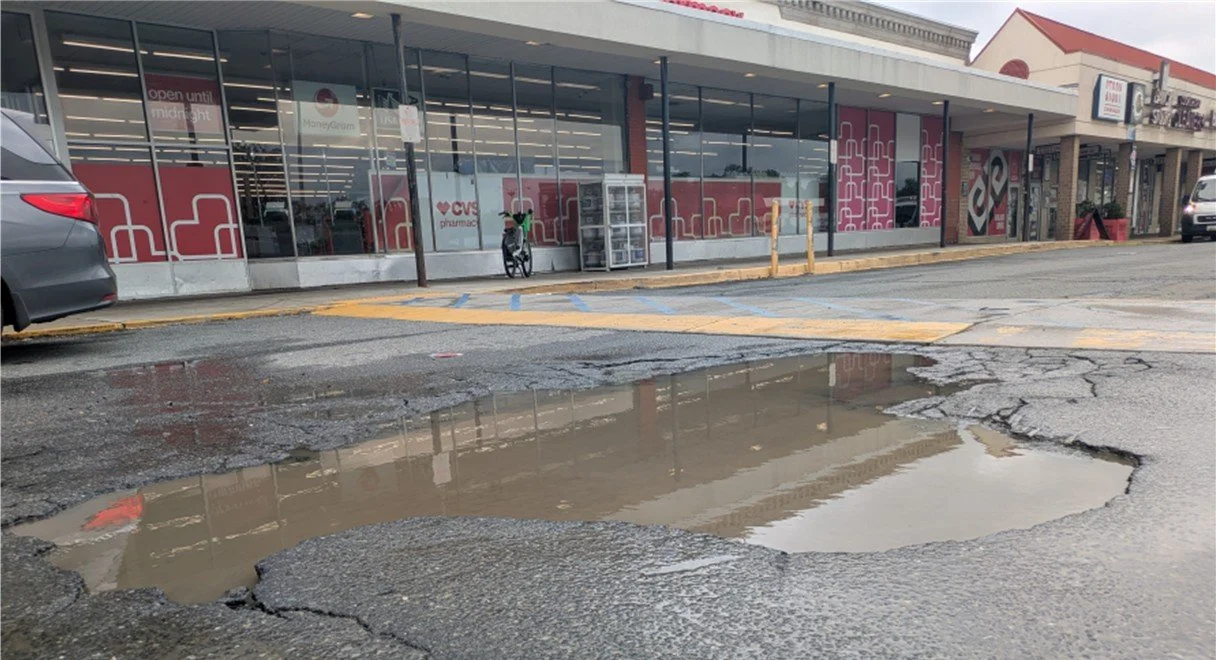
Photo: Montgomery Fix
That's typical for the Glenmont Shopping Center, located at the intersection of Georgia Avenue, Randolph Road, and Layhill Road. We know because we've been tackling problems there, one patch of blight at a time, for the last two years. The trajectory of the pothole repair followed a now-familiar course: a complaint to the county, an inspection, a notice of violation, disputes and denials over responsibility, reinspections, letters, emails, phone calls, occasional citations, and eventually resolution. Public shaming by this publisher has been known to propel the narrative to a conclusion.
The story of the CVS pothole repair offers a case study into why the shopping center poses such unique challenges.
Who Is Responsible for the Glenmont Shopping Center?
The root cause of the trouble in Glenmont is the shopping center's unusual ownership structure. Almost all retail centers and strip malls in Montgomery County have a single owner who leases space to multiple tenants. Grounds and property maintenance are often performed by the owner, typically through a professional management company. Glenmont is one of the rare exceptions.
The Glenmont Shopping Center is one of Montgomery County's earliest suburban shopping centers. Planned in 1952 as part of a 250-acre residential development, it was built in phases between 1956 and 1960 to serve the area's rapidly growing postwar population. Unlike many shopping centers of its era, Glenmont developed under multiple owners, resulting in a diverse mix of national retailers and locally owned businesses.
That ownership structure remains today. The Glenmont Shopping Center consists of 15 parcels. Twelve are owned by eleven different private companies (McDonald’s owns two), including a mix of large corporations, real estate firms, and private family trusts. Two small parcels on the southern tip are State Highway Administration property used to house traffic control equipment. The remaining parcel was purchased by Montgomery County last year. Each parcel includes a section of building (or buildings) and an adjoining area of the center’s massive parking lot.
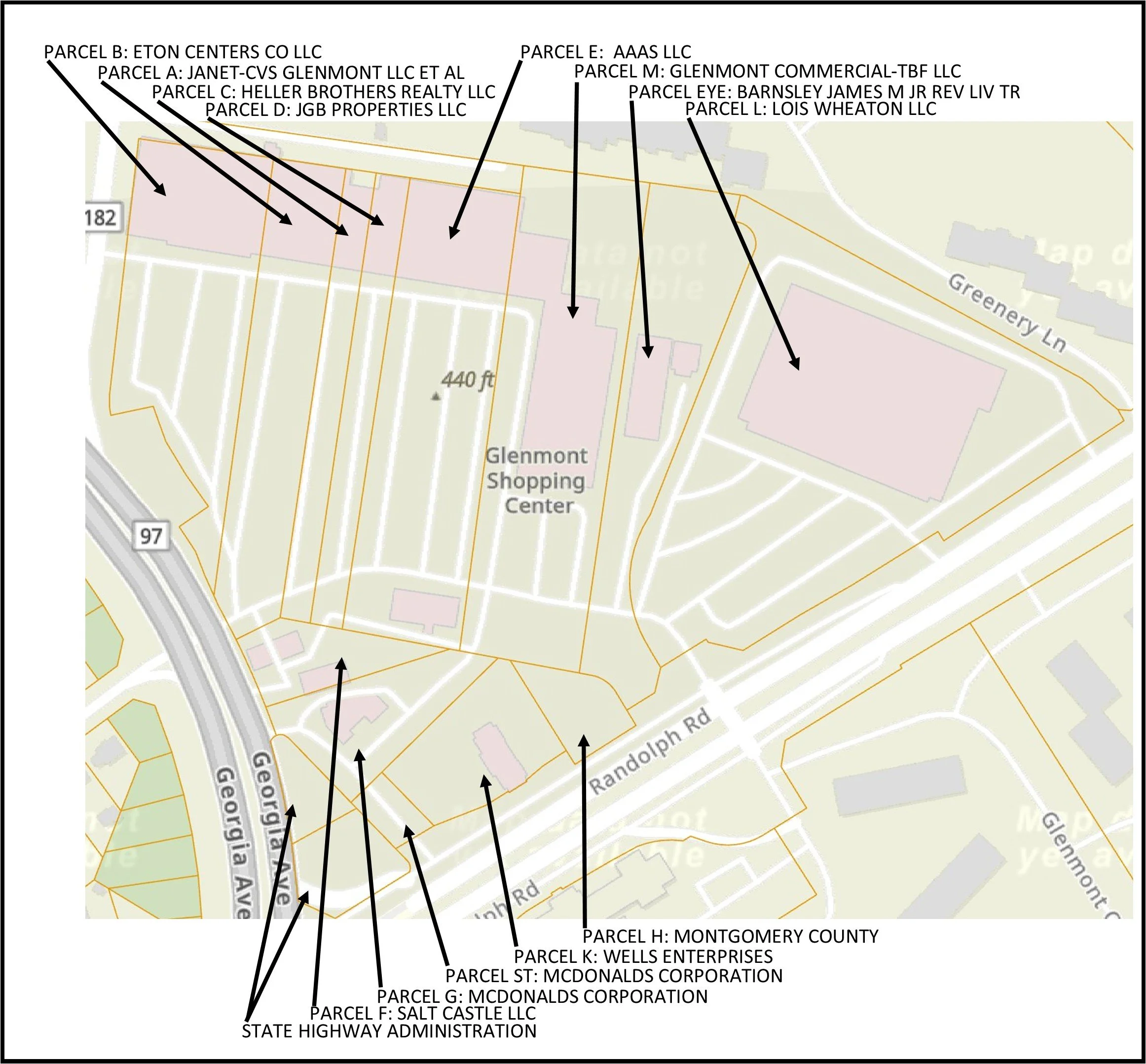
Base image is MC Atlas Webmap. Property names and markers added by Montgomery Fix.
There is no organized shopping center owner group or common management company. Instead, each owner is responsible for its own property. In some instances, responsibility for certain grounds and building maintenance tasks falls to the tenant. In reality, only a few of the properties receive the attention required to maintain compliance with county housing codes. With the majority failing to keep up, trash from one area quickly overtakes the areas that do receive some attention. A pothole or broken glass on a property near a parking lot entrance affects every business, and if the owner responsible ignores it, all suffer.
There is no private security firm patrolling the shopping center, although a few of the businesses, notably Story Cannabis, have their own in-house security. Loitering and vagrancy are rampant. Montgomery County police are kept busy with calls for theft, assault, public intoxication, and welfare checks. To bolster their presence, officers from the station across Randolph Road are encouraged to sit in their cruisers in the parking lot to do their paperwork.
How Problems Get Fixed in Glenmont
When issues are neglected and complaints reach the county, the first step for Department of Housing and Community Affairs (DHCA) Code Compliance inspectors is to determine on which properties the problem exists. Some problems require interagency coordination with the county’s Department of Environmental Protection (DEP) or Department of Permitting Services (DPS). Owners receive an escalating series of communications: first an email or conversation with the owner, then a notice of violation with a deadline to cure. If the problem persists, citations and fines are issued. Problems usually get addressed somewhere within that chain, but occasionally it takes longer. The CVS potholes are a good example.
Potholes in the Glenmont Shopping Center parking lot are nothing new. In fact, they are legendary.
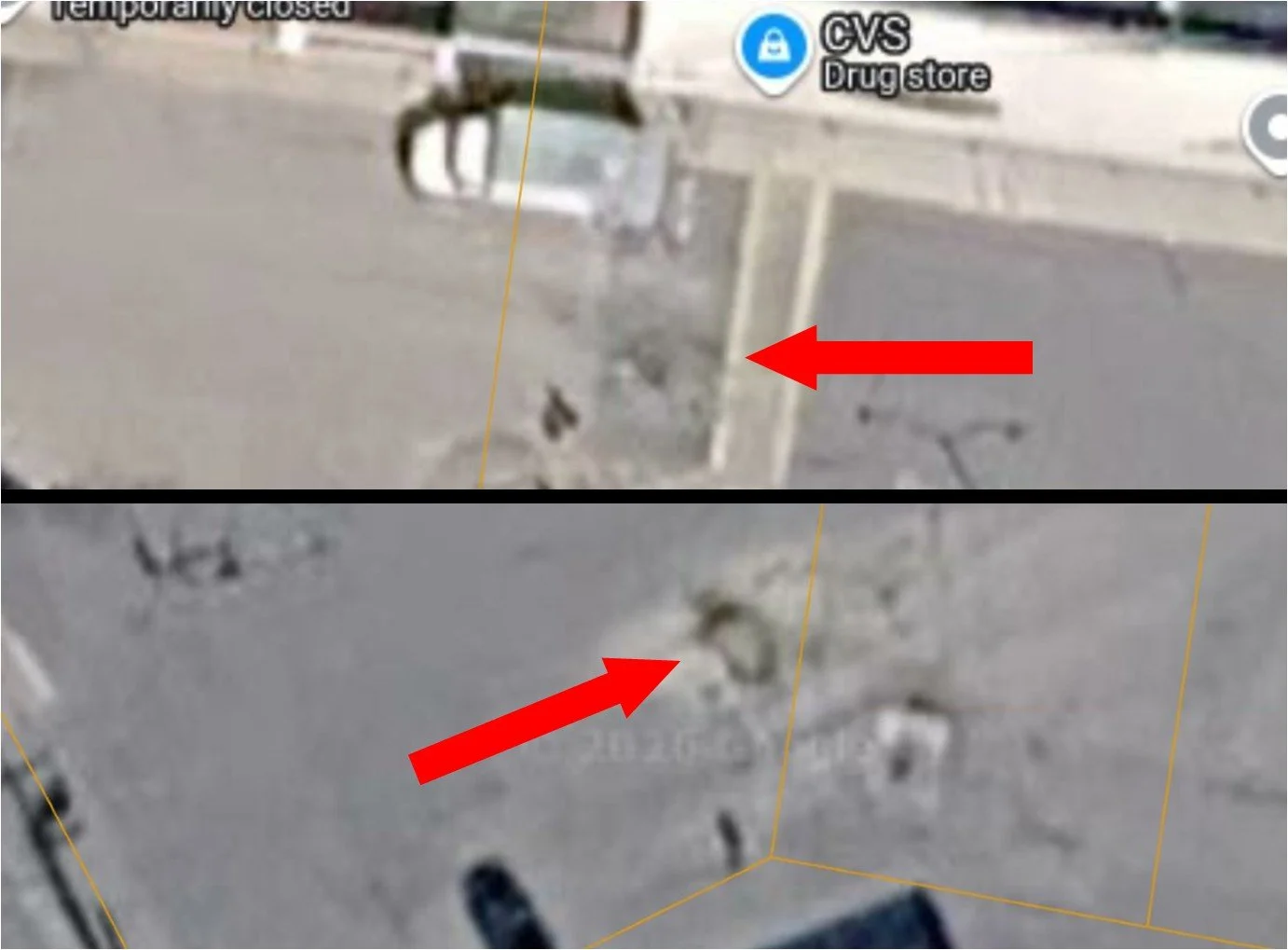
Potholes on CVS property are visible on MC Atlas using the 2024 Hybrid Imagery Basemap
Potholes paled in comparison to other Glenmont issues until the spring. Winter wasn’t kind. When the snowcrete finally melted, the potholes became ridiculous. Twelve feet wide, six inches deep ridiculous, and worthy of Montgomery Leek memes that began appearing in early May.
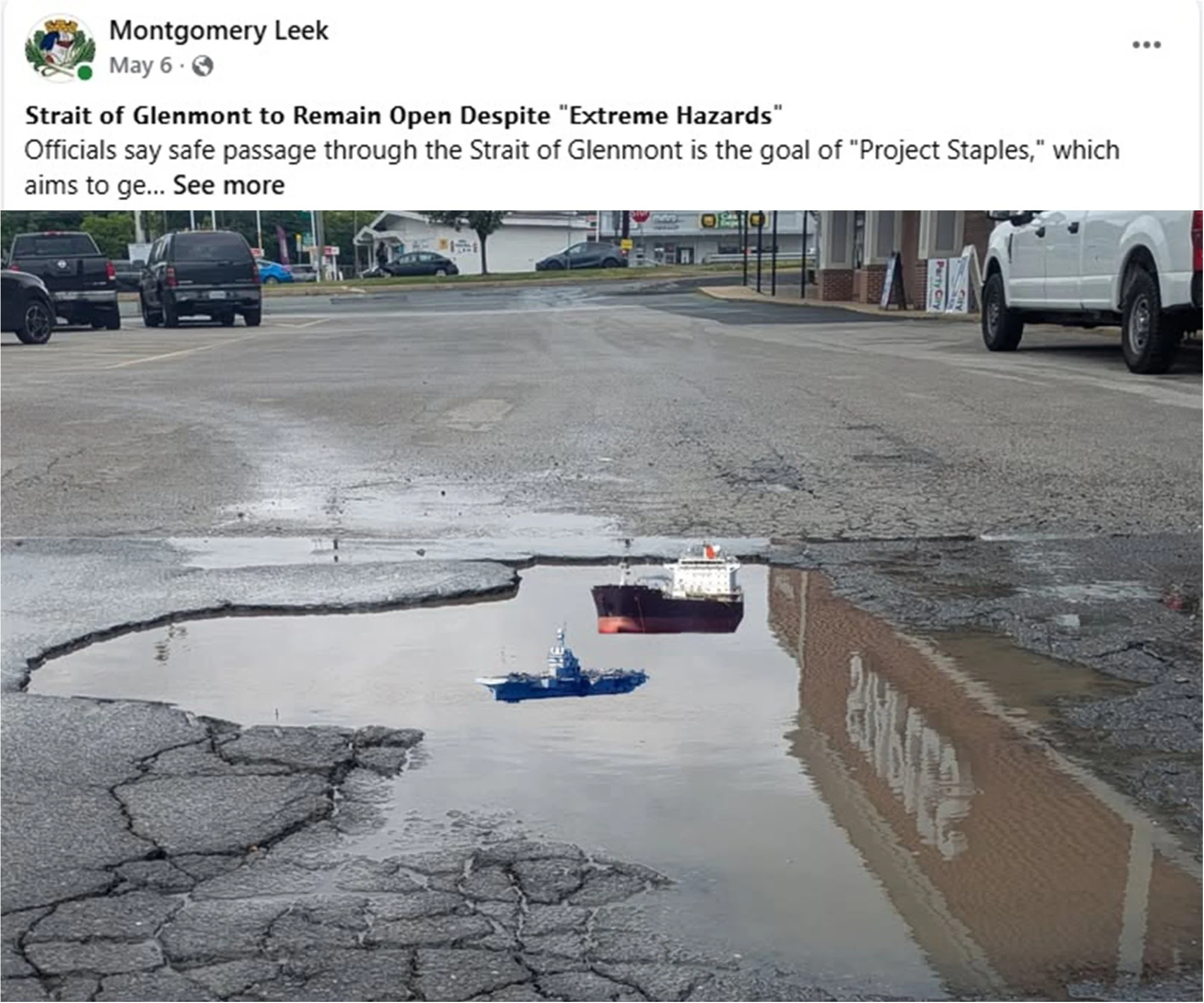
We sent an email on May 6 to county housing code inspector Chris King, whose work has led to the resolution of several Glenmont Shopping Center cases. King visited and issued a notice of violation for the property owner, Janet-CVS Glenmont, LLC. That’s not the same as the store, CVS Health. Janet-CVS Glenmont, LLC is a locally owned private real estate company that leases the property to CVS of Maryland, Inc., a subsidiary of Rhode Island-based CVS Corporation.
Tenant CVS Corporation wrote landlord Janet-CVS Glenmont, LLC on May 19 to request repairs. On June 2, an attorney for the landlord wrote to CVS Corporation to inform it that the lease made the tenant responsible for grounds maintenance and demanded CVS Corporation resolve the county violations. While that contributed to delays, it’s not the county’s concern. Local statute places ultimate responsibility with the owner, regardless of what its leases say.
On June 5, King visited the property and found no changes. He spoke with a representative for the owner, Alan Korobkin, who said repairs would be contracted soon. King returned to Glenmont again on June 11 to take measurements to determine if a second large pothole near the Sunoco station was on Janet-CVS Glenmont, LLC’s property. He confirmed that it was and issued another notice of violation, but Korobkin initially disputed the finding and claimed the pothole was on Sunoco’s property.
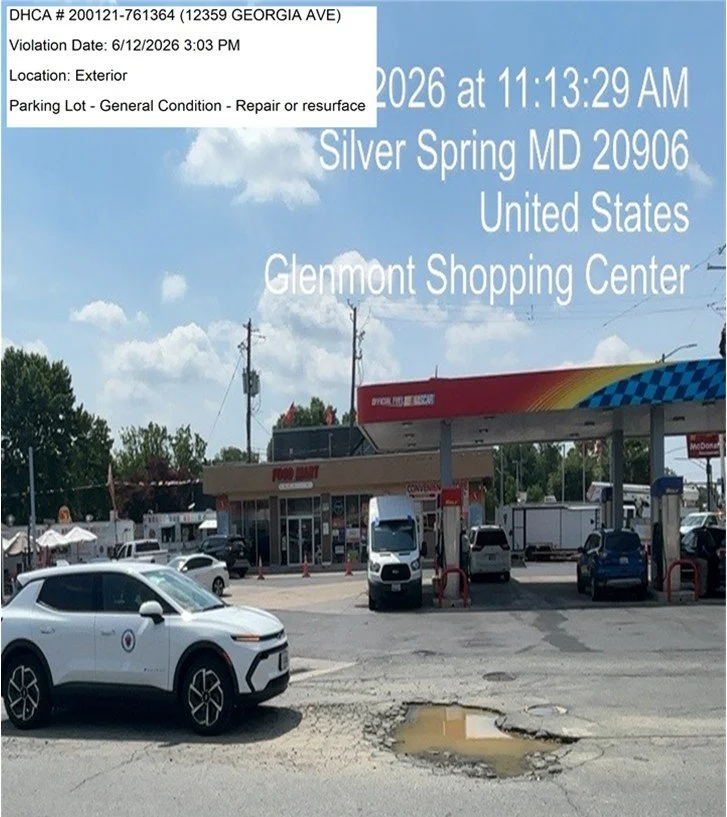
Photo accompanying June 12, 2026 notice of violation issued to Janet-CVS Glenmont,, LLC (Image: Montgomery County Department of Housing and Community Affairs)
By June 22, Korobkin acknowledged responsibility for both potholes, as well as trash on the grounds that King wrote up in a third violation notice. He confirmed repairs to the pothole nearest the store would be done by the end of June and said he was working with CVS Corporation on the other one. The pothole directly in front of CVS was filled on July 2, but the second one was not.
Thomas Howley, a Program Manager at DHCA who oversees county inspectors, visited the site on July 7. Finding the second pothole unrepaired, he sent another email to Korobkin asking for an update. If the repair doesn’t happen this week, Janet-CVS Glenmont, LLC could receive a $1,000 citation.
It’s the same familiar pattern. This time Janet-CVS Glenmont is in the crosshairs. It’s not the property owner’s first time. Nor is it the only property owner to string the county along until DHCA escalates the matter.
What’s the Fix?
For decades now, through at least three community master plans, the county has been scheming how to redevelop the Glenmont Shopping Center. Every iteration involves the same scenario: a developer acquiring all of the parcels and converting the land into a mixed-use development with high-rises, office and retail space. Experts have advised the county that the plan is nearly impossible to pull off. The parcel owners are too diversified and too dug-in to sell. Despite that advice, just last year Montgomery County purchased Parcel H from the State Highway Administration, partially to accommodate a now-canceled reconstruction project, and as a small step toward gaining shopping center control. It was a small step indeed – the lot conveyed with a squatter who has refused to vacate for more than 15 months. Montgomery County personnel still haven’t even stepped onto the property.
None of the parcel owners seem inclined to sell, and why should they be? Two huge new developments are poised to break ground on both sides. To the south, the Glenmont Forest project involves the complete demolition of the aging Americana Glenmont Forest Apartments and their replacement with a mixed-use transit-oriented community containing up to 2,275 multifamily units and 5,000 square feet of retail space. To the north, the Glenmont Metro Center project has approvals to construct up to 1,325 multifamily units, 225 townhomes, and 90,000 square feet of commercial space. As these new buildings rise, so too will Glenmont Shopping Center property values.
Instead of trying to entice or pressure Glenmont business owners into selling, the county should try what has unfortunately become an arcane approach: propping up small, private property owners rather than pushing them toward big corporate interests. We suggest a public-private partnership that creates a nonprofit business coalition in cooperation with the county. The county would allocate matching grant funds to owners to invest in building and grounds improvements, and use its own Parcel H as a coalition headquarters, community center, and police substation.
Such a coalition could function similarly to a localized Business Improvement District (BID), pooling resources to handle center-wide issues that currently fall through the cracks. Instead of eleven different owners pointing fingers, a unified management entity co-funded by property owners and county grants could immediately address shared headaches like trash collection, grounds maintenance, and coordinated private security. Utilizing Parcel H as a physical anchor would make the county an active, on-site partner.
Glenmont cannot afford to wait another decade for a pie-in-the-sky master plan to materialize while the residents who shop there and the business owners who pay taxes are left dodging six-inch craters and navigating systemic neglect. Code enforcement is a vital tool, but as the CVS case study proves, it is a painfully slow mechanism for managing a fractured, multi-owner property.
If the county wants to revitalize all of Glenmont, it must ditch the forced replacement strategy and instead focus on active stewardship. By fostering a public-private coalition, the county can protect the area's diverse retail ecosystem while enforcing a baseline of dignity and safety for consumers. The future is arriving rapidly on both sides of Georgia Avenue; it’s time for the heart of Glenmont to finally catch up.
# # #
Publisher’s Note: Montgomery Fix would like to thank the Montgomery County Department of Housing and Community Affairs (DHCA) for its transparency and cooperation in providing information contributing to this report.