Meet Your Local Pedorthist: Interview with JoAnn Epps
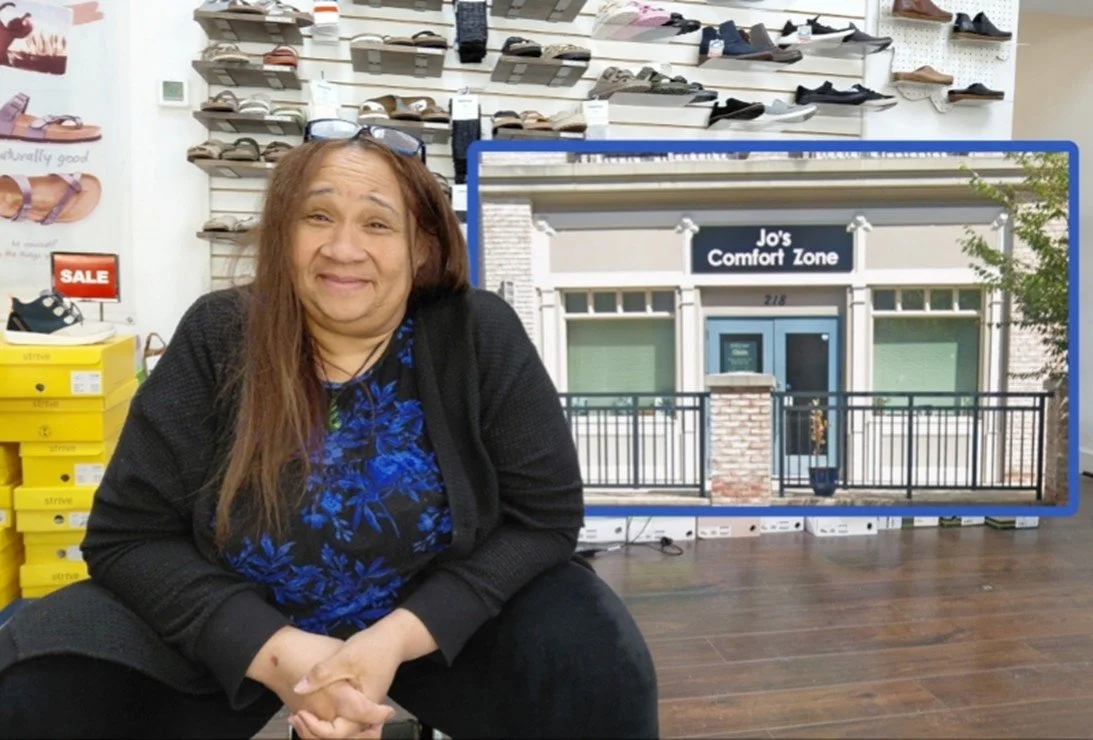
Photo credit Mark Lautman. Insert Google Street View.
There are things that we don’t mention to our partners, or that we “forget” to mention. In my case it was flat feet. Maybe I thought it wasn’t important, or that she would reject me if she knew. Two children and ten years later, we were in the National Gallery of Art, and my legs were aching as the docent was explaining the importance of perspective in Italian Renaissance art. I hardly enjoyed a minute at the museum. During the Metro ride back, she asked me if I have flat feet. I confessed, and she insisted that I look into orthotics. I did, and they changed my life.
In the market for a second pair, I got a recommendation for Jo’s Comfort Zone. The pair she made for me gave as much relief as the first pair. I was so grateful I asked proprietor JoAnn Epps for an interview.
What, or who, is a pedorthist?
A pedorthist is someone who practices pedorthics. It’s a catch-all term for the study of lower-body mechanics. My subspecialty within that field is a therapeutic shoe fitter. I also provide orthotics that help balance the body.
How did you get into this field?
I was a performer in a band, and I also had a part-time job at Target. I developed a back problem which prevented me from doing either job. I went to a podiatrist who suggested that I stop wearing heels. I thought he was a quack, but I changed my shoes anyway. That cleared the pain, so I was able to return to work. On my follow-up appointment, I told him about my relief, and that I’d like to learn more about how feet and shoes work to alleviate pain.
Amazingly, he told me that I couldn’t learn more about this, because I’m a woman. He explained that he had seen many people start studying pedorthics, but the women always dropped out. I told this story to my mother, who said, “You can learn anything, so I’ll send you to school.” I went to Temple University, and here I am. Honestly, I got into this field to prove him wrong and that women can indeed succeed as pedorthists, but now more than anything I feel the satisfaction of helping my patients.
You’ve been in this field quite some time. Are you still learning new things?
Absolutely. Technology and AI are impacting footwear as much as any other industry. I’m not too concerned about being replaced by a robot. A human can see and diagnose problems associated with the feet that are beyond the capabilities of computers and cameras. Compared to robots, humans interact much better with humans.
How do you get new customers?
Initially, I started out with getting referrals from one doctor. For the first three years he sent me only diabetics. Then his partner started sending me all types of foot-related issues as well. After that they both sent me patients with all sorts of underlying conditions. Those patients mentioned me to their own friends and family. I’ve built up quite a customer base, and without doing any advertising.
If you do good work and you are honest, then business will come. If you are not honest, business will come, leave, and never come back. I tell patients immediately if I can’t treat them. If I’m not certain about a course of treatment, I’ll say we’ll try one treatment, and try something else if it doesn’t work.
Physicians and dentists can become frustrated when their patients do not follow a course of treatment. Do you get frustrated with some patients?
I can identify difficult patients the minute they walk through the door, give me a prescription, and say, “I have no idea why a doctor would send me to a shoe lady.” After we sit down I explain the treatment plan, and they say, “But that’s not what I want” or “I don’t want to do that.” My typical reply is, “No problem, you can do what you want, but chances are you’ll be coming back to me in a few years with even worse symptoms.” Nine out of ten times that’s what happens.
How does someone know that pain in the legs or in the back is related to shoes or feet?
Most people don’t know that poor feet or improper shoes can refer pain to other parts of the body. Eventually they may mention their condition to a friend or family member, who in turn recommend seeing a shoe fitter.
When that person arrives, I go through a checklist of possible causes, and when appropriate I recommend an insert or a new shoe. I check the wear pattern on the shoe, and check how long they’ve had the shoes.
Sometimes a treatment as simple as an over-the-counter insert is enough to clear a symptom. Those cost no more than $75, and are a very cost-effective first step. If after a month there is no improvement , I send the patient to a doctor to get a diagnosis.
If someone wants orthotics, do they need a prescription?
If someone already has orthotics, they typically know the nuances of wearing them. In those cases I don’t need a prescription to make a new pair.
In today’s throwaway culture, is there ever a situation in which it’s cost-effective to repair a shoe?
It depends on the shoe and the required repair. Typically, it’s worthwhile to resole, resize, or change the buckle of a quality shoe. It makes sense to put a new sole on a pair of Ferragamos or Birkenstocks that costs $400 or more.
Are some professions more susceptible to foot problems than others?
The top three professionals I get are chefs, school teachers, and nurses. Chefs work 12 to 16 hours a day six days a week, and the entire time they are on their feet in the kitchens. Teachers are standing and walking on hard tile from six in the morning to five in the evening. Nurses work 12-hour shifts three days a week, and the younger ones are wearing nothing more than sneakers.
What are your views on other therapies for the feet, such as reflexology and acupuncture?
They are all great, and they all work. A lot of the efficacy depends on the patient’s openness. I’m in favor of all forms of healing.
Lastly, what’s the best way for us to care for our feet?
Get measured every three years. Your foot size changes throughout your life. What you were at age 18 will never be what you are at age 30 or 40. Your feet support all of your weight, and they unavoidably change shape over time. The arches become compressed and the feet expand down. You can avoid discomfort and injury by matching your shoes to your feet.
Jo’s Comfort Zone is located at 218 Spectrum Drive, Gaithersburg, MD. For more information, visit their website.