In December 1801, four enslaved people escaped from Montgomery County, Maryland, leaving three slaveholders with a problem, at least from their perspective. Abraham, 36, his wife, Lucy, 24, their 18-month-old son and another man named Phil, 22, had run away, apparently traveling together. As was common at the time, their enslavers placed newspaper advertisements offering a combined $120 reward for their capture and return.
An advertisement published Jan. 21, 1802, in The Philadelphia Gazette & Daily Advertiser was signed by Eleanora Magruder, Charles Miles and Harry W. Dorsey. It described Abraham's height and a distinctive mark on his chest, Lucy's complexion and clothing, and a noticeable lump beneath her child's jaw. The advertisers suspected the fugitives might change their names and clothing to avoid detection. Anyone capturing them could collect a reward by returning them to their enslavers or delivering them to jail.
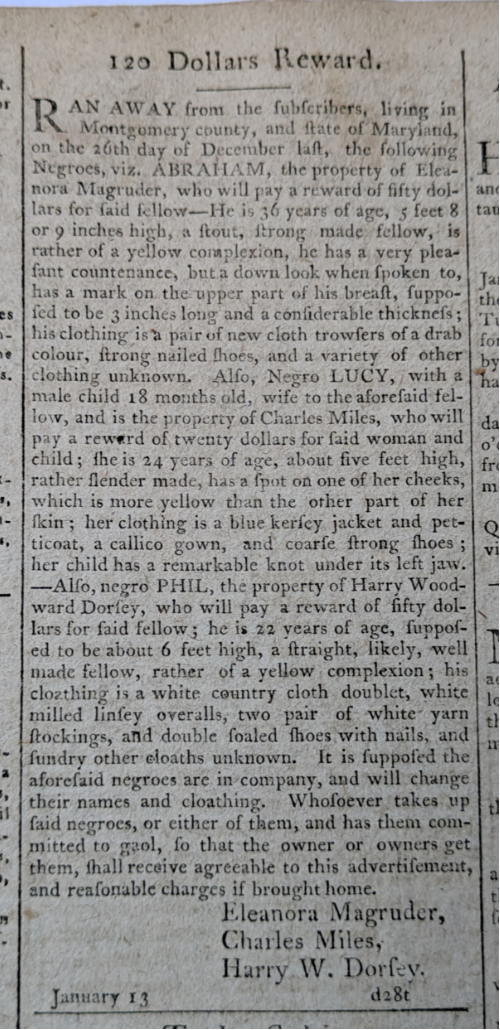
The Philadelphia Gazette & Daily Advertiser, Jan. 21, 1802. Source: GenealogyBank.
It was hardly the first time a Magruder sought the return of an enslaved person through a newspaper advertisement. Historical newspapers contain numerous notices involving members of the extended Magruder family offering rewards for escaped people, advertising slave sales, settling estates and participating in legal proceedings in which human beings were reduced to transferable financial assets.
Documents collected by Montgomery Fix, some dating back more than 250 years, reveal the Magruder family's extensive involvement in slavery across numerous branches and generations. They build on 1790 census records that recently brought public attention to Col. Zadok Magruder, one of Montgomery County's founders and the namesake of Magruder High School in Derwood, and to his legacy within a remarkably resilient family that built phenomenal generational wealth on the backs of its slaves.
From Scotland to Maryland: The Magruder Clan
The Magruder family's American history began with Alexander Magruder, a Scottish immigrant who arrived in Maryland around 1652, possibly as a prisoner of war transported to the colonies. He acquired substantial landholdings before his death in 1677. In historian Russell R. Menard's study of formerly indentured Maryland men, he is one of only three mid-17th-century indentured men who acquired more than 1,000 acres in their lifetimes. Alexander had 2,400 acres, built a tobacco shipping port, and had six living children when he died at age 67.
Few formerly indentured men became such prominent citizens and extensive landholders, and even fewer also had so many surviving children. The growth of the Magruder family’s property holdings from colonial America through the Civil War is a testament to both entrepreneurial and reproductive proclivities. One of Alexander’s sons, Samuel Magruder (1654–1711), and his wife, Sarah Beall, had a large family, including seven sons who survived into adulthood. Samuel became a prominent planter, merchant and public official. By the time of his death, Samuel owned approximately 1,350 acres in Prince George's County. His estate included 15 enslaved people, according to the Maryland State Archives. Three of Alexander's other sons also had children, and within just three or four generations, his descendants had spread throughout the colonies, establishing farms, plantations and businesses in Maryland and Virginia in the late 17th and 18th centuries.
According to historian and writer Susan Tichy, creator of the website Magruder’s Landing, “With few exceptions, the many thousands of Magruders and McGruders in the United States descend from this one man [Alexander Magruder].”
Many Magruder men were professionals, including doctors, lawyers and merchants, and took roles in local government. Among the clan's most prominent members was Col. Zadok Magruder (1729–1811), Samuel's grandson and Alexander's great-grandson. Zadok served in the Revolutionary War militia and was among seven men selected to organize Montgomery County's government following its establishment in 1776. His plantation, The Ridge, stood near present-day Muncaster Road in Derwood.
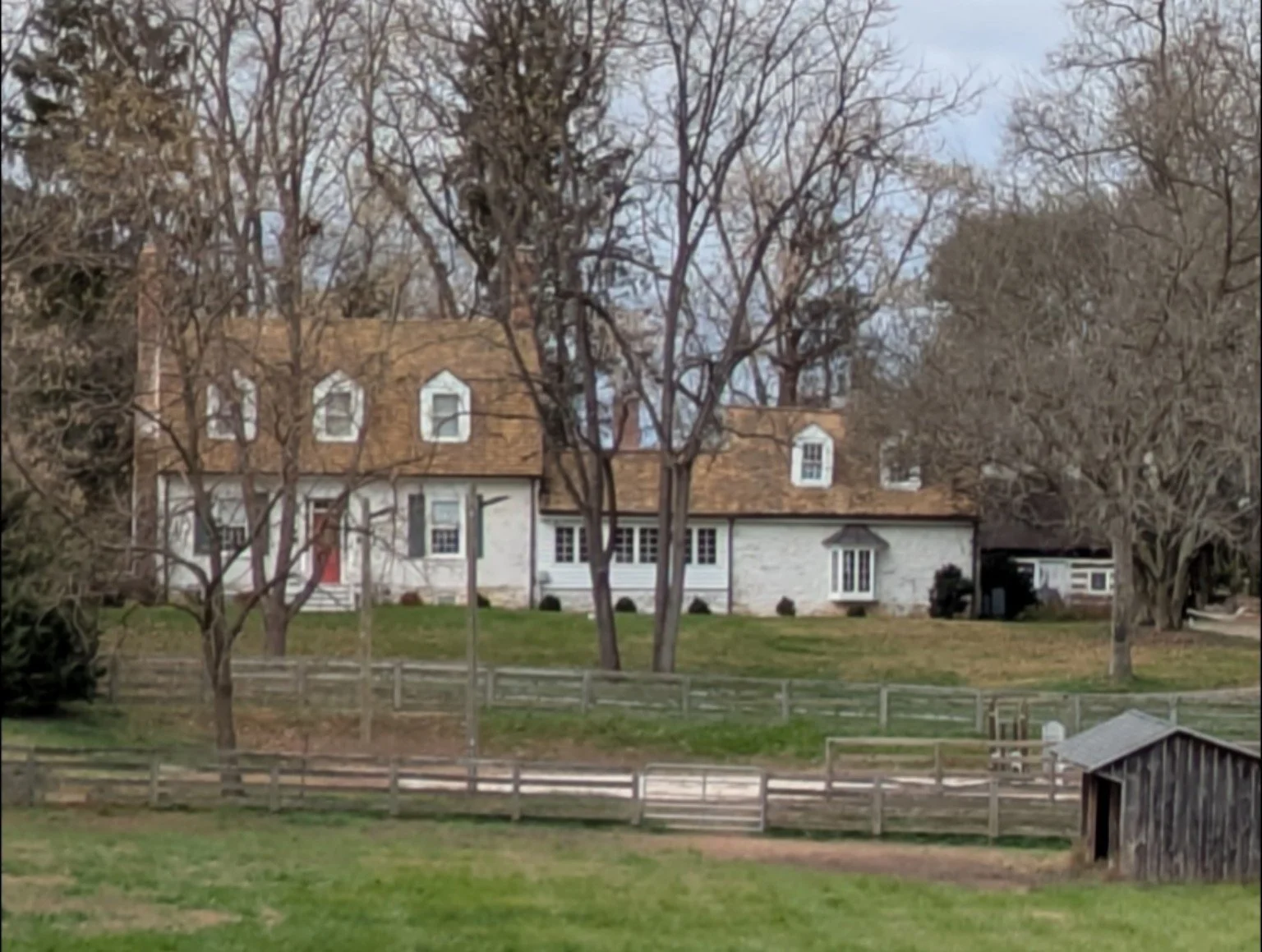
The Ridge residence in Derwood, MD, Nov. 14, 2026. Photo by Montgomery Fix.
The Magruder family's involvement in slavery began with its patriarch, Alexander. When he died in 1677, an inventory of his estate listed four indentured servants and one slave, named Sambo. According to Tichy’s research, thousands more would be enslaved by Magruders over the following two centuries. Maryland’s first census, in 1790, shows 45 Magruder households in three counties, of which 41 owned slaves. The census recorded 26 people enslaved by Colonel Zadok Magruder at The Ridge.
The Ridge survives as a private residence. A historic log building, quarters for enslaved people, still exists on the property. Photographed by Montgomery Fix from a neighboring property, the structure provides a rare physical glimpse into the lives of the enslaved people who sustained the plantation.
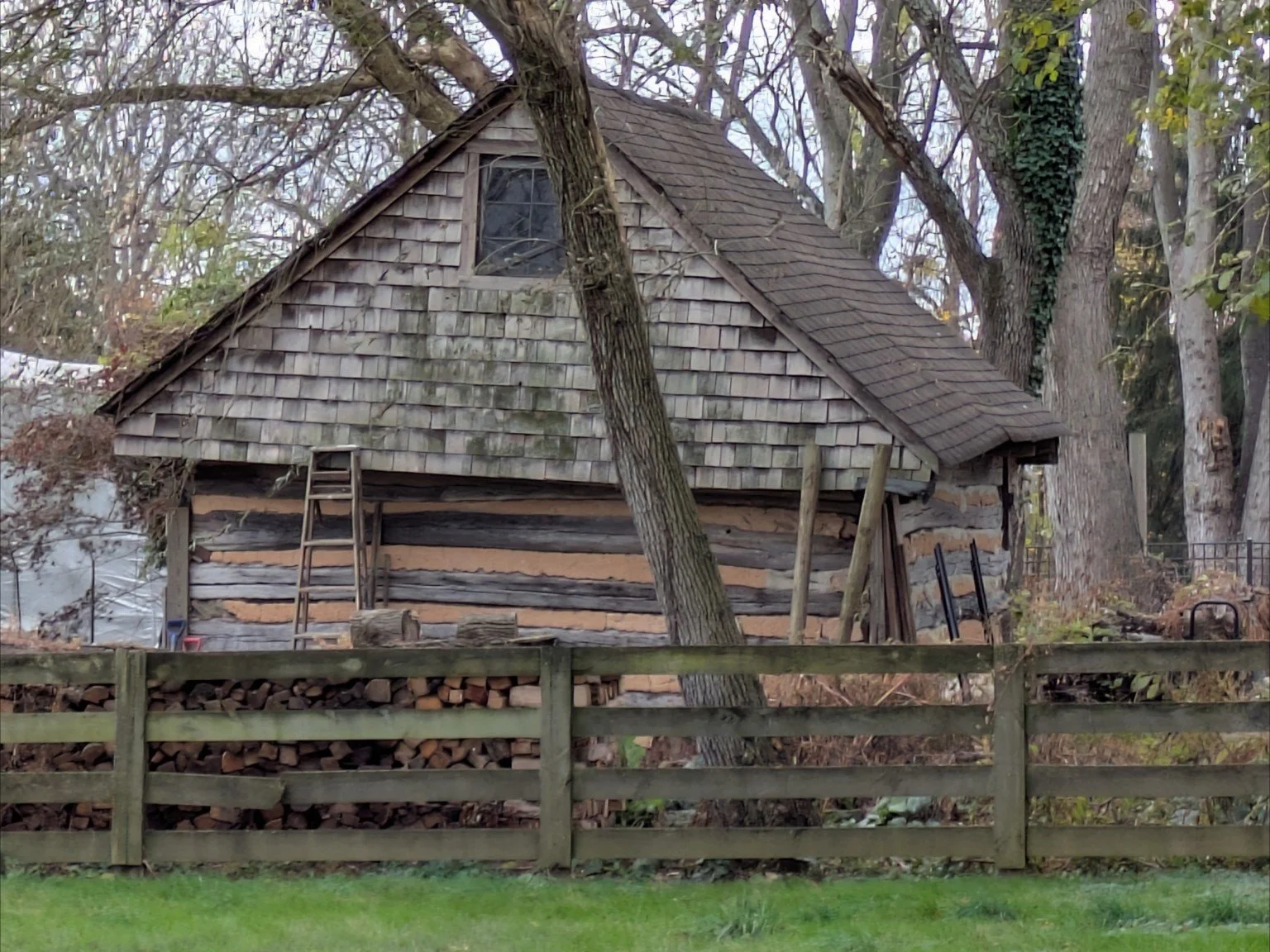
The historic slave house at The Ridge, Nov. 14, 2026. Photo by Montgomery Fix
Wanted: Runaway Slaves
In colonial America, enslavers commonly placed newspaper advertisements offering rewards for the return of people who escaped. Pennsylvania's gradual abolition law of 1780 made it an important destination for people escaping enslavement in Maryland. Enslavers placed notices in Maryland and Philadelphia newspapers and, later, in Washington, D.C., publications.
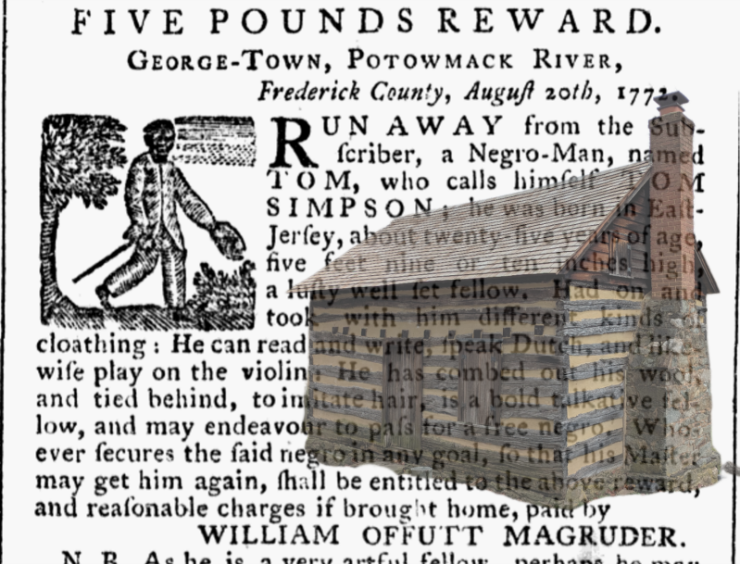
One of the earliest advertisements uncovered is dated Aug. 20, 1772, and was placed in the Pennsylvania Packet by William Offutt Magruder (1740–1819), a first cousin once removed of Colonel Zadok. Living near Georgetown when it was still part of Frederick County, William offered five pounds for the capture of Tom, an enslaved man approximately 25 years old who also called himself Tom Simpson.
Tom could read and write, spoke Dutch and played the violin. His enslaver described him as outgoing and talkative and expressed concern that he might attempt to pass himself off as a free Black man. William specifically warned ship captains against transporting Tom, suggesting concern that he might escape by water.
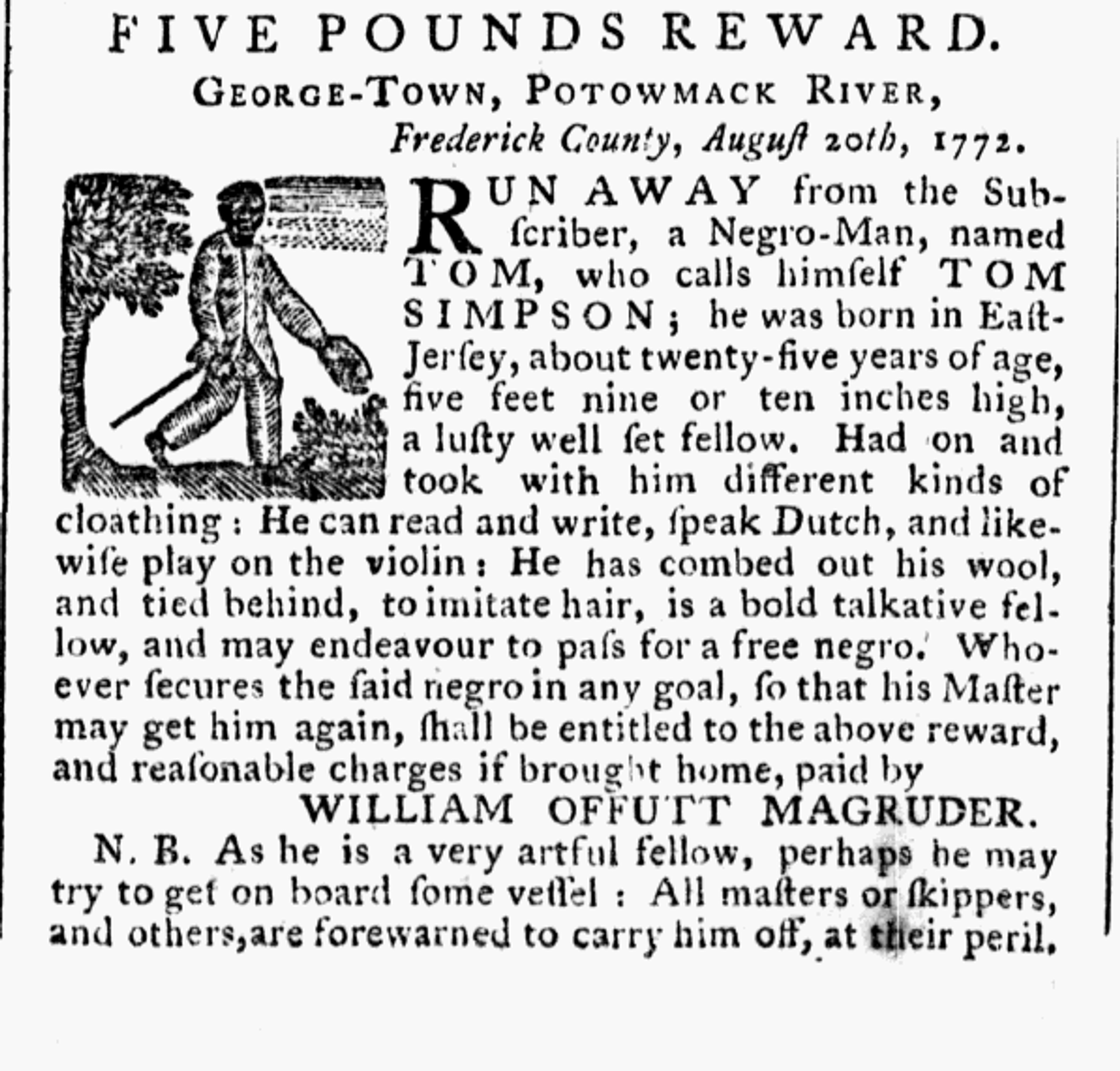
Pennsylvania Packet, Aug. 20, 1772. Source: GenealogyBank.
In 1785, Samuel Magruder, one of Alexander’s grandsons, placed an advertisement in the Maryland Journal seeking the return of two slaves, “a Wench” named Sue and a man named Will, suspected of travelling together to Pennsylvania.
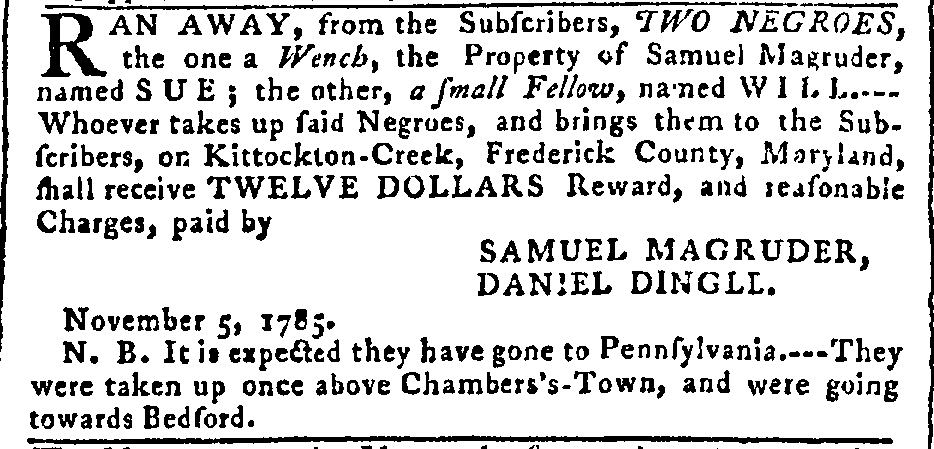
Maryland Journal, Dec. 2, 1785. Source: GeneaologyBank.
In 1788, Nathaniel Magruder, a first cousin of Colonel Zadok, and Nathaniel's son Walter, Zadok's first cousin once removed, placed an advertisement in the Maryland Journal offering rewards for two people who escaped. One was a man named Jerry, approximately 27. The other was an unnamed woman approximately 18 years old. The advertisers suspected the two might attempt to reach Pennsylvania and warned that they could be traveling with forged passes.
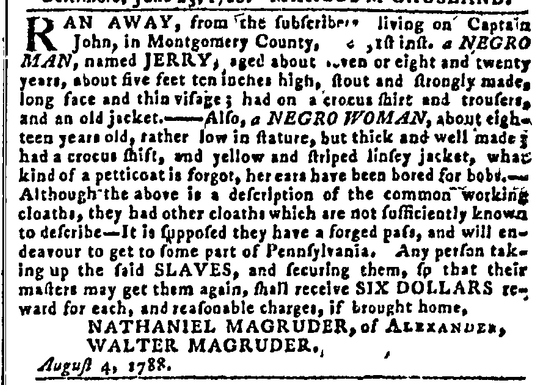
The Maryland Journal, Aug. 8, 1788. Source: GenealogyBank.
Another advertisement appeared in Rights of Man in 1797, offering $20 for the capture of Nat, approximately 40, who escaped from Montgomery County. It was signed by Edward Magruder, likely the son of John Magruder and Jane Offutt, which would make him another first cousin once removed of Colonel Zadok.
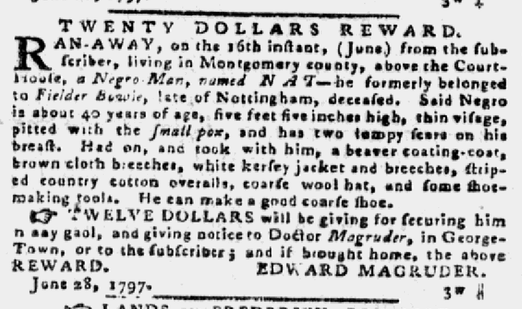
Rights of Man, Aug. 2, 1797. Source: GenealogyBank
The previously shown 1802 advertisement for Abraham, Lucy, her son and Phil that appears above Eleanor Magruder’s signature provides another connection. Two women named Eleanor or Eleanora Magruder were living at the time. One was Colonel Zadok's daughter, married to Ninian Magruder III. The other was the widow of Charles Magruder, Zadok's first cousin once removed. The widow appears more likely to have placed the advertisement. Under Maryland law, widows generally possessed the legal authority to own property and enter into contracts, while married women's rights were considerably more restricted. Another signer of the 1802 advertisement, Harry Woodward Dorsey, married Rachel Magruder Cooke, a daughter of Colonel Zadok, in 1807.
In December 1805, Samuel Magruder offered a reward in the Federal Gazette for Phil, approximately 30, who escaped from his property near Bladensburg. Like Tom Simpson decades earlier, Phil was described as someone who could play the fiddle. The reward varied according to the distance at which he was apprehended.
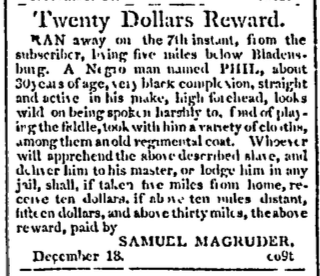
Federal Gazette, Dec. 24, 1805. Source: GenealogyBank.
The advertisements followed a common convention. Enslavers provided names, ages, complexions, clothing, distinguishing physical characteristics and suspected destinations. Monetary rewards encouraged strangers to apprehend freedom seekers, while local jails and sheriffs served as collection points. The examples shown here are just a few of many similar notices posted over nearly two centuries.
The notices describe enslaved people's appearance and perceived financial value, but also preserve fragments of personal histories that might otherwise have disappeared. Tom Simpson was literate, multilingual and musically talented. Abraham and Lucy, from neighboring plantations and possibly married, escaped with their infant son. Jerry and an unnamed woman fled together. Phil played the fiddle.
Human Beings for Sale
Running away was only one of the circumstances that brought enslaved people into the Magruders' newspaper advertisements. On June 10, 1785, the Maryland Journal carried a notice announcing a public sale of enslaved men, women, boys and girls from the estate of Thomas Magruder, deceased. Thomas was a first cousin of Colonel Zadok. Their fathers, William and John Magruder, were brothers. Two of the executors were Thomas's brother Basil Magruder, also Zadok's first cousin, and his nephew William Burrell Magruder, Zadok's first cousin once removed.
The advertisement offered enslaved people of various ages as part of the settlement of Thomas's estate, to be sold for the benefit of those legally entitled to its value.
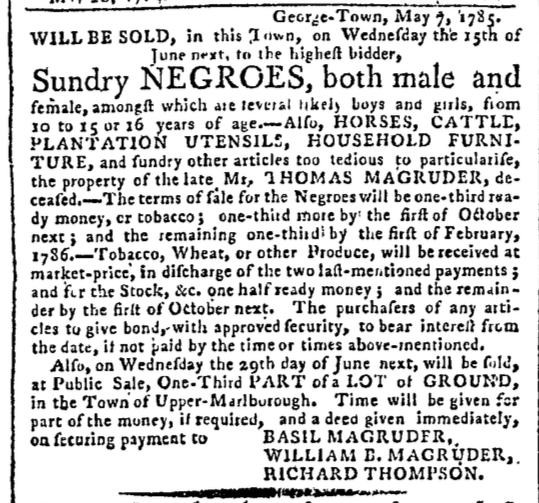
The Maryland Journal, June 10, 1785. Source: GenealogyBank.
Another advertisement, published Nov. 18, 1800, in the Museum and Washington and George-Town Advertiser, announced the sale of enslaved men, women, boys and girls, together with corn, fodder and other agricultural property. It was signed by John Read Magruder. Two generations of the family bore that name. John Read Magruder Sr. (1736–1811) was a first cousin of Colonel Zadok, while his son, John Read Magruder Jr., was Zadok's first cousin once removed. Both were adults when the advertisement appeared.
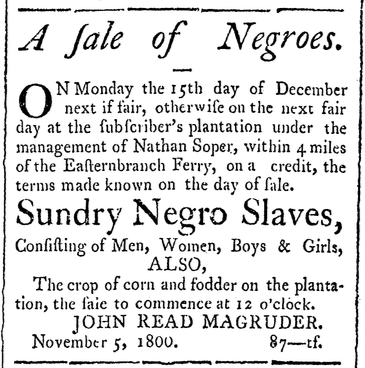
Museum and Washington and George-Town Advertiser, Nov. 18, 1800. Source: GenealogyBank
These advertisements expose the commercial mechanics of slavery. Human beings could be sold to settle estates, satisfy creditors or convert one form of property into another. Their financial value was assessed alongside land, crops, livestock and farm equipment.
In February 1811, the Baltimore Whig advertised a sheriff's sale involving two enslaved females, an adult woman described as an accomplished cook and a girl described as a house servant. Both had previously belonged to James A. Magruder (James Alexander Magruder), a son of John Read Magruder Sr. and a first cousin once removed of Colonel Zadok. The two individuals had been seized to satisfy a claim involving unpaid house rent owed to James McCannon. They were to be sold at public auction, with the proceeds used to satisfy the creditor.
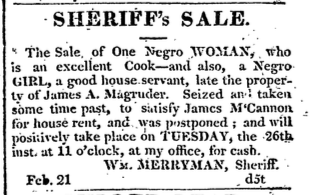
The Baltimore Whig, Feb. 1811. Source: GenealogyBank.
An October 1815 advertisement announced the public sale of 14 enslaved men, women and children from the estate of Thomas Smith, with the auction scheduled to take place at the home of Alexander H. Magruder in Prince George's County. Alexander belonged to another established branch of the Maryland Magruder family. The notice identifies him as the host of the auction, not necessarily the enslaver of the people being sold.
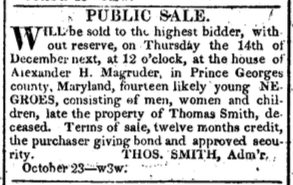
Daily National Intelligencer, Oct. 26, 1815. Source: GenealogyBank.
Slavery as a Family Inheritance
The treatment of enslaved people as financial assets extended into marriage, inheritance and the distribution of family estates. In November 1789, the Maryland Gazette published an unusual notice from Mary Magruder, wife of Nathaniel Jones Magruder, another member of the extended family. Mary announced her intention to petition the Maryland General Assembly for legislation protecting her use of enslaved people inherited from her deceased father. She sought to prevent her husband from depriving her of control over those individuals during her lifetime.
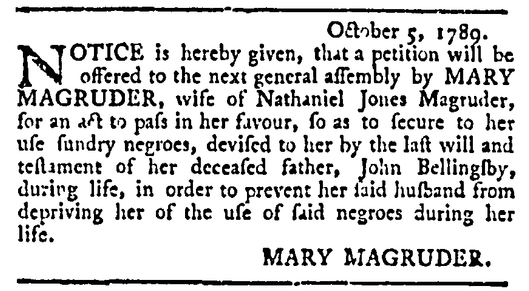
The Maryland Gazette, Nov. 1789. Source: GenealogyBank.
The notice illustrates the legal position of married women during the period, and how slaves could become disputed property even within families. Marriage generally transferred control of a woman's personal property to her husband unless special legal arrangements protected her interests. Mary's petition was an effort to preserve control of inherited property that consisted of human beings.
Another revealing example comes from the estate of John Read Magruder Sr., Colonel Zadok's first cousin. When John died in 1811, his will distributed numerous enslaved people among his descendants. His son John Read Magruder Jr. inherited several, including Frank and his wife, Cate, along with other named members of an enslaved family. The will also provided that another son, James, would control enslaved people during his lifetime, after which they would pass to James’ children. Income earned from hiring out enslaved workers was to be used toward the education and maintenance of family members.
In another branch of the family, the estate of Dr. Zadok Magruder Jr., the colonel's son, provides an opportunity to follow an enslaved individual across generations. When the younger Zadok died in 1809, an inventory completed the following year identified 16 enslaved people, including a child named Rezin, approximately 7 years old. Rezin Prather was held in slavery within the Magruder family plantation at The Ridge, and could have occupied the log building photographed for this article.
Research published by genealogist Robyn N. Smith in the Maryland Genealogical Society Journal traces Rezin through subsequent family records. The evidence suggests that he passed to the doctor's daughter Elizabeth Magruder, who married Nathan Cooke in 1825. Under the marriage laws of the period, enslaved people inherited by Elizabeth would generally have come under her husband's legal control.
Although the precise distribution of Rezin is not documented in a surviving estate record, Smith reconstructed the likely sequence using inventories, tax assessments and related documents. Rezin survived slavery and lived to see emancipation. His family's later history became intertwined with the development of Prathertown, an African American community near Goshen.
When the Sheriff Found Your Slave
Another feature of the historical record was the detention of alleged freedom seekers by local sheriffs. In September 1797, a notice from the sheriff in Hagerstown described a Black man named John who had been taken into custody. John reportedly stated that he was enslaved by William Magruder of Prince George's County and had escaped from another man near Great Falls on the Potomac. Several men named William belonged to the Magruder family at the time. The sheriff instructed the purported owner to retrieve John and pay the detention expenses. Otherwise, John could be sold to recover the fees.
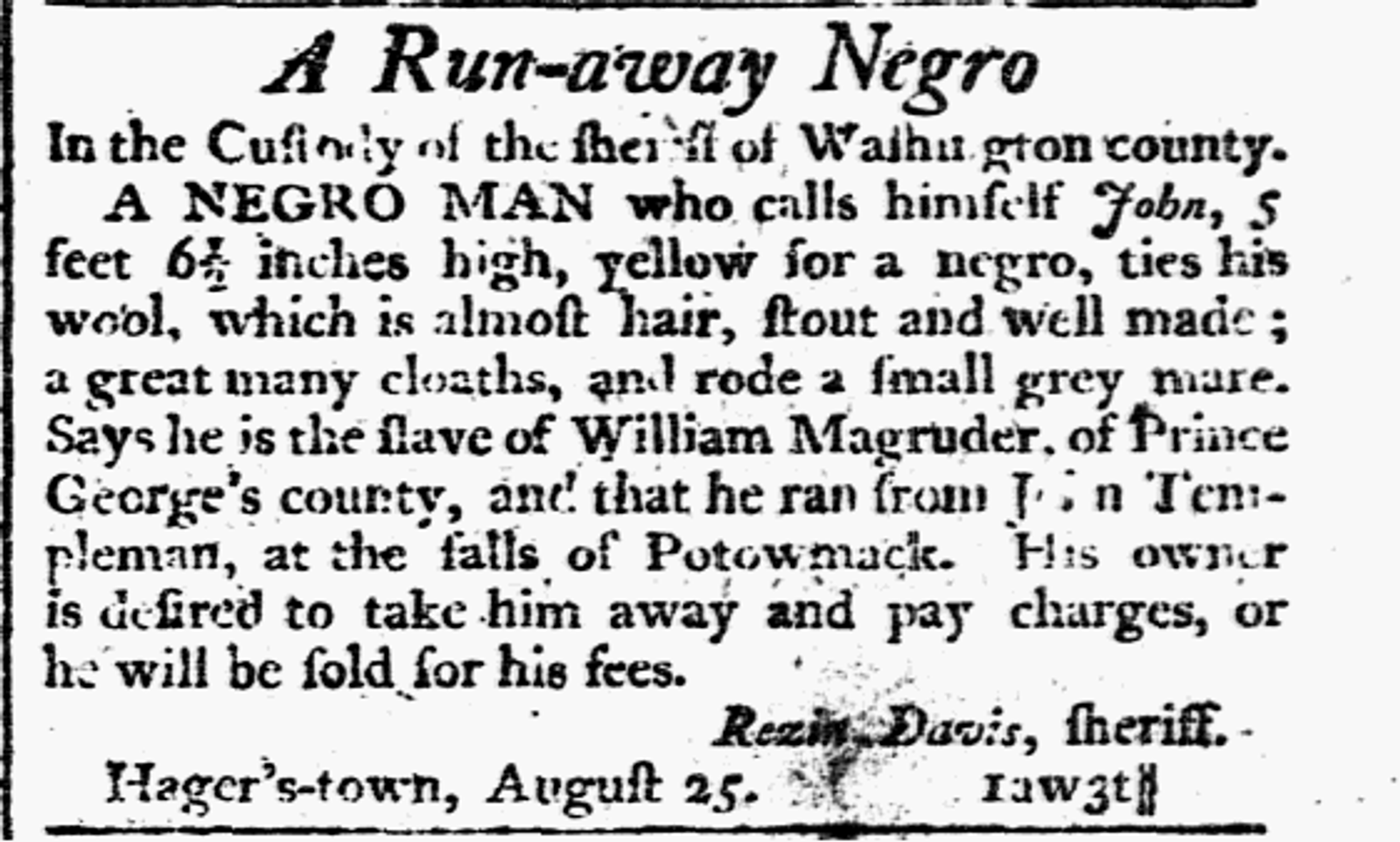
Federal Gazette, Sept 1, 1797. Source: GenealogyBank.
Several similar sheriff’s notices appeared over the centuries, including an 1821 advertisement in the Baltimore Patriot for Gabriel Diggs, approximately 23, who had been committed to the Baltimore County jail as an alleged runaway. He reportedly identified John Read Magruder of Prince George's County, near Upper Marlboro, as his enslaver. By that time, John Read Magruder Sr. had been dead for a decade. The notice therefore points to his son, John Read Magruder Jr., Colonel Zadok's first cousin once removed. The sheriff directed the purported owner to establish ownership, pay the detention expenses and take Gabriel away.
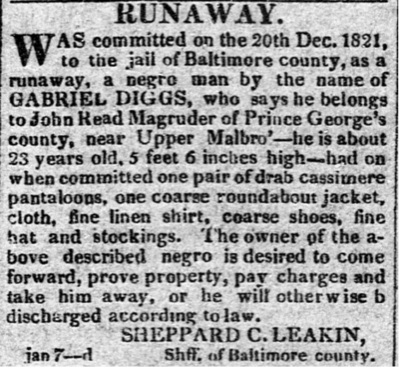
The Baltimore Patriot, Jan. 1822. Source: GenealogyBank
Such advertisements also show how government institutions supported slavery. Sheriffs, jails, courts and newspapers formed part of a system through which enslavers could reclaim people who had escaped. The notices also reveal the precarious position of Black people accused of escaping slavery, whose freedom could depend upon the claims of an alleged owner and the decisions of authorities, and whose capture was incentivized with substantial reward.
From the Colonial Era to Emancipation
The Magruder family's involvement in slavery continued through the 19th century, including within Colonel Zadok's direct line of descendants. His grandson, Dr. William Bowie Magruder (1802–1873), purchased the 308-acre Oakley farm near Brookeville in 1836. A prosperous physician and agricultural landowner, he operated a substantial farming enterprise. Maryland State Archives research documents that William Bowie Magruder enslaved 19 people in 1853 and 30 by 1860. Tax assessments from the 1850s identify 25 enslaved individuals by name.
Among them was a young man named George, born around 1841. A separate Archives record identifies George Dorsey, 23, enslaved by William Bowie Magruder and drafted into the Union Army in 1864. The matching name, approximate birth year and enslaver suggest that the two records refer to the same person.
The 1860 census recorded two slave quarters for enslaved people on the farm. One survives as Oakley Cabin, now a historic site operated by Montgomery Parks. It may have been the childhood home of George Dorsey.
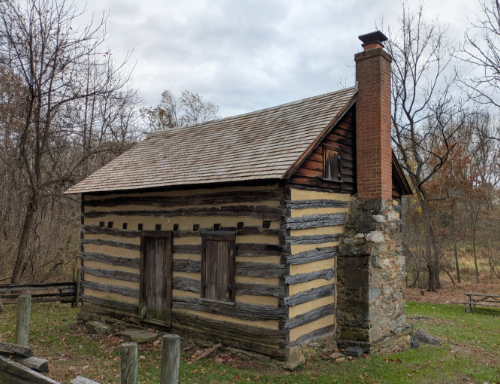
The Oakley Cabin, Nov. 14, 2026. Photo by Montgomery Fix
Maryland abolished slavery on Nov. 1, 1864, nearly two centuries after Alexander Magruder first settled in the colony and more than 150 years after the estate of his son Samuel recorded 15 enslaved people.
The Magruders were not alone in their participation in slavery. The institution was deeply established throughout colonial Maryland and remained central to Montgomery County's agricultural economy well into the 19th century.
In 1800, Montgomery County had 15,320 residents, of whom 6,288, approximately 41%, were enslaved. Tobacco cultivation, wheat production, household labor and agricultural commerce all relied heavily on enslaved labor. Many prominent county families held people in slavery. Public officials, prosperous farmers and merchants accumulated wealth through landownership and agricultural production supported by enslaved workers.
The surviving documents do not establish that the Magruders were uniquely involved in slavery or that family members were more abusive than other enslavers. They do, however, reveal how extensively the institution permeated the lives, finances and legal affairs of this prominent Maryland family.
The Magruder Name and a Modern Reckoning
In May 2018, two student journalists at Watkins Mill High School, Sarah Elbeshbishi and Kevin Finn, published research identifying three Montgomery County high schools named after people who had enslaved others.
Their investigation examined Col. Zadok Magruder, Thomas Sprigg Wootton and Richard Montgomery, the Revolutionary War general for whom both Montgomery County and Richard Montgomery High School are named.
The students consulted historical records and experts, including the 1790 census documenting Colonel Magruder's 26 enslaved people and records describing slave quarters at The Ridge. Their work was featured in a May 21, 2018, column by John Kelly in The Washington Post.
The issue eventually led to a formal public reckoning. In February 2023, members of the Magruder High School community petitioned the Montgomery County Board of Education to change the school's name, specifically citing the 1790 census showing that Colonel Zadok Magruder enslaved 26 people.
Community discussions and surveys revealed divided opinions. A Montgomery County Public Schools (MCPS) report found 43% of survey respondents opposed a name change, 32% supported it and 25% were undecided.
Supporters argued that a public school should not honor someone who enslaved other people. Opponents raised concerns about historical context, community identity, school traditions and the cost of changing the name.
In February 2025, the school board removed $800,000 in proposed renaming-related funding from its fiscal 2026 operating budget, suggesting that future capital funding might support such changes. As of November 2026, the school continues to bear Colonel Zadok Magruder's name.
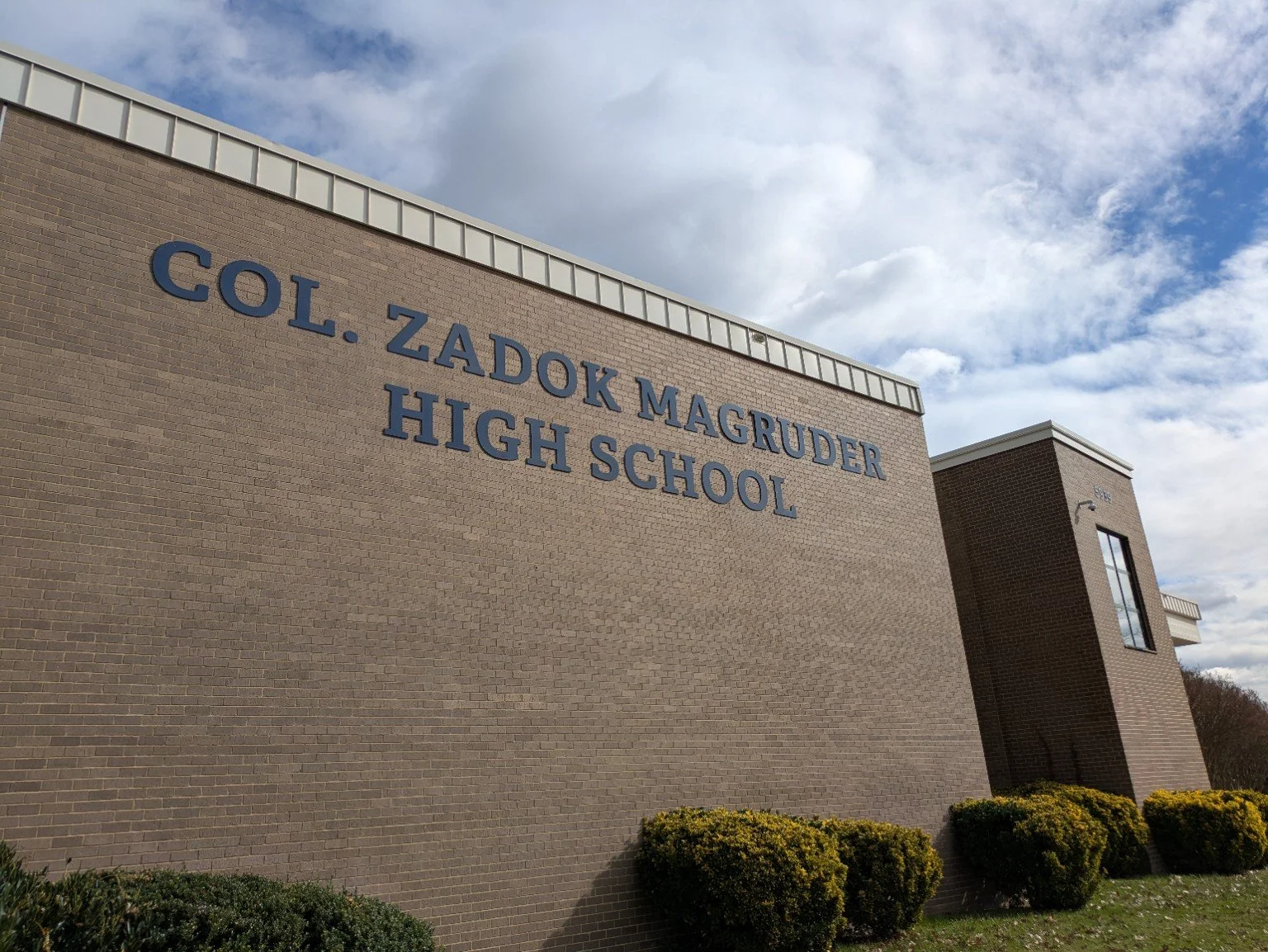
Col. Zadok Magruder High School, Nov. 14, 2026. Photo by Montgomery Fix.
Beyond the Census and into the 21st Century
A census entry records that Colonel Zadok Magruder enslaved 26 people in 1790. It tells us little about who those people were, how they lived, whether their families remained together or what ultimately happened to them.
The newspaper advertisements, wills and estate records provide a different perspective. For generations, the Magruders recorded enslaved people as property to be purchased, sold, inherited, recovered or used to satisfy debts. Those documents preserve their names and fragments of their lives.
Earlier this year, MCPS decided to permanently move the student body from Wootton High School in Rockville to the newly built Crown High School in Gaithersburg. Wootton’s badly deteriorating building will be used as a temporary holding school while other facilities are renovated. Magruder students and faculty are expected to be the first to occupy Wootton, while their own building receives a multi-million-dollar makeover. The plan isn’t popular, and concerns about relocating have overshadowed the debate about renaming.
Wootton High School is named for Thomas S. Wootton, known as the founder of Montgomery County, Maryland. It is one of the other two schools identified by MCPS students as being named for people who owned slaves. Like the prominent and prosperous Magruders, the Wootton family name appears in the pages of 17th- and 18th-century newspapers advertisements and notices associated with the escape, capture, transfer and sale of enslaved people.
The Magruders had a runaway slave problem more than two centuries ago. Today, the family's involvement in slavery has become a runaway story of its own. What two student journalists helped bring into public view in 2018 has grown into a record spanning generations, and the reckoning they helped begin remains unsettled.