A Look at the Bottom 10 Salaries of MCPS Employees
This week Bethesda Magazine revealed who makes up the Montgomery County Public Schools (MCPS) district's top 100 earners. At the top is Superintendent Thomas Taylor, earning a whopping $406,253 salary, followed by 99 career bureaucrats and school administrators all making over $200,000. The list naturally begs a follow-up question: Who is working at the opposite end of the payroll spectrum?
Behind Montgomery County’s $3.6 billion public education enterprise, which serves more than 160,000 students across 211 school facilities, is a vast operational workforce that keeps schools running daily. These frontline support personnel clean classrooms, serve hot lunches, assist special education students on school buses, and staff main offices.
Under current collective bargaining agreements between the Board of Education and the Service Employees International Union (SEIU) Local 500, the baseline pay floor across the district stands at $20.65 per hour for Grade 6 supporting service roles in Fiscal Year 2026. However, hourly rates do not tell the complete financial story. Because a substantial portion of the district's operational staff works short daily shifts tied strictly to the 182-day student academic calendar, annual take-home pay for many support positions falls drastically below what the hourly wage implies.
Here is an in-depth look at the 10 lowest-paid job positions across MCPS, ranked by pay grade, contract duration, and realized annual earning potential.
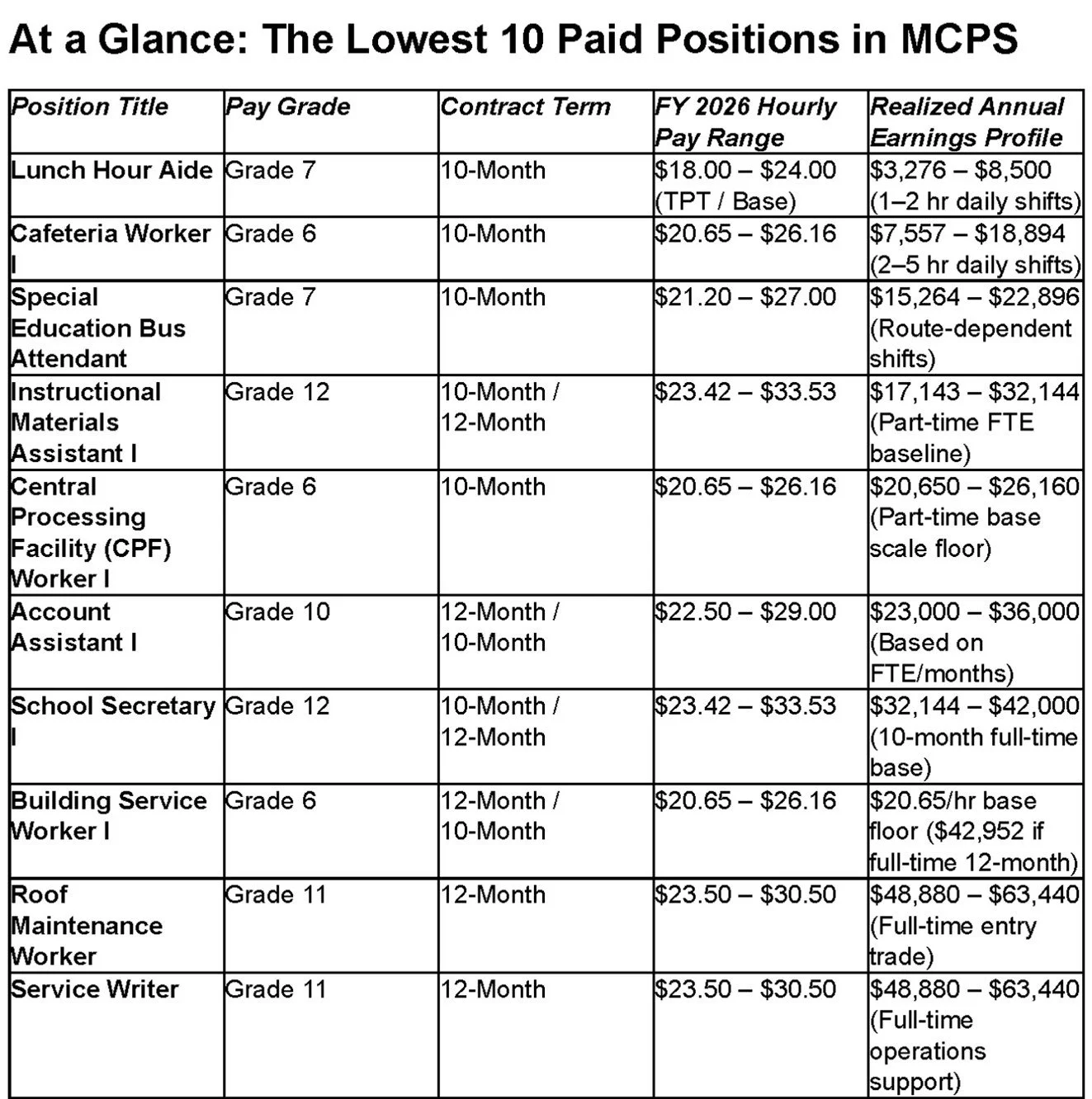
Inside the Bottom 10 Positions
1. Lunch Hour Aide (Grade 7)
Recording the lowest overall annual gross income of any job position in the school system, the Lunch Hour Aide position carries an official Pay Grade 7 placement, one grade higher than entry-level kitchen helpers, yet yields the smallest paycheck. Aides monitor elementary school cafeterias and playgrounds, manage recess games, enforce safety rules, and assist teachers during brief absences. Because work shifts are restricted to narrow 1.0 to 2.0 hour windows during mid-day lunch periods across the 182-day student year, annual earnings remain modest. At hourly rates ranging from $18.00 for temporary appointments to $24.00 for permanent staff, an aide working one hour daily grosses as little as $3,276 annually, while a two-hour aide maxes out under $8,500.
2. Cafeteria Worker I (Grade 6)
As the frontline workforce of the MCPS Division of Food and Nutrition Services, Cafeteria Worker I employees handle food assembly, entree service, and commercial kitchen sanitation across school buildings. Operating on 10-month contracts covering 183 active workdays, staff receive an entry wage between $20.65 and $26.16 per hour. However, job postings show schedules are typically budgeted for part-time shifts ranging from 2.0 to 5.0 hours daily. A worker on a 2-hour daily shift takes home roughly $7,557 in gross base pay over the school year, while a 5-hour daily shift generates about $18,894 before taxes.
3. Special Education Bus Attendant (Grade 7)
Working within the Department of Transportation, Special Education Bus Attendants travel alongside bus operators to care for students with physical, sensory, or emotional needs. Attendants assist children on and off wheelchair lifts, secure specialized restraint harnesses, monitor medical conditions such as seizure disorders, and manage student behavior during transit. Classified at Grade 7 with hourly wages between $21.20 and $27.00, attendants work split morning and afternoon route schedules averaging 4.0 to 6.0 hours daily over 180 transit days. At the starting pay rate, a 5-hour daily assignment yields an annual base compensation of approximately $19,080.
4. Instructional Materials Assistant I (Grade 12)
While positioned higher on the district’s pay scale at Pay Grade 12 ($23.42 to $33.53 per hour), Instructional Materials Assistants working in elementary media centers or central warehouses are frequently subject to part-time 10-month scheduling. Staff unbox shipments, catalog library books, track digital equipment loans, and manage media inventory. When assigned to a part-time 4-hour daily schedule across 183 school days, an entry-level assistant earns an annual base salary of $17,143, demonstrating how part-time FTE caps can keep higher grade classifications within low income brackets.
5. Central Processing Facility Worker I (Grade 6)
Stationed at the district's centralized food manufacturing plant in Gaithersburg, CPF Worker I staff prepare bulk food orders, pack pre-portioned meal kits, and operate commercial cook-chill equipment. The position demands significant physical labor, including moving 250-pound food dollies into walk-in freezers and lifting 60-pound ingredient crates. Earning the district floor rate of $20.65 to $26.16 per hour on 10-month schedules, these operational roles yield annualized base pay between $20,650 and $26,160 based on part-time FTE allocations.
6. Account Assistant I (Grade 10)
Serving as entry-level financial support in school main offices and central departments, Account Assistant I personnel audit invoices, log purchase orders, balance student activity accounts, and prepare bank deposits. Placed at Grade 10 on the SEIU pay scale, the role carries an hourly rate ranging from $22.50 to $29.00. While full-time 12-month staff earn a baseline salary near $46,800, part-time or 10-month school-based assignments bring annualized gross pay down into the $23,000 to $36,000 range.
7. School Secretary I (Grade 12)
Serving as the primary administrative point of contact in school main offices, School Secretary I staff check in visitors, manage phone lines, process attendance records, and assist school leadership. Earning an hourly scale between $23.42 and $33.53, many secretaries work on 10-month contracts covering 183 workdays at 7.5 hours per day. At the starting hourly rate, a 10-month secretary earns a base annual salary of $32,144.
8. Building Service Worker I (Grade 6)
Making up the primary custodial staff across all 211 school facilities, Building Service Worker I employees maintain building cleanliness, sanitize restrooms, operate floor scrubbers, move furniture, and clear snow from walkways. Positioned at the Grade 6 entry scale ($20.65 to $26.16 per hour), full-time 12-month custodians earn $42,952 annually. However, part-time and 10-month schedule variations represent the entry salary baseline for facility operations.
9. Roof Maintenance Worker (Grade 11)
Assigned to the Division of Maintenance and Operations, Roof Maintenance Workers inspect commercial roof membranes, clear storm drains, apply emergency leak patches, and repair flashing. Paid between $23.50 and $30.50 per hour under 12-month full-time schedules (2,080 annual hours), starting gross pay is $48,880. While higher than part-time roles, Grade 11 represents the entry compensation tier for full-time trade personnel in the district.
10. Service Writer (Grade 11)
Operating out of central transportation depots and maintenance shops, Service Writers serve as liaisons between field supervisors and repair technicians. Duties include transcribing repair calls, creating maintenance work orders, tracking replacement parts, and compiling fleet records. Earning $23.50 to $30.50 per hour on full-time 12-month schedules, entry-level gross compensation starts at $48,880 annually.
The Schedule Gap: Why Hourly Rates Don't Tell the Whole Story
A key insight from analyzing district payroll structures is that low annual earnings in MCPS are primarily a product of work schedule limitations rather than extremely low hourly rates.
Under current labor agreements, the $20.65 per hour minimum wage floor for Grade 6 ensures that a support staff member working standard full-time hours (2,080 hours per year) would earn a baseline salary of $42,952. However, K-12 operational needs create significant demand for short-shift labor. Positions like Lunch Hour Aides, Cafeteria Workers, and Special Education Bus Attendants are structurally tied to the student calendar and limited to specific time slots—such as split bus routes or a two-hour lunch window.
As a result, employees in these roles work anywhere from 180 to 900 total hours per fiscal year, placing a structural cap on their total take-home pay:
Standard Full-Time Schedule (12-Month): 2,080 hours/year yields a $42,952 base annual salary.
Cafeteria Worker I Schedule (10-Month, 3 hrs/day): ~549 hours/year yields an $11,336 base annual salary.
Lunch Hour Aide Schedule (10-Month, 1.5 hrs/day): ~273 hours/year yields a $4,914 base annual salary.
Strategic Adaptation: The "Combo Position"
To earn a living wage and secure access to health benefits in an expensive region like Montgomery County, many support staff utilize dual appointments or "combo" positions negotiated by SEIU Local 500.
Under this framework, employees stitch together two separate part-time job titles to build a longer daily schedule. For example, a worker might combine a 4-hour Special Education Paraeducator shift in the morning with a 1.5-hour Lunch Hour Aide shift at mid-day.
Aggregating these assignments allows staff to exceed 20 hours per week—the threshold required to qualify for group health insurance, retirement contributions, and paid leave under the district's collective bargaining agreement. For MCPS, the dual-appointment system offers a practical way to fill brief, hard-to-staff operational windows without having to hire single-task staff.
Cost of Living, Affordability, and the Economic Gap in Montgomery County
While dual appointments and "combo positions" allow support professionals to cobble together 25 to 35 hours of work per week, a troubling economic reality remains: none of the salaries listed on the bottom 10 spectrum, even when combined into full daily schedules, are sufficient to maintain a decent living standard in Montgomery County.
Montgomery County consistently ranks among the most expensive jurisdictions in Maryland and the nationwide area. High regional housing costs, soaring rent prices, childcare expenses, and overall inflation mean that local living costs far exceed national averages. Economic self-sufficiency benchmarks for Montgomery County indicate that a single adult requires an annual income of approximately $50,000 to $55,000 to cover basic necessities like housing, healthcare, food, and transportation without public assistance. For an adult raising a child, that self-sufficiency threshold rises to well over $85,000 per year.
Against these regional economic realities, the earnings profile of MCPS operational support staff highlights a severe affordability gap:
Single-Role Part-Time Earnings: A Lunch Hour Aide making $3,276 to $8,500 annually or a part-time Cafeteria Worker making $11,300 to $18,800 earns far below federal poverty guidelines, making self-sufficiency impossible on a single assignment.
Full-Time Baseline Floor: Even full-time 12-month operational roles at Grade 6 (such as standard Building Service Workers earning $42,952) fall $7,000 to $12,000 short of the basic living wage needed for a single adult in the county.
The "Combo Position" Ceiling: When an employee combines a part-time Paraeducator role with a Lunch Hour Aide shift to create a 6-hour daily schedule (30 hours/week), their realized annual compensation tops out between $28,000 and $36,000. While this crosses the threshold for health benefits, it still leaves workers tens of thousands of dollars short of regional affordability standards.
Consequently, many frontline MCPS support staff must work second or third jobs outside the school system, rely on multi-income households, or endure severe housing cost burdens just to remain in the community where they work.
While news reports detailing executive salaries highlight top-tier compensation rivaling corporate leadership, the operational backbone of Montgomery County Public Schools continues to navigate an intense economic squeeze. Addressing this structural wage gap remains a critical challenge for future labor negotiations and budget priorities if the school district hopes to recruit and retain the essential workforce that keeps its schools open every day.