Awakened by a Bombing: MoCo’s Antisemitism Evolution
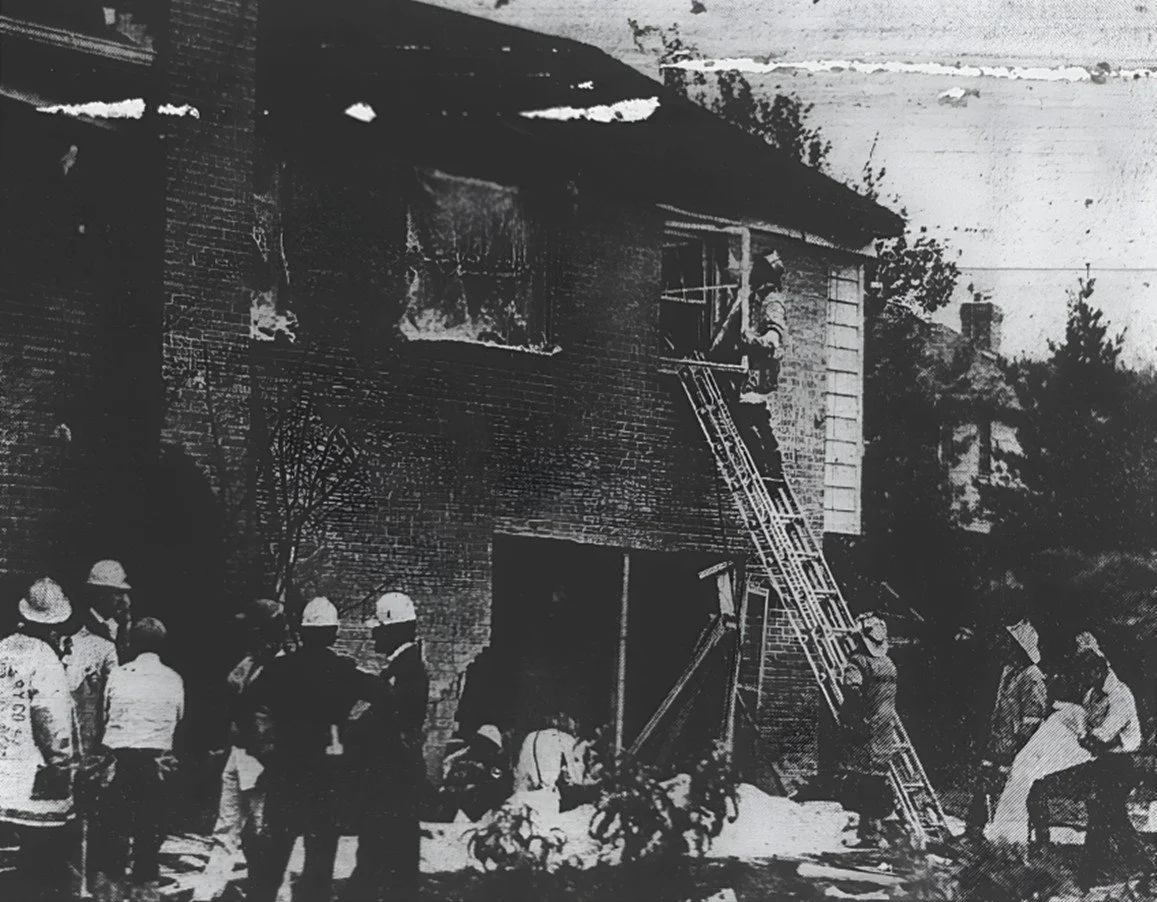
The Washington Post (July 25, 1977), Photo by Douglas Chevalier. Restored from microfiche by Montgomery Fix. Used for historical commentary.
A few hours before dawn on July 25, 1977, a thunderous boom jolted Rockville’s Flower Valley neighborhood awake, bringing terror and unparalleled destruction to the bucolic community. A powerful bomb planted deliberately beneath the bedrooms of a family’s home on Sunflower Drive detonated with a roar that still echoes today.
I was nine years old, and the explosion rocked our house three blocks away, toppling the soccer trophy and model airplanes from the shelf above my dresser.
The blast on Sunflower Drive blew a gaping hole in the home’s exterior wall, shattered glass at homes five blocks away, and killed the family dog sleeping inside. Upstairs, a couple and their three children, ages 9, 12, and 14, were deafened and terrified but miraculously mostly unharmed. FBI investigators later called them “very, very lucky” to be alive.
My father, who went off in the night with a next-door neighbor to learn what happened, told me some of those details the following morning. When I asked him why somebody would do such a thing, he said nobody knew yet. Except he did. And by the end of that summer, I would too.
The Sunflower Drive bombing was a sophisticated terrorist attack aimed directly at one of the most prominent Jewish figures in Washington: Morris J. Amitay, then the executive director of the American Israel Public Affairs Committee (AIPAC). The bomb’s placement, directly below where the family slept, was intended to kill. Police and the FBI swarmed the neighborhood in the following weeks, chasing leads that led nowhere. Though the perpetrator wasn't discovered until years later, the new reality was undeniable. Antisemitic violence had arrived in Montgomery County, Maryland.
As the details of the bombing emerged that summer, I learned that Morris Amitay was an important Jewish person. Before then, he had just been my classmate Cheryl's cool dad. A few months before the bombing, my friend Paul and I were invited into the family home, where we marveled at Mr. Amitay's trophies and artifacts from Africa, acquired when he was stationed as a U.S. Foreign Service Officer in South Africa in the 1960s.
Suddenly I was a nine-year-old grappling with the harsh reality that being Jewish didn't just mean being different; there were people who hated me and wanted me dead. These weren't abstract Germans from a generation-old war. They were in my safe neighborhood, where parents let kids roam free-range after school until dinnertime. Mr. Amitay's trophies were in the family room, and the bomb had been placed on the other side of that very wall.
The personal anxiety that began that summer was a quiet, low-boil dread that would stay with me for the next fifty years. That single act of explosive violence still stands as the county’s most violent antisemitic incident. Nothing before or since has matched its destructive power, its targeting of an entire family, or its singular terrorist ambition. How that seed of childhood anxiety grew into a slowly ascending, lifelong state of dreadful resignation requires a look at the county's muted history of exclusion, with a fast-forward to the present, where the threat is no longer a single pipe bomb, but a suffocating, sometimes daily series of events.
A County Without Jews
For most of the 19th century, Montgomery County had no Jewish residents to hate. The area was rural farmland and small towns, settled by English, German, and Scotch-Irish families. Maryland’s earliest Jewish communities clustered in Baltimore and a handful of other spots farther east. The first Jewish families trickled into Montgomery in the late 19th and early 20th century. There were fewer than ten Jewish households county-wide in 1920. Without a visible community, there were no pogroms, no synagogue attacks. Montgomery County Councilmember Sidney Katz, whose family was among those first 10 Jewish households and still the only Jews living in Gaithersburg in the 1950s, told the Washington Jewish Weekly he recalls being “treated differently, but without the negative connotations.”
The Jews were still a curiosity in early twentieth century Montgomery County, but antisemites weren't taking chances. Starting in the 1930s and lasting well into the 1950s, developers and homeowners wrote restrictive clauses into deeds barring “Semitic races,” Jews, and other minorities. Although Black Americans were the primary target, at least a quarter of these covenants specifically listed Jews.
As Washington, D.C., expanded after World War II, Jewish professionals moved into the county, joining a local Jewish population that had begun to achieve success in retail and real estate. Their expansion beyond the few small existing Jewish enclaves received pushback. In 1947, neighbors in Bannockburn Heights in Bethesda filed a short-lived lawsuit attempting to evict a resident's Jewish husband for “irreparable damage” to property values. The Federal Housing Administration openly encouraged such actions, viewing racial and religious “transitions” as threats to stability. Jews could live here, but not everywhere.
In 1948, Ohr Kodesh in Chevy Chase was established as the first synagogue in Montgomery County. Its founding was contemporaneous to Shelley v. Kraemer, a Supreme Court case partially stemming from the Bannockburn Heights incident that ruled state-enforced discrimination violated the Fourteenth Amendment. The rule did little to change the landscape. Montgomery County’s Mapping Segregation Project review of 416 downcounty plats recorded between 1949 and 1952 found 126 (30%) with racial restrictive covenants.
My parents arrived in Montgomery County in 1962, transplants from New York with a newborn. My father, an attorney, had taken a job with the Federal Trade Commission. They started in the Summit Hill Apartments in Silver Spring, having been told other young Jewish couples lived in the building. It was a uniquely diverse community for mid-1960s Montgomery County. Ten years later the director of the county’s Office of Landlord-Tenant Affairs told the Washington Post, “There are about 500 rental projects in Montgomery County” but said only five of them—Good Acre, Long Branch, Quebec Terrace, Summit Hill, and Rosemary—were significantly integrated. “The rest of the county apartment housing is basically lily white.”
In 1966, my parents bought a single-family home in Forest Estates, one of the few Wheaton-area suburban neighborhoods developed by Jewish real estate developers in the 1940s and early 1950s. They became best friends with a Japanese family across the street. I learned to swim in a Christian neighbor’s backyard pool and went to nursery school at Grace Episcopal Church. Born a year before Martin Luther King’s assassination triggered riots in Washington, D.C., I had no inkling of the discrimination and racial tension all around me.
In July of 1967, Montgomery County passed landmark local legislation, the Fair Housing Ordinance, prohibiting discrimination in the sale or rental of housing across the county. Five months later I was born, followed shortly by the passage of the federal Civil Rights Act of 1968. On August 15, 1968, the County Council enacted a second broad and comprehensive Fair Housing Law that supplemented the Fair Housing Provisions of the Civil Rights Act.
The laws were changed but the damage was done. Decades of institutionalized, government-approved antisemitism left an indelible mark. By 1970, the Montgomery County Jewish community was estimated at 70,000. Its size and influence was sufficient to make it a target. The appearance of swastikas on synagogues and schools had begun.
My parents moved to Flower Valley in 1971, attracted by the newly built 4-bedroom colonials with plenty of space for our family of five. The neighborhood was predominantly White and Christian, with a handful of Jewish, Asian and Black families living side-by-side. There was surely racial tension, but I was a kid and didn’t see, hear, or feel it. And then came the night of July 25, 1977.
That was the summer I figured out that it wasn't that my father didn't like playing tennis across the street at Manor Country Club, it was that they had no Jewish members and wanted to keep it that way. It wasn't that our family "didn't do Cub Scouts"; it was that the local troop was sponsored by a Catholic church, had no minorities or Jews, and preferred it that way. That was the summer I started asking questions about the Holocaust, and I began to really understand what it means to be Jewish, even when your family doesn't practice Judaism.
The Bombing and Its Architect of Hate
Morris Amitay was a brilliant, hard-charging lobbyist. He transformed AIPAC from a modest operation into a Washington powerhouse, relentlessly advocating for U.S. military and financial support for Israel. Colleagues described him as tenacious; critics saw him as the aggressive face of the Israel lobby.
The attack fit a pattern of rising domestic terrorism in the 1970s, though we wouldn't learn the true identity of the perpetrator until much later. On March 1, 1984, the notorious white supremacist serial killer Joseph Paul Franklin formally confessed to the bombing. The Rockville attack was an opening salvo in his violent, three-year campaign of terror across the United States targeting Black Americans, Jews, and interracial couples. Franklin was a mission-driven killer, and he targeted Amitay to strike at the heart of Jewish political advocacy in the United States. The Anti-Defamation League called it a “savage terror bombing.”
Amitay himself continued his work undeterred; the family home was rebuilt and they moved back in, adding sophisticated home security. Amitay remained a force in pro-Israel advocacy until his death in Rockville in 2023 at age 86, his resolve in the face of the attack boosting his profile and amplifying his message. But for me and my dozen or so Jewish classmates at Flower Valley Elementary School, the world never felt completely safe again.
From Vandalism to Violence
In the decades that followed the bombing, antisemitic acts in Montgomery County never again reached that level of lethality. The 1980s and 1990s mostly saw spikes in graffiti. Swastikas on synagogues, schools, and homes were hateful property crimes, not attempts on lives. Meanwhile, the county’s Jewish population thrived. Esther Gelman and Sidney Kramer, elected to the Montgomery County Council in the 1970s, became powerful Jewish voices in local politics. Kramer was elected County Executive in 1986. Synagogues multiplied, day schools opened, and neighborhoods like Potomac became national symbols of affluent Jewish suburbia. Restrictive covenants faded into history, replaced by interfaith dialogues, Holocaust education mandates, and community security partnerships. But the petty acts of antisemitic property crime and hate speech remained, slowly growing in proportion with the Jewish community it targeted.
Antisemitism has been surging in Montgomery County over the last decade, and especially since the Hamas terrorist attacks in Israel on October 7, 2023. The threat in 1977 was physical and explosive, but singular and extraordinary within Montgomery County’s borders. The threat we face today is more pervasive, shifting away from singular terrorist actors toward spontaneous, increasingly violent physical assaults and school-based harassment.
According to the Anti-Defamation League, Montgomery County accounts for a staggering two-thirds of all reported antisemitic incidents in Maryland, with 120 cases logged in 2025 alone. In our county of over one million residents, where Jews make up about 10 percent of the population, we have become the number-one target for hate-bias incidents. And it's not just spray paint anymore.
In January 2023, a Jewish customer at a Gaithersburg Giant supermarket was beaten unconscious by a man shouting antisemitic slurs as accomplices yelled "do it for Kanye." In March 2023, the assailant and classmate of a Jewish middle school student claimed antisemitic motives for months of bullying and an assault. In October 2023, a woman was hit in the back of the head with a rock by teens asking whether she was Jewish. In October 2024, a Silver Spring rabbi was assaulted with a wooden stake on a public sidewalk. These are not pipe bombs, but they represent a slow, cumulative rise in hate crime violence. Just outside county borders, however, the escalation recently surpassed Sunflower Drive’s deadliness. On May 21, 2025, a shooting occurred near the Capital Jewish Museum in Washington, D.C. during a reception hosted by the American Jewish Committee. Two Embassy of Israel staff members who were leaving the event were killed by an American from Chicago who chanted "Free, free Palestine!" as he was taken into custody.
Unlike me, Jewish kids growing up in Montgomery County today don't get to enjoy nine years of innocence. Montgomery County Public Schools (MCPS) has become ground-zero for hate-bias incidents. MCPS experienced a shocking 383 percent spike in school-based hate reports between 2021 and 2022, driven overwhelmingly by peer-to-peer anti-Jewish and anti-Black bias. That upward trajectory has continued, with more than one-third of all hate incidents in the county now occurring inside K-12 facilities.
Jewish children today are living through their own versions of my 1977 disillusionment, but the perpetrator isn't a domestic terrorist; it's their classmate. The Jewish Community Relations Council (JCRC) and local parent coalitions have documented middle schoolers greeting Jewish peers with Nazi salutes, children having their yarmulkes snatched from their heads, and elementary school students reporting that classmates refuse to play with them simply because they are Jewish. Parents and educators have grown so alarmed that the Montgomery County Jewish Parents Coalition recently warned that an "atmosphere reminiscent of 1930s Europe" is taking hold in our schools.
What makes this modern landscape so much more disorienting than the summer of 1977 is that the battle lines are no longer clear. In 1977, all of Montgomery County Jewry stood united against a terrorist and white supremacist. Today, the ongoing war in Gaza has fractured historically progressive Montgomery County coalitions and the Jewish community from within. Meanwhile, AIPAC has grown enormously powerful, pouring tens of millions into federal and state elections. One can easily imagine a modern-day assault on an AIPAC leader engendering Luigi Mangione-like support.
This debate over Gaza and Israel leaves the Jewish community fighting outside hatred while splintering internally, and deeply divided over where to draw the line between safety and free speech. Mainstream organizations like the JCRC push for a zero-tolerance policy and the formal adoption of the International Holocaust Remembrance Alliance (IHRA) definition of antisemitism. Meanwhile, a vocal segment of progressive Jewish parents, educators, and government officials has expressed deep discomfort with this approach, signing letters to warn that conflating all criticism of Israel with antisemitism leads to censorship and a chilling of free speech. Even the Montgomery County, MD Council’s landmark 2022 resolution against antisemitism sparked intense debate, ultimately requiring a clarifying amendment stating that criticism of Israel is not antisemitic to secure unanimous passage.
What is happening today in Montgomery County is the local expression of a national crisis. This month the Associated Press-NORC Center for Public Affairs Research conducted a landmark poll of 1,022 Jewish adults, revealing that my quiet, decades-long anxiety is now a shared national reality. Only 34 percent of Jewish Americans report feeling safe in the United States today. A shocking 63 percent say prejudice against Jewish people is an "extremely" or "very" serious problem. Meanwhile, the rest of the country remains largely blind to this dread: only 38 percent of the general U.S. adult population views antisemitism as a serious issue.
The poll also shows that few Jewish adults feel supported by either political party, with most feeling "politically homeless" as support for Israel becomes a polarized flashpoint. Secular Jews like me are squeezed between a far-right that flirts with white supremacy and a far-left that increasingly targets the Jewish community. Perhaps most concerning is the generational divide highlighted by the poll. Younger Jewish adults are far more critical of Israel, with nearly 30 percent of those under 45 believing Israel's actions in Gaza constitute genocide, compared to only 20 percent of older Jewish adults. We are a community carrying a heavy historical trauma, yet we cannot even agree on how to talk about our own homeland. I am reminded of the Jews in the Warsaw ghetto in the 1940s who fought so fiercely amongst their own partisan factions that they didn't unite to fight the Germans until most of their population had already been taken away.
The feeling I get when I look around the county where I have lived for 58 years and see children confronted by hostility in their own schools, defaced synagogues, and antisemitic assaults resulting in hospital stays is the same fear and trembling that woke me at 3:15 a.m. on a July night in 1977. I drive past the house on Sunflower Drive sometimes. The split-level on a meticulously manicured lawn shows no physical scars from my childhood. But other scars remain, far uglier than my psychological ones. They are woven into the deeds of our homes, the security protocols of our synagogues, and the hateful words and symbols spray-painted on elementary school playgrounds.
# # #
Community Acknowledgment: While this piece reflects my deeply personal reckoning with the history of antisemitism in Montgomery County, it is essential to acknowledge that the shadow of bigotry, exclusion, and violence in our community spans far wider and deeper than the experiences of any single group. For centuries, various minority communities here have navigated the painful realities of systemic discrimination, yet none have borne a heavier or more relentless burden than African Americans. From the foundational scars of historic enslavement and state-sanctioned segregation to the institutionalized warfare of redlining, restrictive housing covenants, and physical violence, the Black community in Montgomery County has uniquely suffered the most profound and protracted impacts of white supremacy. The very covenants that sought to bar Jewish families from local neighborhoods were primarily engineered to subjugate and exclude Black residents, just as the serial killer who bombed Sunflower Drive was driven by a sick ideology that actively hunted Black lives alongside Jewish ones. In examining our county's current crisis of hate, especially the disturbing, parallel rise of peer-to-peer anti-Black bias within our public schools, we must remember that the fight against antisemitism is inextricably linked to the broader, necessary struggle for racial justice. Acknowledging this painful hierarchy of historical trauma does not diminish the specific dread of the Jewish experience; rather, it anchors it in a shared truth and a collective responsibility to confront the structural racism that has plagued our neighbors for generations.
Select Sources and Additional Reading
Associated Press-NORC Center for Public Affairs Research: "Most American Jews don't feel supported by either party or President Trump, new AP-NORC poll finds" (July 9, 2026).
Associated Press: "AP-NORC poll and reporting highlights U.S. Jewish community's views on sensitive issues" (July 2026).
Brooklyn Public Library catalog & Audible: The Killer's Shadow: The FBI's Hunt for a White Supremacist Serial Killer (2020).
Bethesda Magazine: “The growth of the Jewish community in Montgomery County” (February 21, 2022)
Chalkbeat: "How antisemitism and the Gaza war have fractured public schools in a diverse county" (May 20, 2024).
Jewish Center for Public Affairs (JCFA): "The Evolution of AIPAC's Political Operation in Washington over 50 Years."
Jewish Community Relations Council (JCRC) of Greater Washington Campaign: "Take Action Now: Urge MoCo Council to Stand Against Antisemitism."
Maryland General Assembly Testimony: Submitted by the Montgomery County Jewish Parents Coalition (2024).
Montgomery County, MD: Mapping Segregation Project.
Montgomery Perspective: "How big of a problem is antisemitism in MoCo?" (July 6, 2026).
National Jewish Outreach Program: “Maryland’s Jews” (April 2025).
Radford University Department of Psychology: "Joseph Paul Franklin: Serial Killer Timeline."
Washington Jewish Weekly: “5 miles of separation with Sidney Katz” (November 30, 2022).
Washington Jewish Week: "Montgomery County Council unanimously passes antisemitism resolution" (November 3, 2022).
Washington Post: “Israel Lobbyist’s Home Damaged by Bomb Blast” (July 25, 1977)
Wikipedia: "Morris J. Amitay."
Publisher’s Note: Every effort has been made to contact copyright holders regarding archival material. If you hold the copyright to media featured here and wish for it to be removed, please contact publisher@montgomeryfix.com