Banerjee's Bankruptcy Dismissal Appeals Denied; Civil Cases to Resume
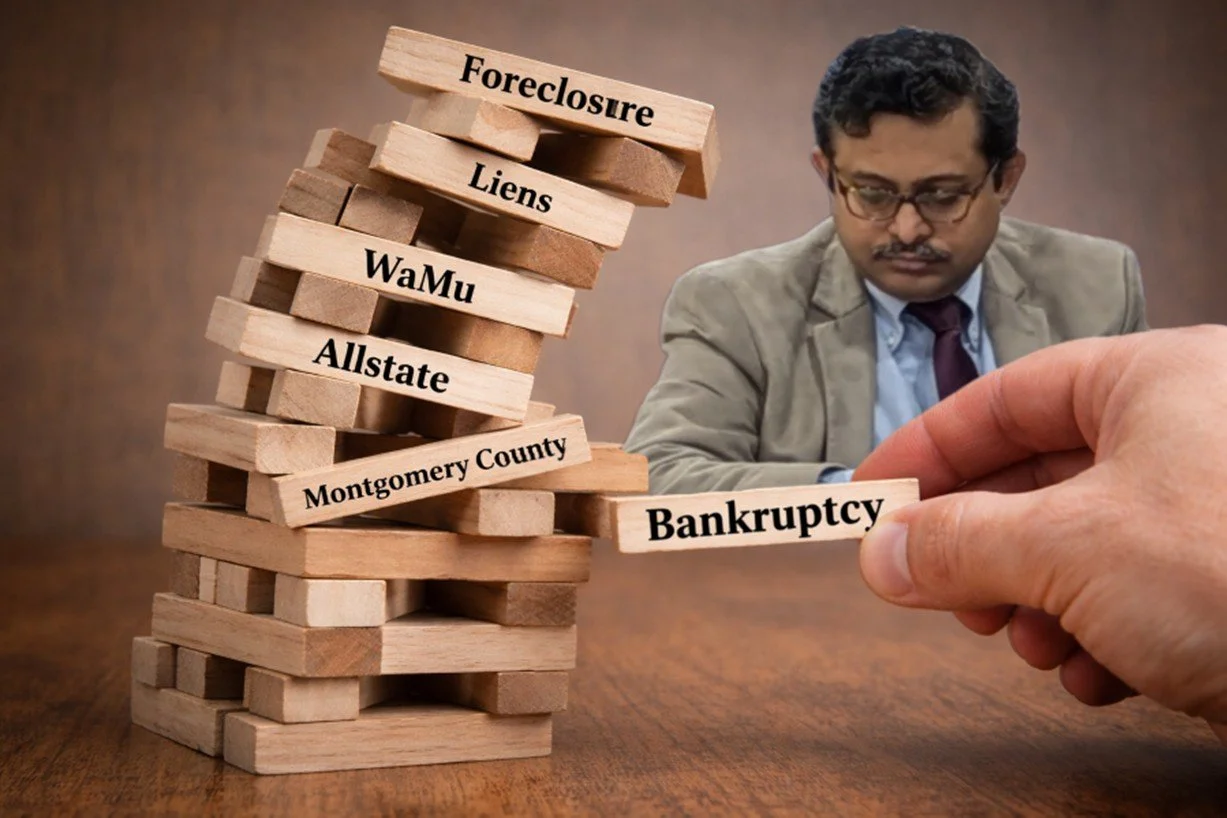
GREENBELT, Md. — The U.S. Court of Appeals for the Fourth Circuit has upheld the dismissal of Montgomery County Executive candidate Mithun Banerjee’s Chapter 13 bankruptcy case, rejecting his appeals in two separate rulings issued November 3, 2025.
In unpublished per curiam opinions, the appellate court affirmed district court orders that threw out Banerjee’s challenges on procedural grounds. The decisions mark the end of more than three years of federal litigation stemming from the bankruptcy filing.
The rulings do not address the merits of the bankruptcy court’s dismissal. Instead, the Fourth Circuit found that Banerjee forfeited review by failing to challenge the actual basis for the lower courts’ decisions in his informal briefs. Both opinions noted that unpublished decisions are not binding precedent and that oral argument was unnecessary.
With the appeals now denied, the bankruptcy court’s March 2024 dismissal order stands, and the automatic stay has remained terminated since that date. No new Chapter 13 or other bankruptcy filing by the Banerjees has been recorded following the final appellate decisions.
Dismissal Sets Off Chain Reaction
Banerjee’s Chapter 13 case held creditors at bay and suspended multiple court cases for years. Entries noting a “suggestion of bankruptcy” appeared in more than a dozen Montgomery County dockets. With the Fourth Circuit rulings, those procedural holds can now be lifted under Maryland Rule 2-507, meaning lenders, debt collectors, and parties in civil cases are free to move forward.
The most immediate pressure is coming from lenders and debt collectors. Foreclosure actions have resumed on Banerjee’s Silver Spring rental properties. Collections have begun on financial judgments previously suspended due to the bankruptcy filing. With tens of thousands at stake, other lenders who withdrew their cases voluntarily in 2022 when the Banerjees filed for protection are likely to begin anew.
Banerjee also filed more than a dozen lawsuits while the bankruptcy was pending. Parties named as defendants in these suits include Allstate Property, Bank of America, The Home Depot, Community Clinic Inc., Fannie Mae, Lotte Plaza Market, BMW of Rockville, Kaiser Foundation Health Plan, Montgomery County, and several individuals. Banerjee sought prepay waivers for the associated filing fees, and the cases have been frozen while courts awaited a decision in the bankruptcy. In addition, Banerjee sued the Montgomery County Renters Alliance and Montgomery Community Media in October 2025, accusing them of unfairly excluding him from a county executive candidate forum; that case has also been stalled at Banerjee’s prepayment-waiver request. And on March 13, 2026, he filed another suit against WAMU 88.5 and American University over similar forum exclusion issues. That filing was administratively deficient but could proceed if corrected. Fee waiver requests in all of these cases will now be addressed by the courts. If waivers are denied, filing fees must be paid for the cases to continue. If waivers are granted, or Banerjee pays the fees, then proceedings move forward on the merits.
For Banerjee, the dismissal of his bankruptcy appeals appears likely to trigger a series of catastrophic life events. Foreclosure on his rental properties would deprive the Banerjees of their sole income source. A gaggle of competing lenders and collectors holding prior liens and judgments are now free to pursue the Banerjees’ home, vehicles, and other assets. A few have already begun.
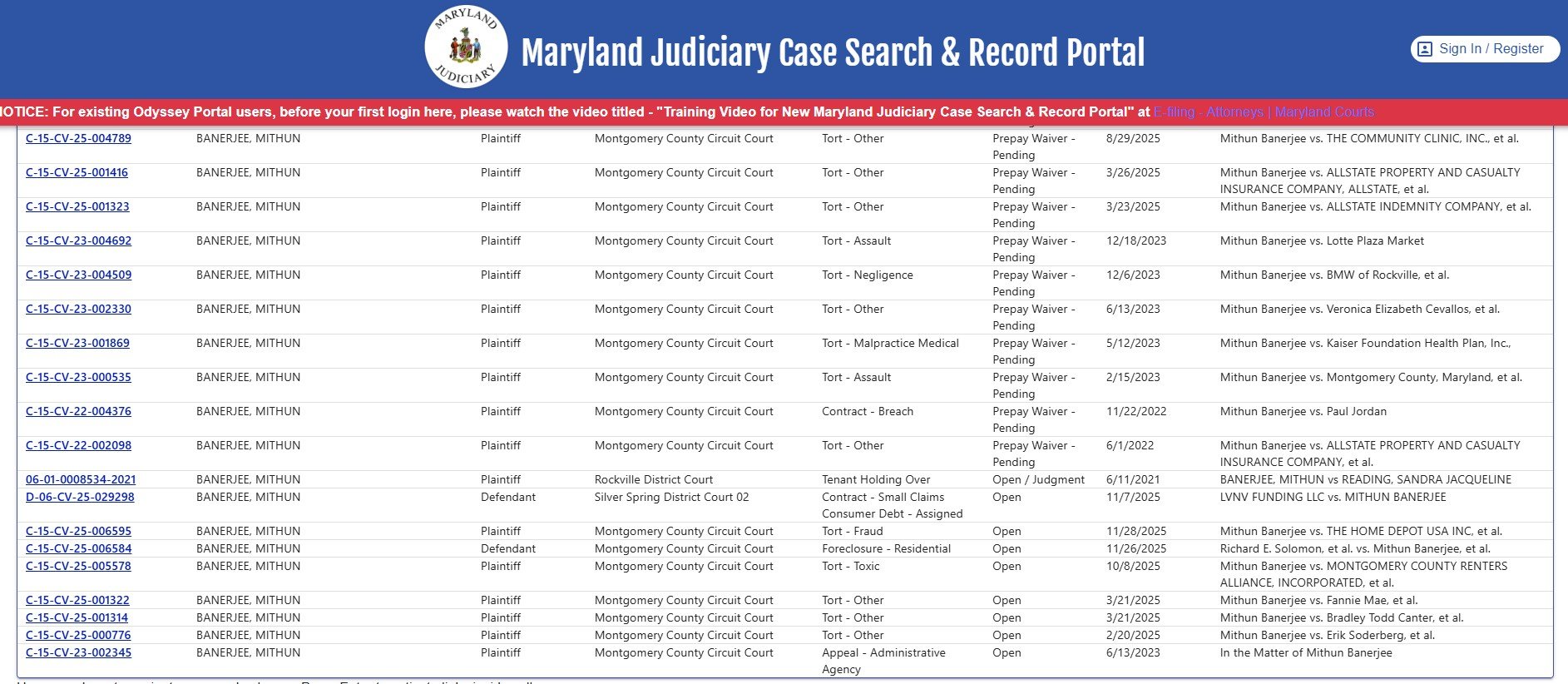
Screenshot of Maryland Judiciary Case Search for Mithun Banerjee, sorted by case status. There are more than 130 active, closed, or appealed case listings under his name since 2011.
A Timeline of the Banerjees Bankruptcy Proceedings
February 2022: Banerjee filed an individual Chapter 13 petition. That case was later replaced by a joint filing.
September 21, 2022: Banerjee and his wife, Malancha Banerjee, filed a joint voluntary petition for Chapter 13 relief in the U.S. Bankruptcy Court for the District of Maryland at Greenbelt (Case No. 22-15183-MCR). The filing triggered the automatic stay under 11 U.S.C. § 362(a), halting most creditor actions and many related lawsuits.
January 10, 2024: Bankruptcy Judge Maria Elena Ramirez entered an order denying confirmation of the debtors’ Chapter 13 plan without leave to amend. The order gave the Banerjees 14 days to convert the case to another chapter or voluntarily dismiss it. They did neither.
January 24, 2024: Banerjee filed a notice of appeal of the confirmation denial order.
March 4, 2024: The bankruptcy court issued its Order Dismissing Case. The court explained that the confirmation denial was not immediately appealable but ruled it retained jurisdiction to dismiss anyway, citing precedent from the Ninth Circuit’s In re Hagel decision.
The order stated: “The Debtors cannot continue to benefit from the automatic stay and hold creditors at bay while having no confirmed plan compelling them to pay their creditors and waiting for the appeal to run its course.”
It noted that the debtors “have enjoyed the benefit of the automatic stay for almost two years (16 months in this case plus an additional six months before that in Mr. Banerjee’s prior case) while the Debtors have made no progress toward confirming a plan, which has unfairly prejudiced creditors.”
The court explicitly terminated the automatic stay. A separate Notice of Dismissal was sent to all creditors and parties in interest the same day, stating: “You are hereby notified that an Order Dismissing the above case was entered on 3/4/24. ALL PARTIES ARE HEREBY NOTIFIED, that the automatic stay imposed by 11 U.S.C. § 362(a) is terminated.”
2024–2025: Banerjee appealed the dismissal and related orders through multiple district court cases in Maryland (including 8:23-cv-03512-DLB, 8:24-cv-00270-DLB, and 8:23-cv-01509-PJM). The appeals centered on procedural issues, including in forma pauperis fee waivers, recusal requests, and stays pending appeal. Several were dismissed without prejudice for failure to pay filing fees or submit proper applications.
October 30, 2025: The consolidated appeals were submitted to the Fourth Circuit.
November 3, 2025: The Fourth Circuit issued its two rulings.
In No. 24-1869 (consolidating appeals from district cases 8:23-cv-03512-DLB and 8:24-cv-00270-DLB), the court wrote: “Because Banerjee’s informal briefs argue for the recusal of the bankruptcy court judge and do not challenge the basis for the district court’s disposition, he has forfeited appellate review of the court’s order… Accordingly, we… affirm the district court’s order dismissing these two bankruptcy appeals.”
In No. 25-1008 (from district case 8:23-cv-01509-PJM), the court similarly held: “Because Banerjee’s informal brief argues only for the recusal of the bankruptcy court judge and does not challenge the district court’s dismissal of his bankruptcy appeal or the determination that the recusal motion is moot, he has forfeited appellate review of the court’s order… Accordingly, we affirm the district court’s order.”
Both opinions noted that unpublished decisions are not binding precedent and that oral argument was unnecessary.