

The Turtles are Awake in Montgomery County
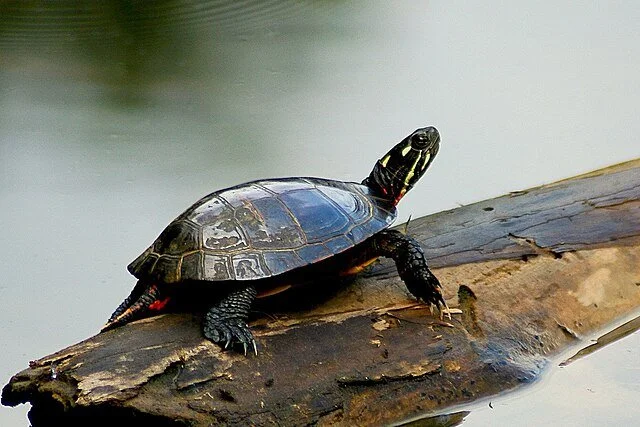
“Painted Turtle on a log (mirrored)” by Scot Campbell (original) and TCO (derivative), via Wiki Commons, licensed under CC BY 2.0. Image modified (mirrored).
It is just one week into spring, and Montgomery County turtles are on the move. Social media posts show them basking on logs in Wheaton Regional Park and swimming along the waterfront eateries at RIO in Gaithersburg. County crews report carefully relocating them from roads to ponds. And they're just getting started.
The turtles are hungry after months spent in brumation (turtle hibernation). Some species are ready to breed; others, ready to lay eggs, seek nesting spots. In case you encounter one in the coming weeks, we put together a quick guide to help identify the 13 species living in Montgomery County. It includes both native turtles and introduced turtles that have established large, decades-long populations.
After the guide, we offer some blunt commentary about keeping turtles as pets, as well as resources for injured animals and surrenders. But first, the turtles.
Eastern Box Turtle (Terrapene carolina carolina)
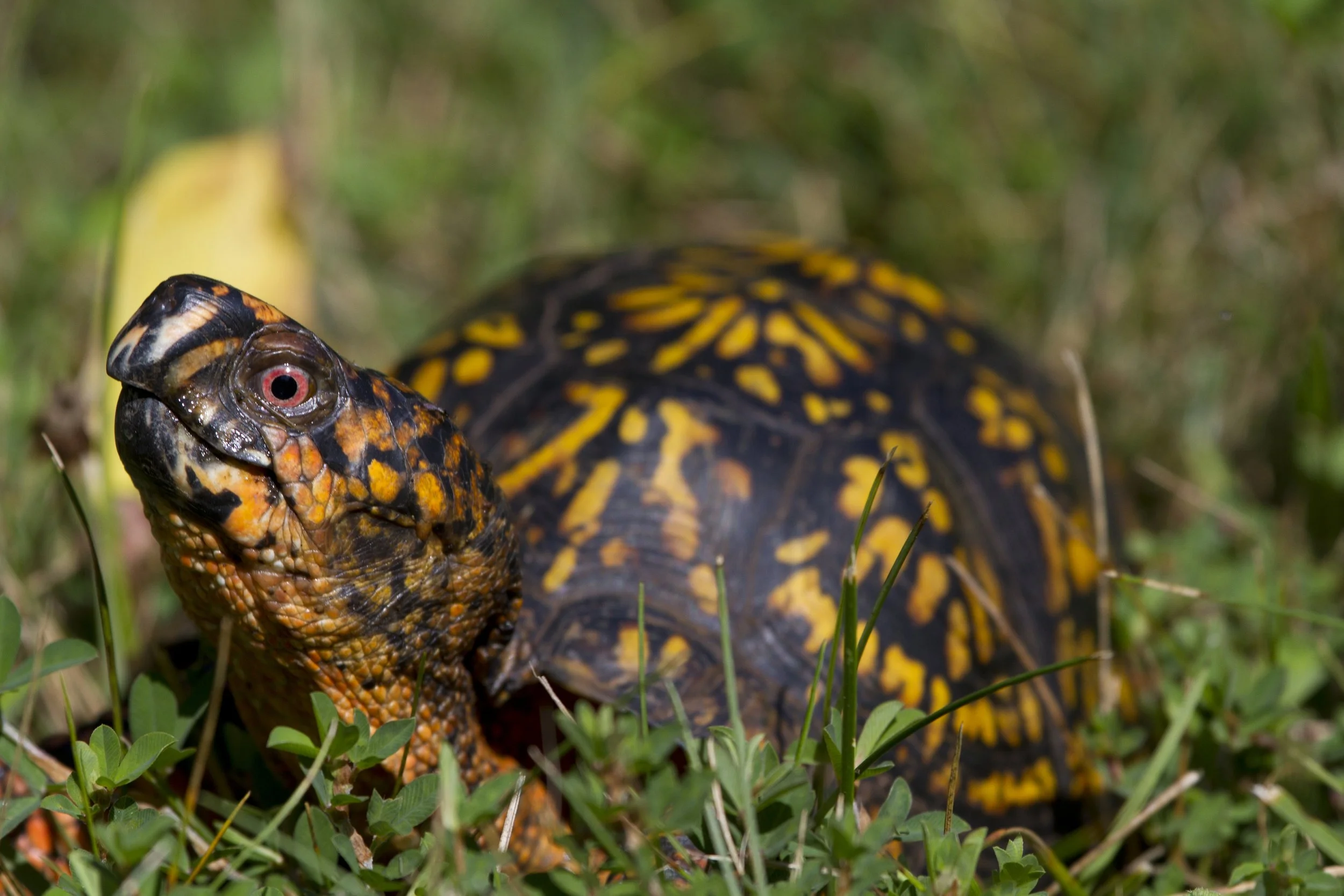
“Eastern Box Turtle” by Shenandoah National Park, via Wiki Commons, in the public domain.
The Eastern Box Turtle is primarily terrestrial and the species you’re most likely to see on land. Box turtles have a hinge on their shell that lets them completely close themselves inside like a box, sealing out predators. They can reach more than 50 years old and usually spend their entire lives within a few-mile range. Some long-time county residents report seeing the same ones in their gardens year after year for decades!
During the construction of the Intercounty Connector (ICC) in Montgomery County, a massive effort led by the Maryland State Highway Administration (SHA) and its partners resulted in the rescue and relocation of more than 900 Eastern Box Turtles from the path of the highway. Post-release, survival rates were less than 65%, primarily due to a lethal outbreak of Ranavirus. ICC researchers concluded the virus outbreak originated naturally, but some wildlife experts are skeptical; broader scientific studies have highlighted factors that link Ranavirus outbreaks to handling and captivity. Remember that later when we talk about pet turtles.
Snapping Turtle (Chelydra serpentina)
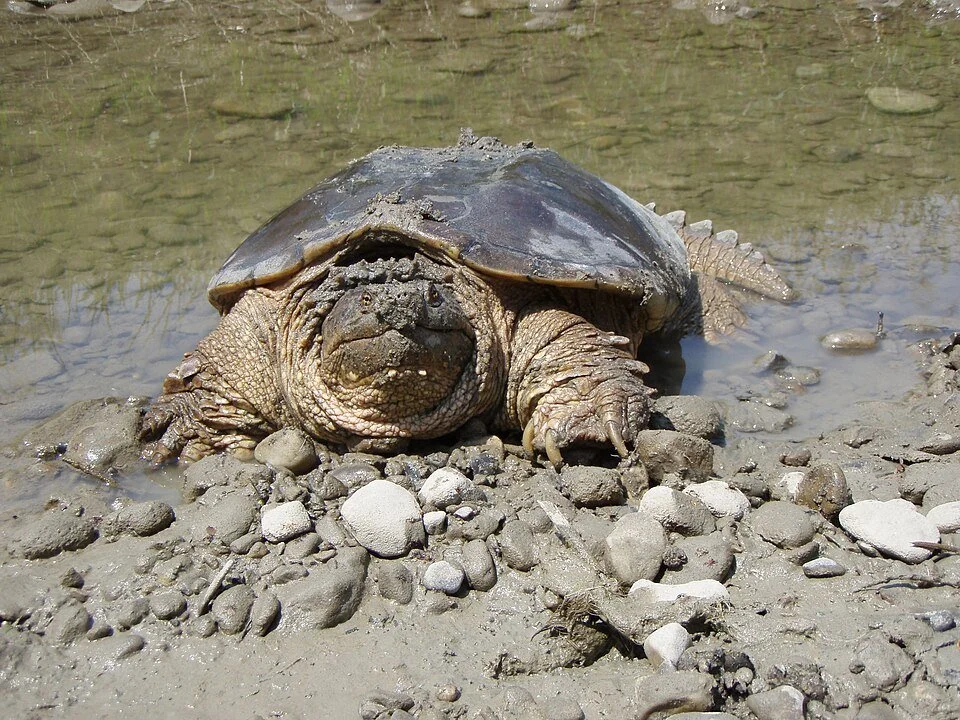
“Snapping turtle Chelydra serpentina” by Shannon Keith, U.S. Fish and Wildlife Service, via Wiki Commons, in the public domain.
The Snapping Turtle is the heavyweight of Montgomery County waterways. Its rugged shell, long tail, sharp claws, and prehistoric look hint at danger, and its long, fast neck and powerful jaws prove it. The world's largest recorded common snapping turtle is a 98-pounder residing at the Schramm Education Center in Nebraska, estimated to be over 90 years old. Makes you wonder what’s lurking in Lake Frank! Want to know? Go to Rockville and see Pumpkin, Croydon Creek Nature Center’s snapping turtle “animal ambassador.”
Despite the reputation, snapping turtles are surprisingly calm. Those famous snaps are a defensive behavior. They rarely leave the water, so just give them space when they occasionally stretch out for some sun.

Eastern Painted Turtle (Chrysemys picta picta)
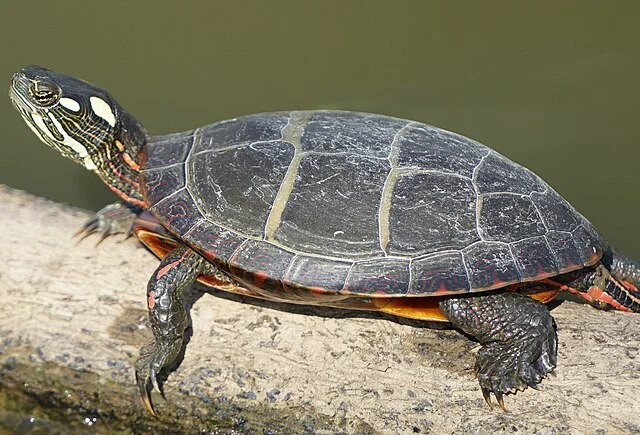
Eastern Painted Turtle (Chrysemys picta picta)” by Greg Schechter, via Wiki Commons, licensed under CC BY 2.0.
When you see a line of small turtles stacked on a log, these are probably painted turtles. They are Montgomery County’s most common natural turtle species, distinctive by the red and yellow markings along the shell and limbs. Until recent decades, the Eastern Painted Turtle dominated Montgomery County’s ponds and lakes. They are still ubiquitous, but they are rivaled in number and often crowded out by introduced and invasive species.
Painted turtles are found as far north as the Canadian Maritimes of New Brunswick and Nova Scotia. Adults can survive being frozen during winter, and hatchlings produce natural antifreeze-like chemicals in their bodies.
Northern Red-bellied Turtle (Pseudemys rubriventris)
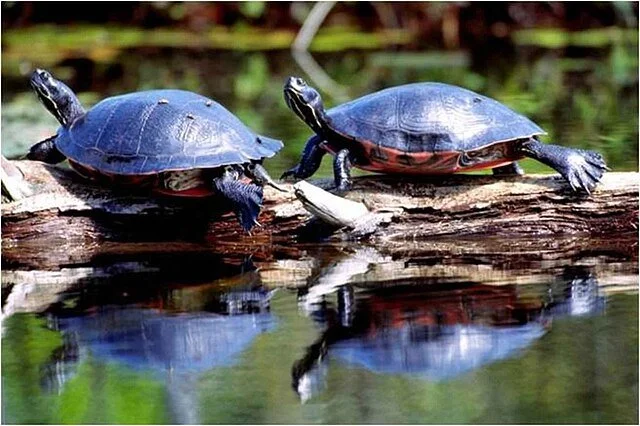
“Pseudemys rubriventris, Plymouth Co., Massachusetts, 2011” by Greg Schechter, via Wiki Commons, licensed under CC BY 2.0.
If you hang around lakes and reservoirs, you’ve probably seen a Northern Red-bellied but didn’t notice. Montgomery County’s stealth turtle is larger than most pond species but more commonly seen swimming than basking. The Northern Red-bellied Turtle lives in bigger bodies of water. As the name suggests, its underside has a reddish tint, though you wouldn’t see it unless it is handled. Ever evasive, even when they do bask, it is only briefly.
Eastern Mud Turtle (Kinosternon subrubrum)

“Eastern mud turtle patuxent research refuge north tract 6.8.25 DSC 4237-topaz-rawdenoise” by lwolfartist, via Wiki Commons, licensed under CC BY 2.0
The Eastern Mud Turtle is small, dark, and easy to overlook. Even avid local hikers and naturalists have never encountered one. It prefers quiet, shallow wetlands and often stays hidden in muddy bottoms or vegetation. Mud turtles can emit a strong, musky odor when disturbed—a defense mechanism that helps deter predators. So, you would know if you’ve come across one!
Eastern Musk Turtle (Sternotherus odoratus)
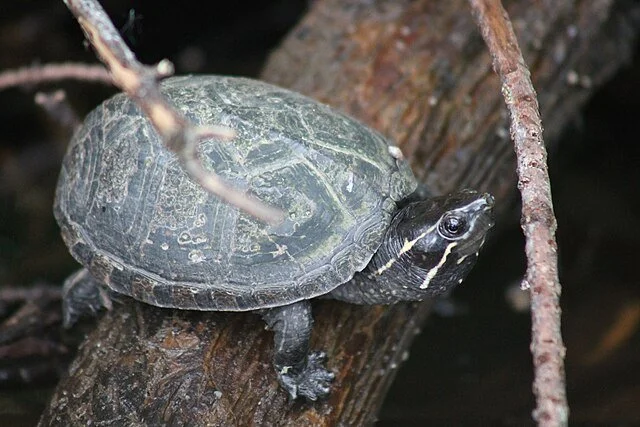
“Sternotherus odoratus” by Dominic, via Wiki Commons, licensed under CC BY 4.0
Closely related to the mud turtle, the Eastern Musk Turtle is also small but more commonly seen basking near water. It has light stripes on its face and a somewhat domed shell. Its nickname is the “stinkpot.” Like mud turtles, it can release a strong-smelling secretion when threatened.
Spotted Turtle (Clemmys guttata)
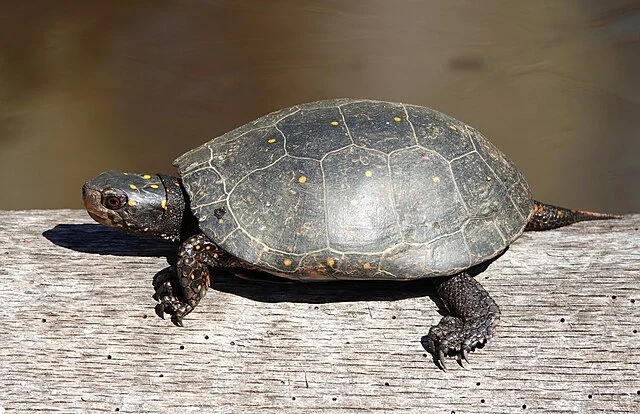
“Spotted Turtle Virginia March 2023” by Erin Huggins, via Wiki Commons, licensed under CC BY 2.0
The Spotted Turtle is perhaps the most striking turtle in the region, with a dark shell dotted with bright yellow spots. It favors wetlands and is much less commonly seen than painted or snapping turtles. It is also one of the smallest species, with adults rarely exceeding 5 inches in length.
The International Union for Conservation of Nature lists spotted turtles as an endangered species. They are protected locally and only survive in isolated, localized populations, many of which are reportedly in decline.
Wood Turtle (Glyptemys insculpta)
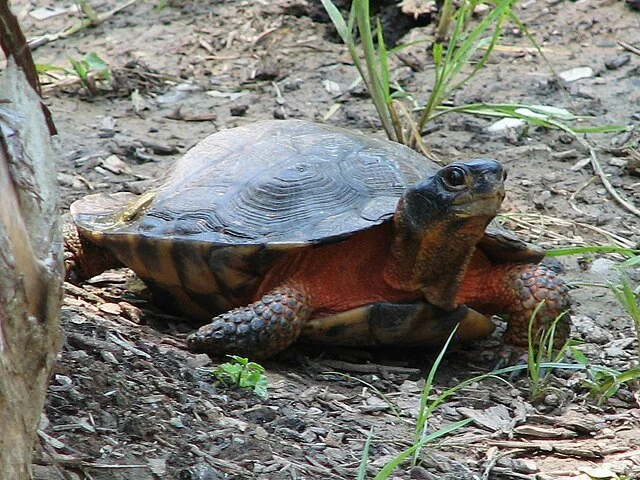
“Wood Turtle (Glyptemys insculpta)” by Ltshears, via Wiki Commons, in the public domain
The Wood Turtle is a semi-terrestrial species that splits time between streams and surrounding forests. Its shell has a sculpted, almost carved appearance. They are only rarely seen in Montgomery County. Wood Turtles are listed as endangered in the state and considered a species in need of conservation due to declining and fragmented populations.
Wood turtles have been observed “stomping” the ground to bring worms to the surface, a rare example of tool-like behavior in reptiles.
Red-eared Slider (Trachemys scripta elegans) – Introduced
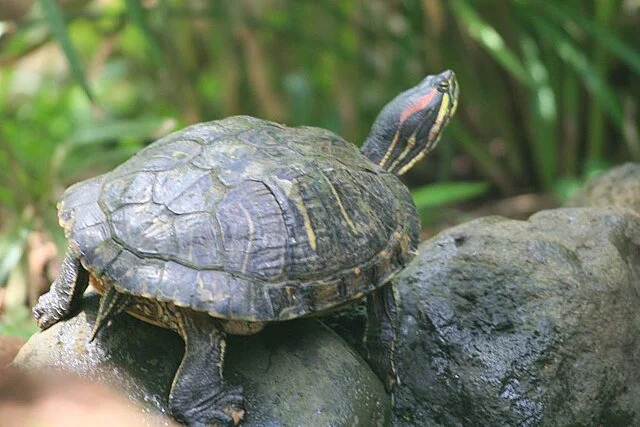
“Trachemys scripta elegans” by David Stang, via Wiki Commons, licensed under CC BY-SA 4.0
The Red-eared Slider is the turtle most people picture when they think of a pet turtle—the green ones with a red stripe behind their eyes. It has been the most commonly sold pet-store turtle in the United States for decades. Before the 2000s, there were dozens of small, independent pet shops scattered across Montgomery County, and many of them sold tiny hatchling red-eared sliders until 1975, when federal law prohibited the sale of turtles less than 4 inches long. Even today, larger red-eared sliders are still widely sold, and they remain the dominant species in the pet trade.
As those turtles grew larger, more expensive to care for, and harder to manage, many were released into local ponds, lakes, and streams. They are a hardy species capable of surviving Maryland winters, and females can lay 3–4 egg clutches per year. The result is that red-eared sliders have become one of the most commonly seen turtles in Montgomery County waters, often outnumbering native species in heavily used or urban ponds.
Yellow-bellied Slider (Trachemys scripta scripta) – Introduced
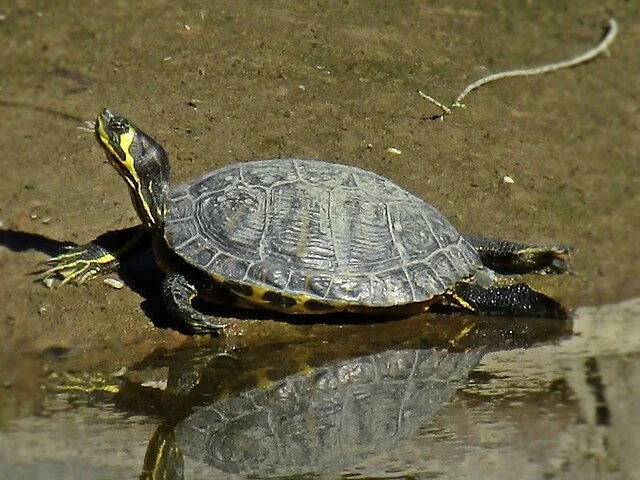
“Trachemys scripta scripta (Emydidae) (Yellow-bellied Slider) - (adult), Río Guadaiza, Spain” by Diego Delso, via Wiki Commons, licensed under CC BY-SA 4.0
Another introduced species and a close relative of the red-eared slider, the Yellow-bellied Slider lacks the red ear marking but has bold yellow striping and a bright underside. In places where both sliders occur, they can quickly outcompete native turtles for basking spots and food.
False Map Turtle (Graptemys pseudogeographica) – Introduced
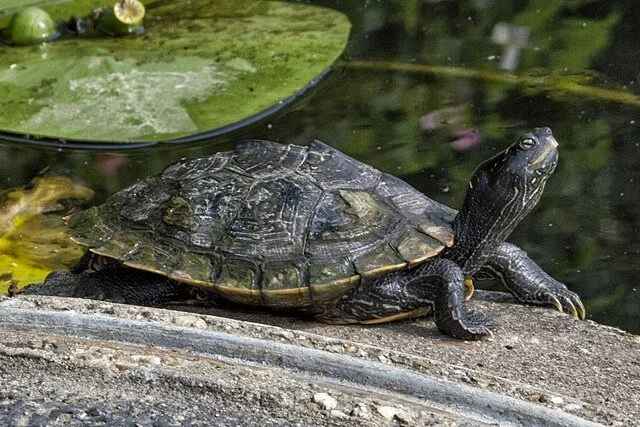
“Graptemys pseudogeographica” by Paul van de Velde, via Wiki Commons, licensed under CC BY 2.0
Named for the map-like lines on its shell, the False Map Turtle is a river species that occasionally appears in local waterways from releases. Map turtles exhibit significant sexual dimorphism, with adult females being much larger than males. Females typically measure 7 to 10.5 inches in length, while males are smaller, ranging from 3.5 to 6.5 inches.
Ouachita Map Turtle (Graptemys ouachitensis) – Introduced
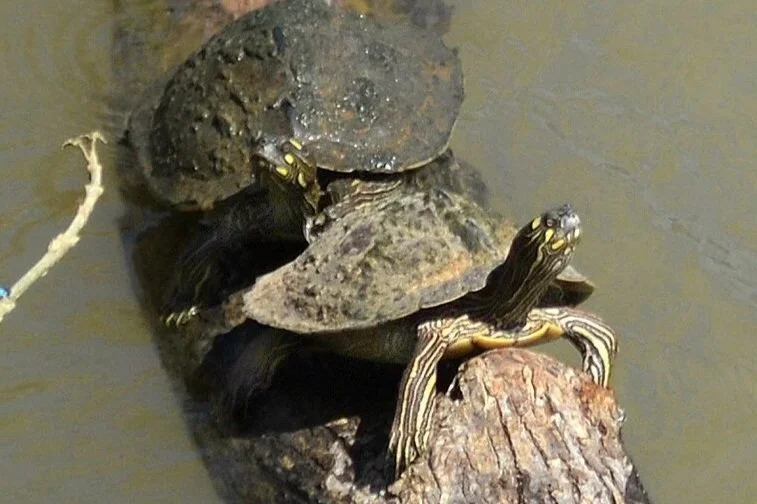
“Ouachita map turtle (Graptemys ouachitensis)” by USFWS Mountain Prairie, via Wiki Commons, in the public domain. Image modified (cropped)
Another map turtle species seen due to release, the Ouachita is distinguished by bold markings on the head and a more pronounced keel on the shell. Like other map turtles, it relies heavily on clean, flowing water habitats, which makes established populations less common in Montgomery County’s inland ponds and lakes.
River Cooter (Pseudemys concinna) – Introduced

“Suwannee River Cooter - Pseudemys concinna suwanniensis, Lower Suwannee National Wildlife Refuge, Chiefland, Florida” by Judy Gallagher, via Wiki Commons, licensed under CC BY 2.0.
The River Cooter is a large, herbivorous turtle with intricate, swirling shell patterns. It’s native to the southeastern U.S. but shows up locally through introductions. The River Cooter has surprising speed in the water and on land. While they may wander from one body of fresh water to another, they stay within their home ranges.
Those are the 13 turtles you might encounter in Montgomery County. If you want to appreciate these fascinating, resilient animals, there are plenty of opportunities to do it the right way: in the wild, where they belong. On a sunny day, you can see turtles in nearly every pond in every park in the county!
Turtles Do Not Make Good Pets
In fact, turtles make lousy pets. If anyone is qualified to say that, it’s me. My Snapping Turtle, Sid, was with me for 36 years, through puberty, college, marriage, and kids. It wasn’t easy, and I’m not sure I would do it again.
The core issue is commitment. When you get a turtle, you are potentially signing up for decades. Many can live 30, 40, even 50 years or more. Some outlive their original owners. A turtle is a long-term obligation that will follow you through moves, career changes, family life, and everything in between.
Rehoming any pet is a struggle, but turtles are on an entirely different scale of difficulty. You cannot responsibly release a turtle into the wild, lest you kill off an entire population (remember those Eastern Box Turtles relocated from the ICC?). You cannot easily rehome it. Shelters don’t always take them and often have to euthanize. The fact is that very few people want a full-grown turtle.
Turtle care is far more demanding than most people expect. Proper husbandry requires a large enclosure, powerful filtration, UVB lighting, heating elements, basking areas, and regular maintenance. Tanks must be cleaned, filters maintained, bulbs replaced, and water quality constantly managed. When a tank won’t suffice, you need to invest in stock tanks and tubs. It’s all very expensive and time consuming.
And then there’s the smell, regardless of how clean you keep their tank.
Helping Turtles in Distress
If you see a turtle crossing the road or in danger of being run over, move it in the direction it was already heading, and only a short distance. Don’t take it to a “better” location. Turtles are built for longevity and stability. Many spend decades in the same small patch of habitat. When they move, it’s usually for a reason.
If a turtle is clearly injured (cracked shell, bleeding, hit by a car) you should contact the Montgomery County Animal Services and Adoption Center. They can guide you or connect you with wildlife resources. Another option is the Maryland Department of Natural Resources, which also provides guidance on handling native wildlife.
If you must move an injured turtle off the road, place it in a ventilated box and keep it in a quiet, shaded area until you can get instructions.
What to Do with an Unwanted Pet Turtle
Releasing a pet turtle into the wild is the worst option. A released pet may carry pathogens or parasites into local turtle populations, and even a turtle that is native to Maryland can create problems if it is moved from one watershed or population into another. Captive turtles also often do poorly after release because they may not know how to find food, avoid predators, or survive winter conditions the way a wild turtle does.
If you need to surrender a pet turtle, there are a few options in and around the Montgomery County region:
Montgomery County Animal Services and Adoption Center is an open-admissions shelter and will accept any animal belonging to a Montgomery County resident, but appointments are required and owners must call ahead. The county says surrender should be a last resort and specifically notes that some animals may ultimately not be placeable, so people should understand that outcome is possible.
The Mid-Atlantic Turtle and Tortoise Society (MATTS) helps with injured turtles in the wild and with surrendered pet turtles and tortoises. MATTS is based in Highland, MD. It is foster-based rather than a large centralized intake facility, which means contacting them first is essential.
Dean’s Turtle Farm, located in Westminster, MD, is a private turtle and tortoise sanctuary, and many of its residents came from previous owner surrenders. It also has a surrender form on its website. At the same time, the farm says it is not a public intake facility and that intake is extremely limited, so reach out first rather than just showing up with an animal.
The Baltimore Critter Society rescues, rehabilitates, and adopts out owner-surrendered reptiles, amphibians, and small mammals.
Second Hand Serpents Reptile Rescue, located in Elkton, provides a safe place to surrender unwanted reptiles.
Because rescue capacity can change quickly, it is smart to contact any rescue before making plans.


.jpg)

_(49866261538).jpg)


_(Yellow-bellied_Slider)_-_(adult),_R%C3%ADo_Guadaiza,_Spain.jpg)
.jpg)
.jpg)
