Government Inaction Threatens Historic Montrose School
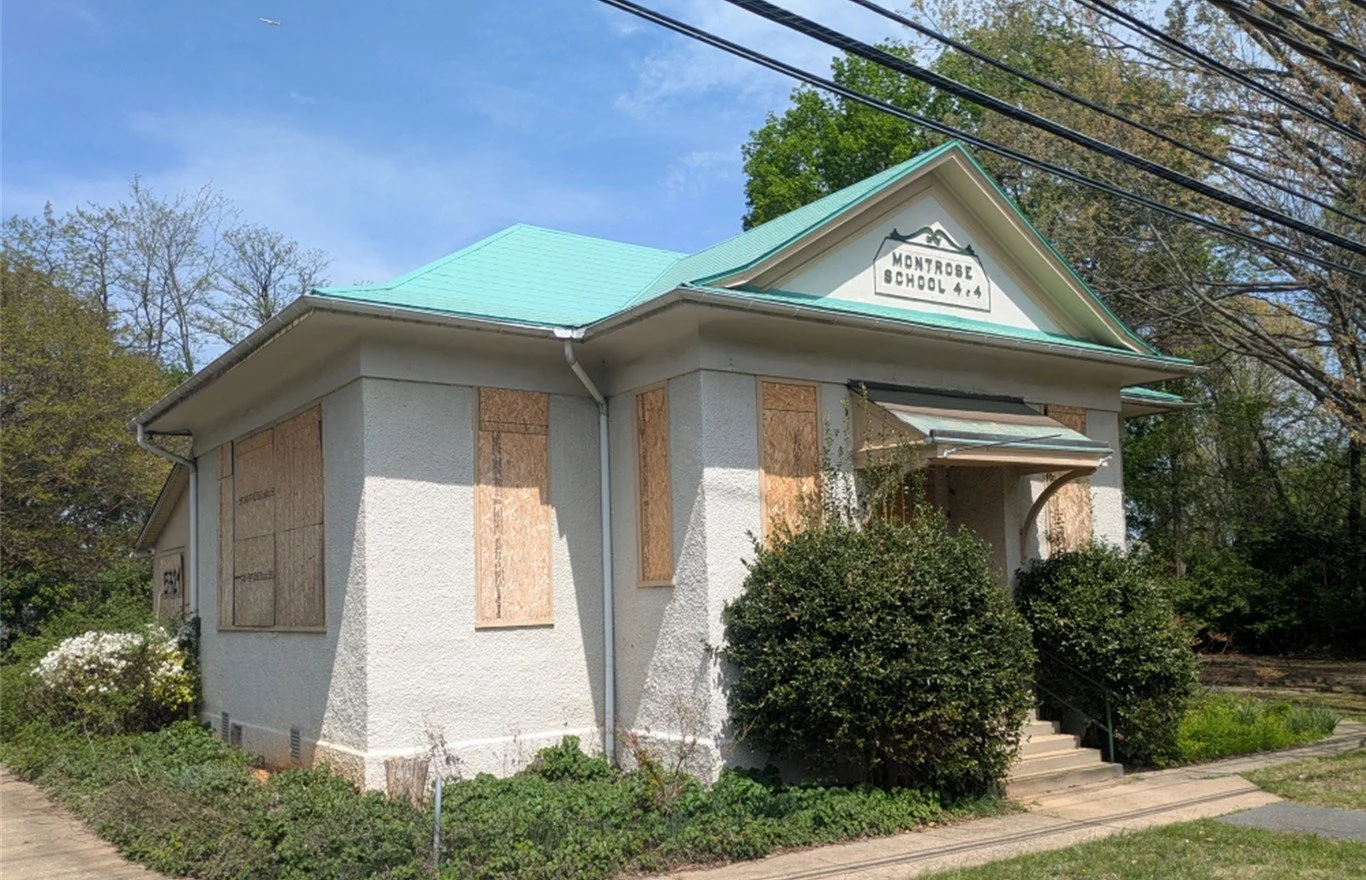
(Photo: Montgomery Fix, April 2026)
For 115 years, the little Montrose School on the crest above the intersection of Rockville Pike and Randolph Road in North Bethesda withstood the test of time, witnessing the growth of a sleepy farming community into a bustling suburban enclave of high-rise buildings, strip malls, and miles of asphalt.
The Montrose School still stands, but what should be one of North Bethesda’s most visible and celebrated historic landmarks is now hidden from view and in a state of disrepair, swallowed by dense overgrowth along the Randolph Road corridor. Scrub brush and unmanaged trees have closed in around the site, giving rise to troubling conditions. Within that leafy, vine-tangled cover are encampments, sprawling debris fields, and clear signs of vandalism. Protective boarding was installed on every window following repeated break-ins, but even that has proven ineffective.
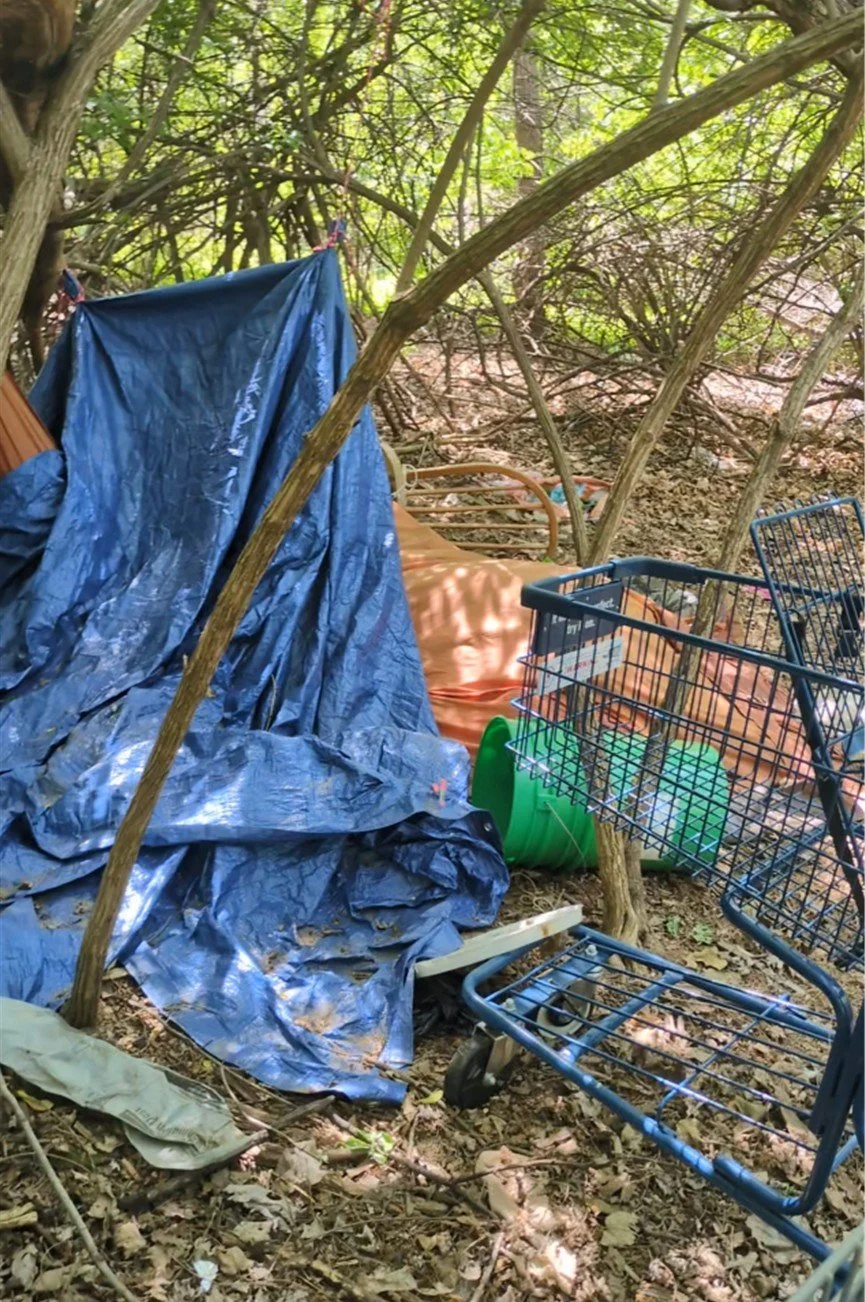
Elements of encampments are hidden in the bushes adjacent to the school, along with pockets of litter, empty alcohol bottles, and debris. (Photo: Montgomery Fix, April 2026)
It is a quiet tragedy for a building that has already survived more than a century of profound change. Constructed in 1909, the Montrose School is located in what was then the village of Montrose. It replaced an earlier one-room schoolhouse that had grown inadequate following the late-19th-century arrival of the B&O Railroad. The new structure was designed by Thomas C. Groomes, an architect commissioned by the county to modernize its public school system. His two-room schoolhouses reflected the progressive educational thinking of the era, prioritizing light, air, and spaces designed to improve both student learning and health.
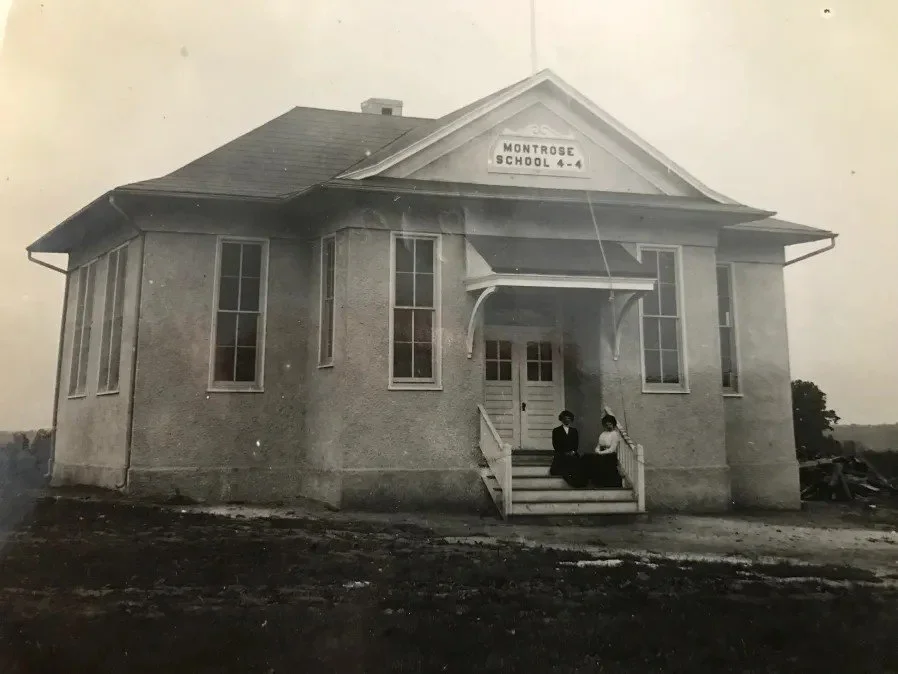
Montrose School, photo by Lewis Reed, circa 1908, via Reed Brothers Dodge History
When the Montrose School opened, it relied on coal stoves for heat and kerosene lamps for light. Well water and outhouses were replaced by electricity and indoor plumbing much later. Like all public schools in Montgomery County during that era, it was strictly segregated. White students attended Montrose, while Black students from the area were forced to travel to schools in Rockville or Scotland.
The Montrose School remained in continuous educational use through the mid-20th century, expanding in 1948 with a third classroom (and indoor plumbing), giving it capacity for about 100 students. However, by 1960, suburban developments and large, modern facilities made the Montrose School obsolete. It was converted first to special education use, then to administrative offices, and by 1970, it sat abandoned entirely.
The building’s fate was in jeopardy as state highway plans took shape in the mid-20th century. The land beneath and around the school was acquired by what is now the Maryland Department of Transportation State Highway Administration (SHA), and the structure itself fell into deep disrepair. However, in 1979, the local preservation organization Peerless Rockville stepped in, purchasing the building for a single dollar and beginning the long process of stabilization and rehabilitation. While the organization did not control the land beneath the school, it entered into a ground lease arrangement that saved the structure, leading to its designation as a Montgomery County historic site in 1979 and its addition to the National Register of Historic Places in 1983. At its centennial celebration in 2009, it stood as a laudable preservation success.
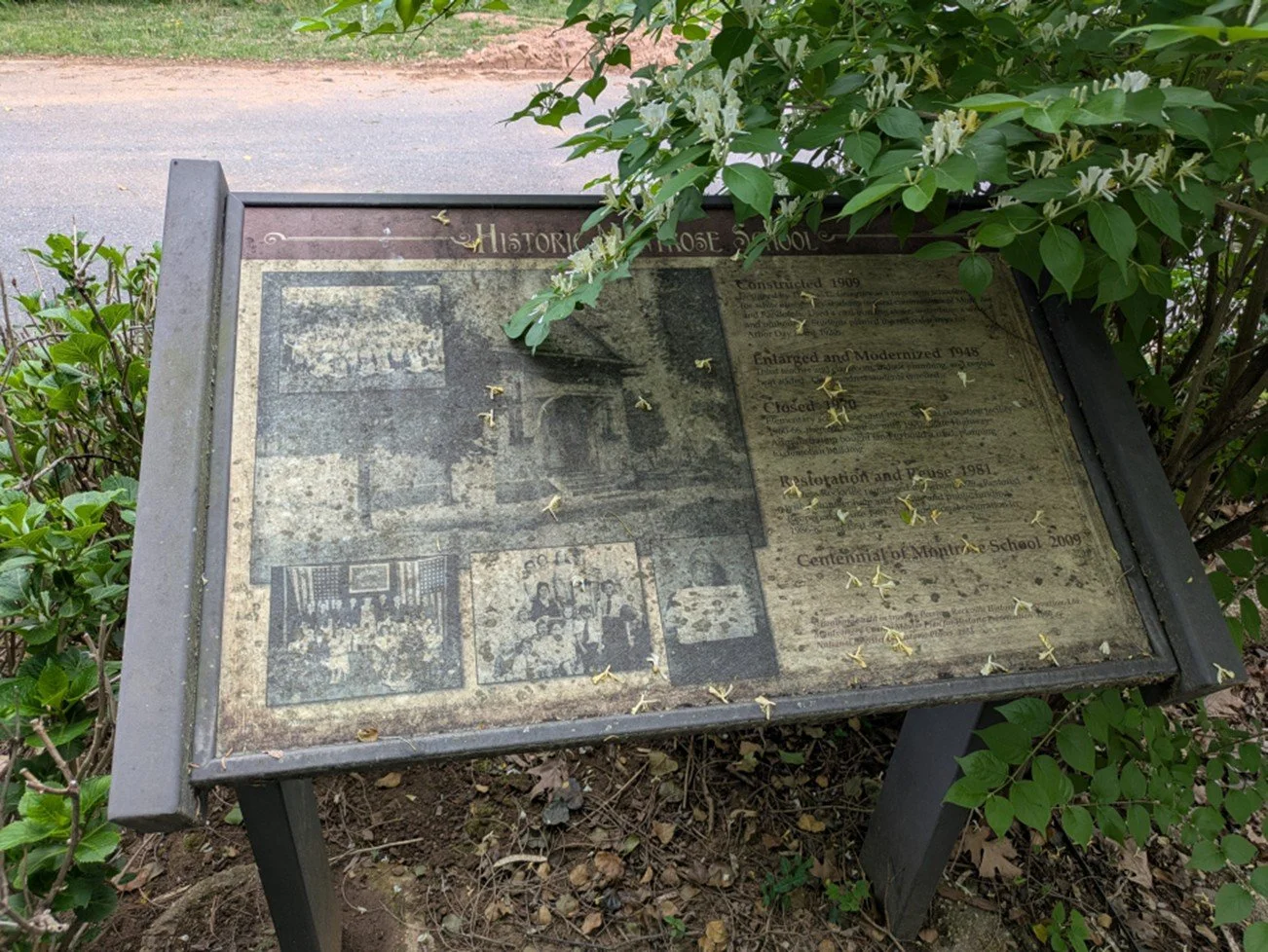
A visitor sign installed in 2009 to mark the centennial of the Montrose School is covered by overgrowth and a thick layer of dirt. (Photo: Montgomery Fix, April 2026)
In the decade or so leading up to the COVID-19 pandemic, the Montrose School was leased by a private nursery school, while all around it growth boomed. New high-rises took over the skyline around White Flint and Pike & Rose. The Montrose Parkway (now called Josiah Henson Parkway) created an efficient corridor to I-270 and Potomac.
The tenant was still operating at Montrose School in 2019, with kindergarten students reported in Maryland’s Nonpublic School Enrollment Report. It closed along with public schools at the beginning of 2020 and was never reoccupied.
In recent years, Peerless Rockville has worked to reactivate the Montrose School as a childcare center. After years of effort, in 2024, Peerless reached a significant milestone by finally acquiring the 0.89-acre immediate footprint beneath the building. What was considered a vital acquisition, however, had unexpected consequences leading to the central problem threatening the property today. The Montrose School area is a fragmented section of oddly configured plats that creates a dangerous gap in responsibility. While Peerless owns the building and its immediate footprint, the surrounding parcels on all four sides remain under SHA control, and additional nearby parcels fall under various county jurisdictions tied to long-abandoned transportation plans, including the eastern extension of Montrose Parkway. With no single entity managing the site and its surroundings, the school is lost to bureaucratic land control limbo.
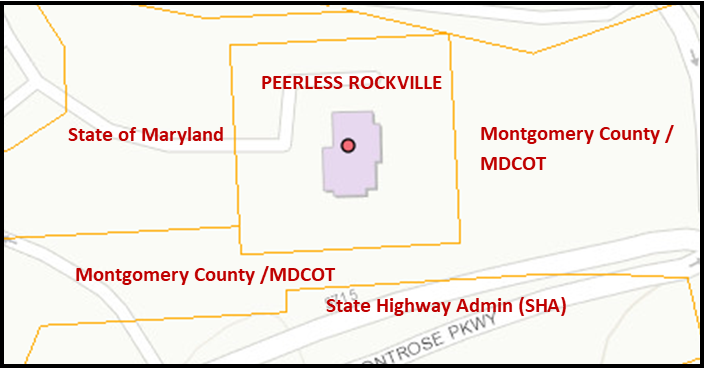
MCAtlas labels the parcels shown here as State of Maryland and State Highway Admin (SHA). The other parcels are not labelled but, according to county personnel, fall under MCDOT authority as part of the former Montrose Parkway East extension right-of-way.
Peerless Rockville says it has worked diligently to secure the structure and maintain its small section of the grounds, and that the encampments, trash accumulation, and overgrowth are located on the adjacent, government-owned parcels. A comparison of Google Street View images provides a time-lapse progression of the Montrose School from a beacon on the hill in 2012 to fully shielded from public view in 2025.
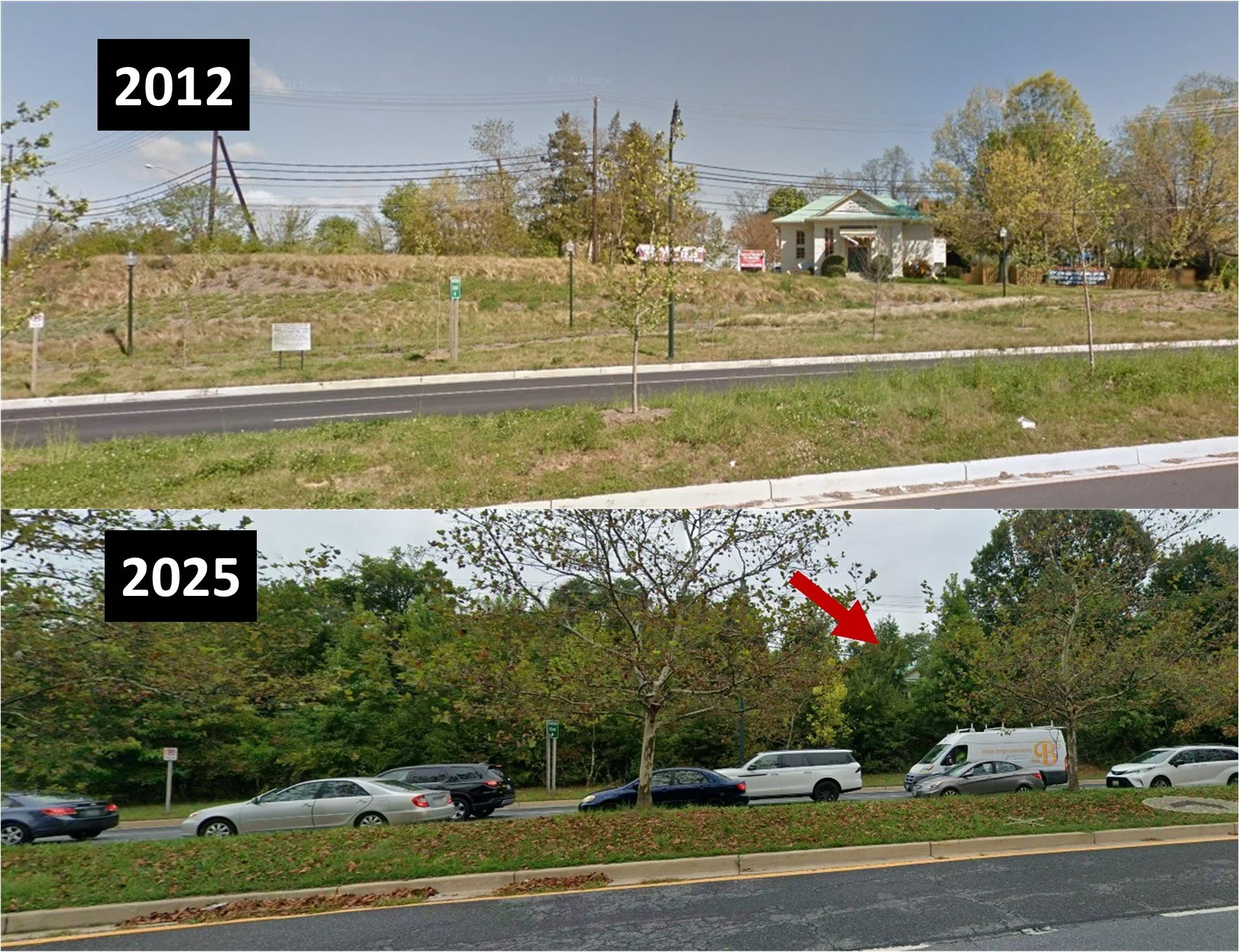
(Photos: Google Street View)
The dense growth has become an active site for temporary encampments, dumping, vagrancy, and crime. Over the past two years, Peerless has reported repeated break-ins alongside ongoing concerns about vandalism. It appears the boarded structure was very recently breached through a second-story window. For this vacant historic building, now is the critical phase where weather exposure, interior damage, fire risk, and structural compromise can spell disaster.
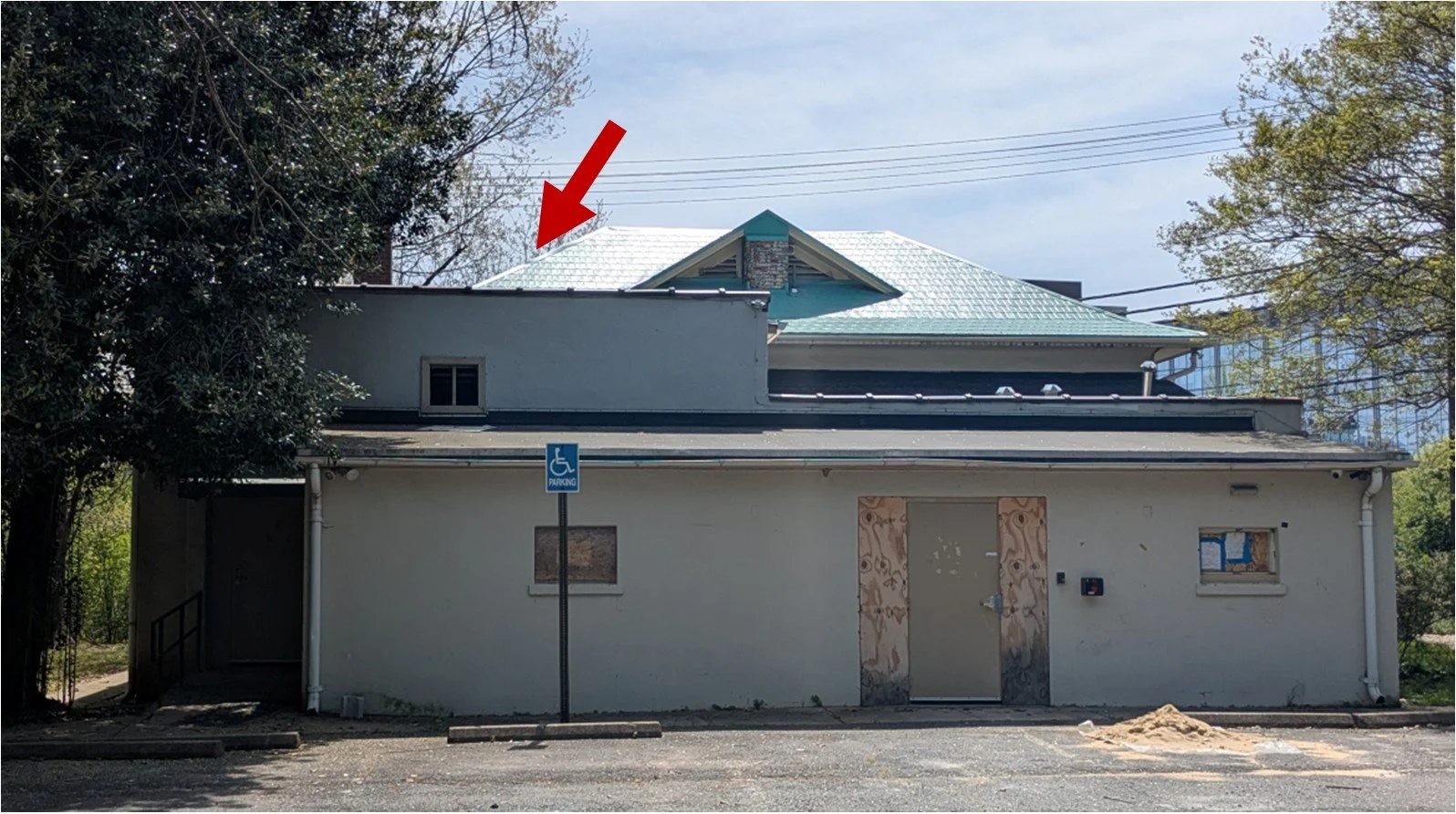
(Photo: Montgomery Fix, April 2026)
The acute issues at Montrose are part of a broader pattern of neglect, blight, homelessness, and violent crime along the Randolph Road corridor. The stretch between Rockville Pike and Parklawn Drive has experienced these challenges for nearly a generation, as recently reported in our article, “The Lawless Forests of North Bethesda.”
Peerless has engaged neighboring stakeholders and adjacent commercial property owners. There is shared concern across the area and growing frustration about the lack of aggressive vegetation clearing and routine maintenance on state- and county-owned parcels. There is also widespread acknowledgment that any response must be balanced with humane considerations for the unhoused individuals who now occupy the space.
Local government is well aware of the situation. The office of Councilmember Kate Stewart, whose district includes the area, confirmed prior involvement, coordinating with Peerless, SHA, and the Bethesda Regional Services Center on episodic vegetation trimming and trash removal. Yet, because responsibility remains divided across agencies with limited jurisdictions, maintenance has been weak, inconsistent, and incomplete.
The Montrose School is not lost. At least, not yet. Its future depends entirely on stabilizing the environment around the building before the structure itself is irreparably compromised. Historic preservation requires funding, a dedicated organization, and cooperation from government partners. At Montrose, the first two essential pieces are in place. The missing piece is the government acting in partnership. Montgomery Fix wrote to the State Highway Administration 10 days ago with questions about the property. Like Peerless, Kate Stewart, and the residents of North Bethesda, we are still waiting for answers.