The Lawless Forests of North Bethesda
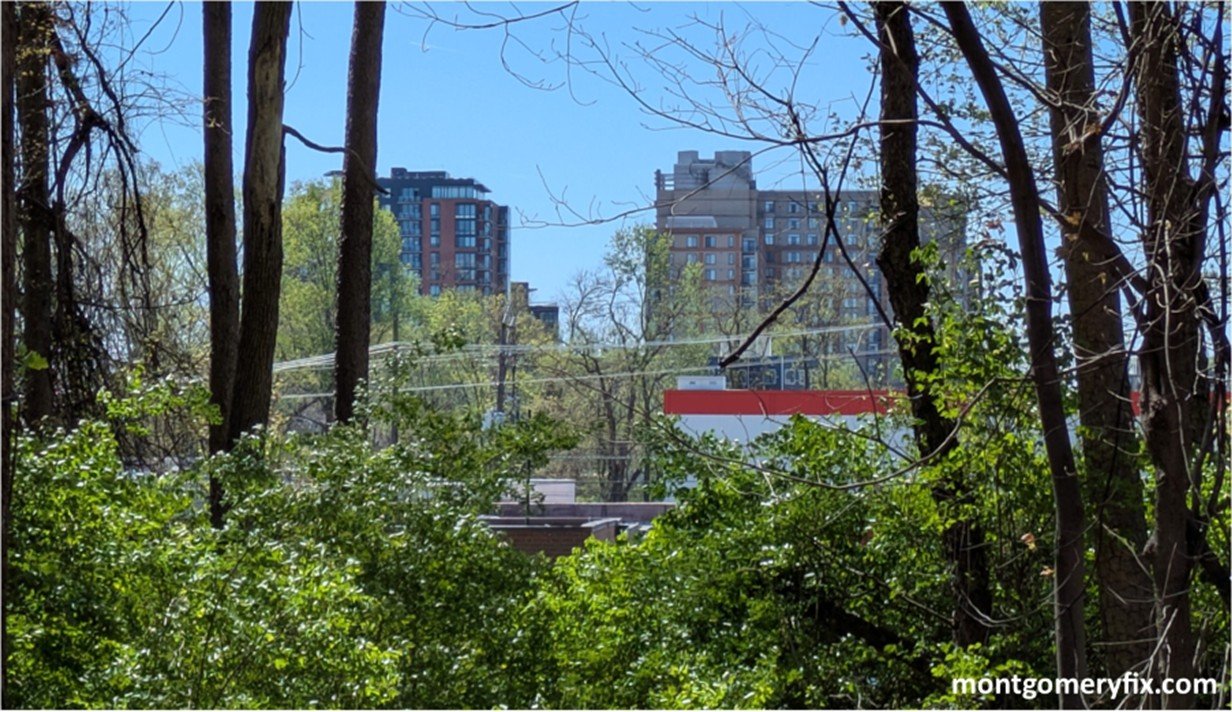
NORTH BETHESDA, Md. – Along the Rockville Pike corridor, North Bethesda has emerged as a modern hub of transit-oriented luxury. High-rise apartments with rooftop pools march north from Pike & Rose to Twinbrook Quarter, transforming the skyline with manicured glass and steel. But just a few hundred yards away, behind the aging commercial strips of Randolph Road, progress halts at a wall of tangled vines surrounding a 15-acre forest neglected for decades. The hidden, suburban wilderness is a lawless land of junked cars, fields of trash, and a history of violence that the county has failed to contain for a generation.
Since at least the late 1990s, these woods have been the site of predatory attacks and domestic violence. In October 2010, a 24-year-old woman was assaulted and nearly raped. Her attacker was charged with attempted first-degree rape and first-degree assault based on witness testimony and DNA samples. Fourteen months later, in December 2011, another man living in an encampment was arrested for an attempted rape. The assault was severe and triggered a rare multiagency crackdown. At the time, the Environmental Protection Agency and county health officials cited the site for "deplorable" and "unsafe" conditions, noting that the area was carpeted in human waste and trash. Officials attempted to clear the camp but did not force displacement. The results were short-lived. Within months, the tents and the violence returned.
In January 2016, this off-grid world claimed a life in an incident so gruesome it forced the county to briefly look behind the tree line once again. A man died in an encampment fire in the woods behind the 5400 block of Randolph Road. As flames engulfed the victim's tent, first responders struggled to reach the site at the edge of the woods and behind a cluster of tightly parked cars. The tent was allegedly set ablaze by another homeless individual following a dispute. Montgomery County police eventually ruled the death a homicide.
The 2016 encampment homicide and earlier rapes are the darkest chapters in a long history of crime and violence, but they are just a fraction of police-involved matters associated with the forests. A Montgomery Fix review of police dispatch records for areas around the urban wilderness revealed a persistent pattern of disorder. From 2017 through early 2026 in the 5400 block of Randolph Road, a commercial zone with no housing, police responded to nearly 700 incidents over nine years. More than 60 percent of those calls involved trespassing, suspicious persons, and welfare checks, with 38 incidents involving serious violence, including stabbings, robberies, and assaults on police officers.
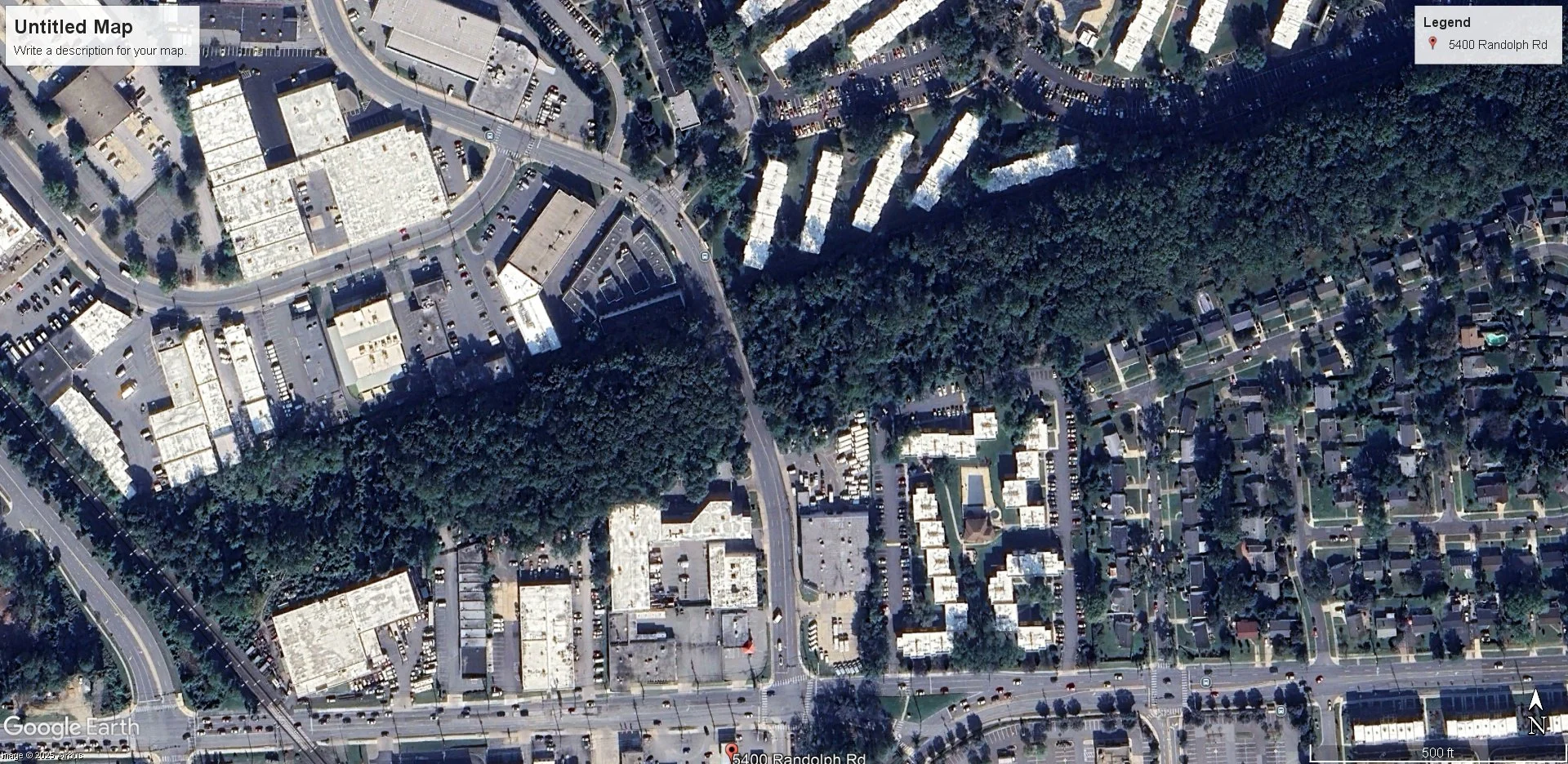
Parklawn Drive bisects the forested strip spanning the 5400 block (left side) of Randolph Road from the 5300 block
The Current State: Junk, Tents and Sludge
A decade after the fatal fire, the only changes to the North Bethesda forest are the accumulated disarray of ten more years of neglect. It is a "no-man's land" where the rules of civil society don't apply and aren't enforced. In February and March of this year, Montgomery Fix documented conditions in the area, spoke with encampment residents and local business owners, and traced the history of the property. A report, complete with plat maps and photographs, was submitted to County Executive Marc Elrich, the County Council, and the heads of several county agencies.
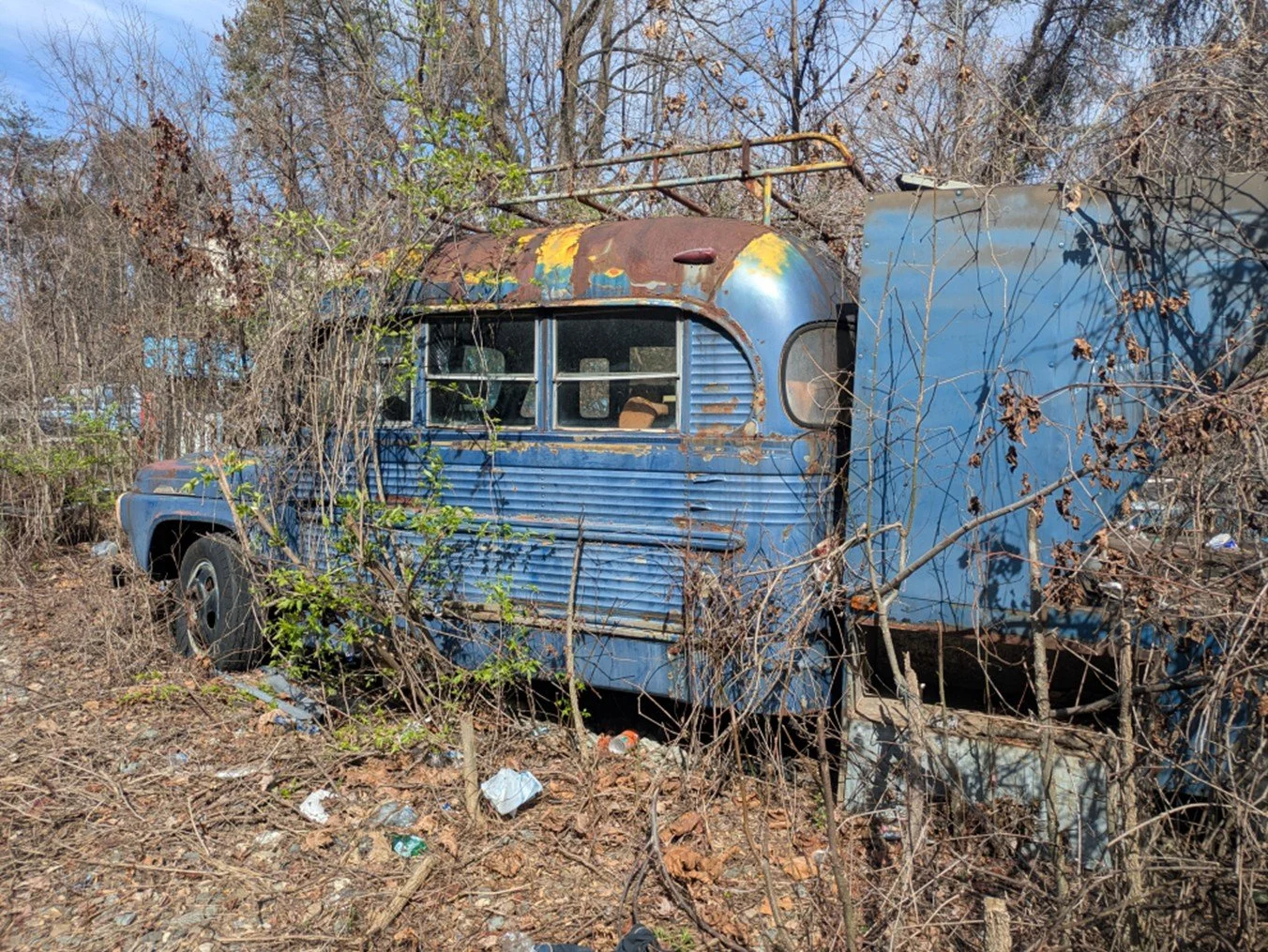
Abandoned vehicles like this late 1950s Ford short chassis school bus provide shelter to the homeless.
The wooded corridor behind the 5300 and 5400 blocks of Randolph Road contains a patchwork of temporary and permanent settlements. In the 5400 block, a few dozen junked vehicles dating back to the 1950s sit rusting under invasive vines. Several are used as shelter. Other individuals house themselves in abandoned box trucks and shipping containers. Small tents and blue tarps are tucked in the brambles. The ground is a mosaic of tens of thousands of beer bottles, garbage fields stretching into drainage ditches, old tires, and mattresses. A thick gray sludge from an illegal stone-and-masonry dump behind Wilkins Avenue is leaching into the soil. On a recent visit, residents were seen cooking over open flames on a camping grill, surrounded by bone-dry overgrowth and a mound of discarded propane tanks.
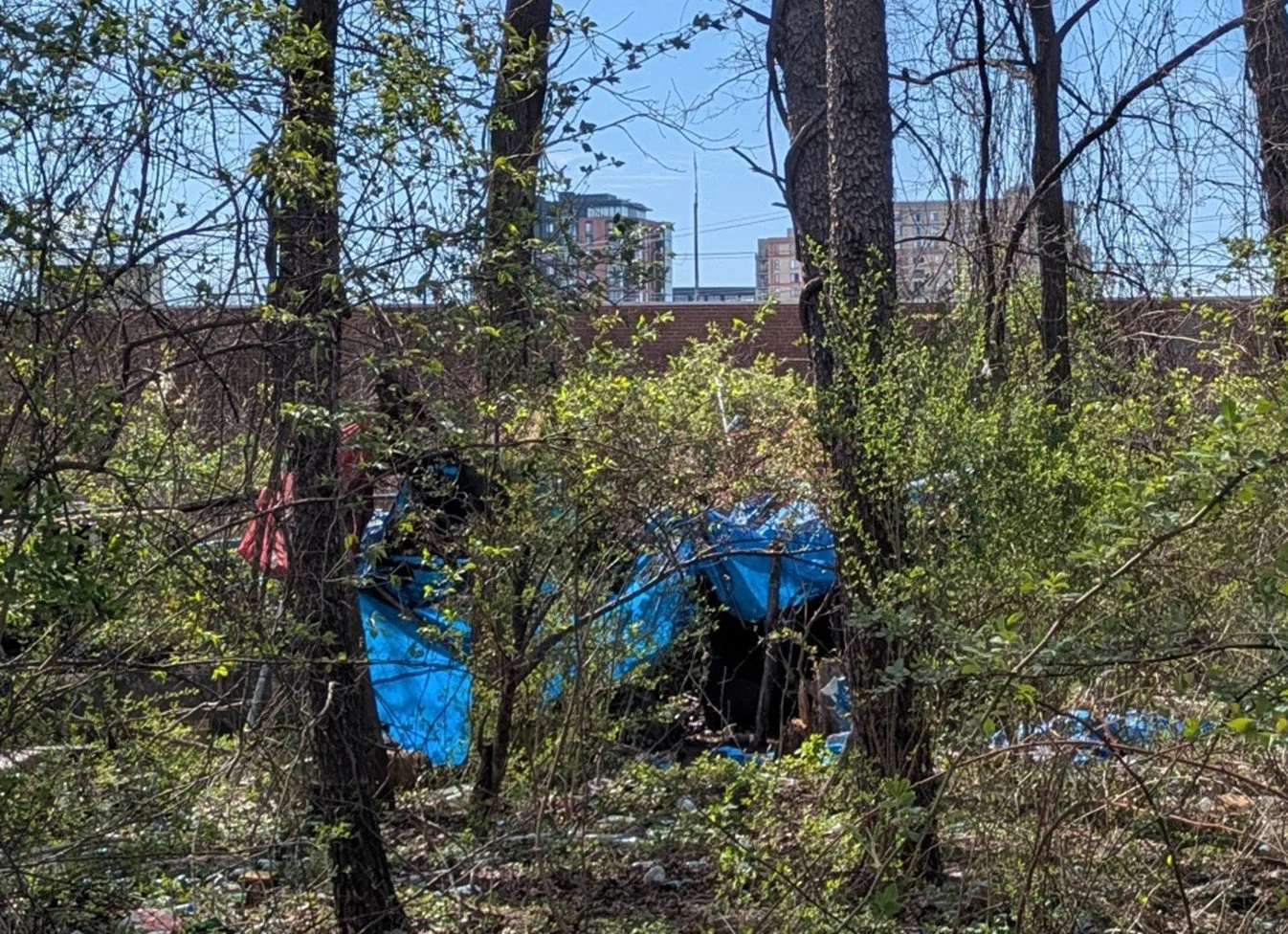
A shelter made of tarps propped up with sticks and vines sits in the shadows of the Aurora Apartments (left) and the Arrowwood Apartments (right) in recently developed sections of Nebel Street in North Bethesda.
In the stretch of forest adjacent to the 5300 block of Randolph Road, there is less industrial waste but no fewer signs of clandestine life. Clusters of trash and alcohol containers surrounding mattresses and sleeping pads dot the woods behind the U-Haul Moving and Storage and the Randolph Square Apartments. Similar conditions were documented in the 5500 block in front of Bob's Discount Furniture and Mattress Store.
Business Owners Gave Up Long Ago
Scott Milestone’s family trust has owned property in the 5400 block of Randolph Road since 1998, during which he described being a captive witness to the chaos. His land ends just behind a 37,000-square-foot commercial building, a narrow alley separating it from the lawless forest. He told us many of the cars buried under the brush behind his property predate his ownership, a claim verified through historical aerial imagery.
Milestone estimates that as many as a dozen people live in the woods at any given time, utilizing vehicles, box trucks and storage containers as housing. He spoke of witnessing multiple assaults and hearing accounts of rapes and violent crimes that never make the official police ledger. He has tried everything to bring order to the instability: handing out contractor trash bags and offering money for cleanups, providing food, and erecting barbed-wire fencing. The fences are torn down within days. “I can’t keep them out or control it,” Milestone said. “My property ends at the building. Everything else is the county’s land.”
After so many decades of neglect, some neighboring businesses have simply stopped asking the county for help. “Anytime we’ve ever called to report it, they don't do anything or the business itself ends up getting cited,” said the manager of an automotive shop in the 5400 block, who asked not to be named for fear of repercussions.
A Classic Case of Hidden Space
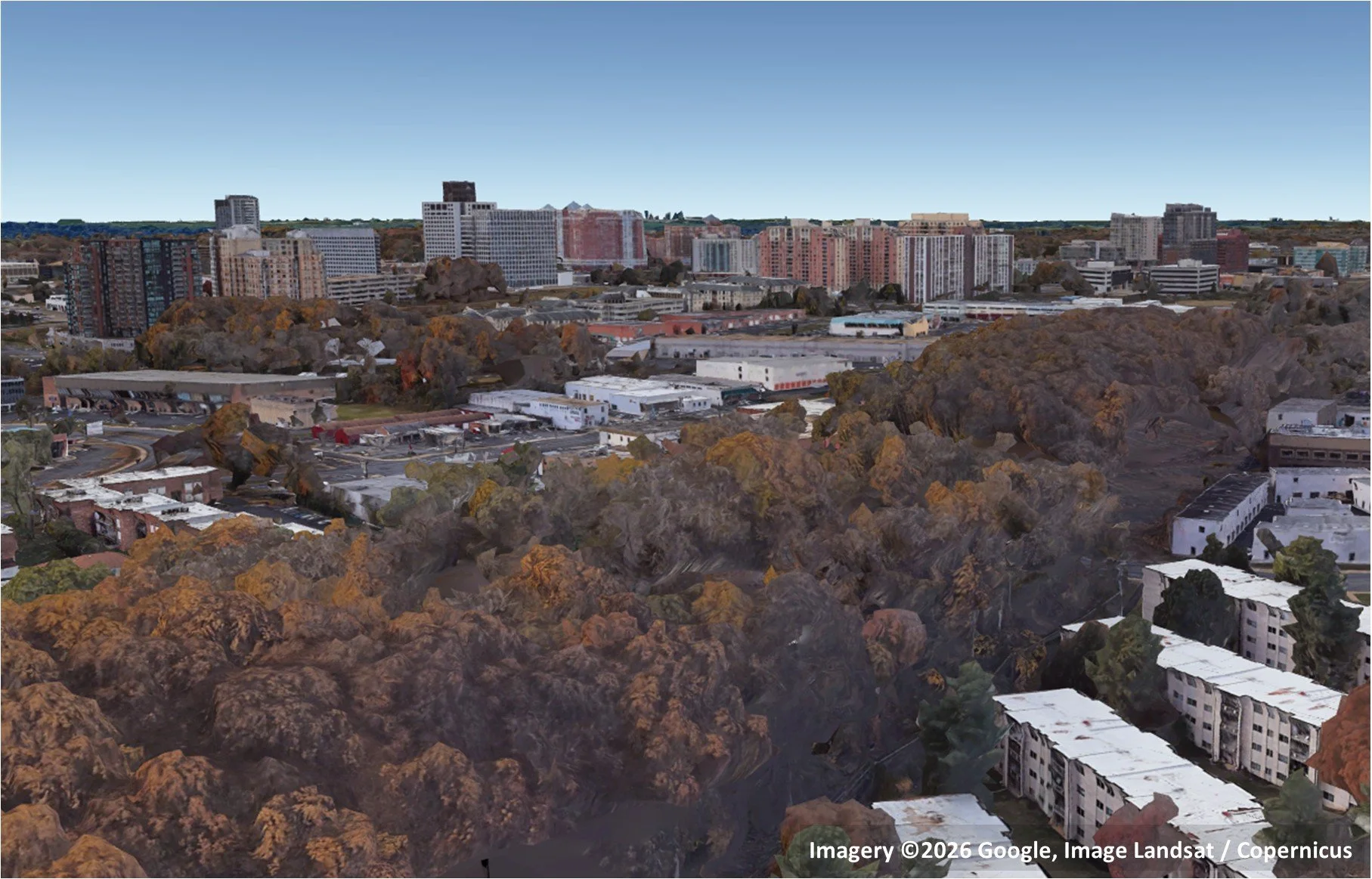
In the foreground, the “lawless” forests of North Bethesda spanning the 5300-5400 blocks of Randolph Road.
Montgomery County is full of hidden spaces where illegal dumping, camping, and drug and alcohol abuse take place out of sight. They exist along state highways, behind industrial parks, and in the woods abutting shopping centers and neighborhoods. Montgomery Fix has documented and reported 25 such spaces to Montgomery County authorities this year, all north of the 495 Beltway, from Germantown to Wheaton. The North Bethesda forest is an ideal hidden space, its purpose in limbo for decades in an inaccessible area for which responsibility is vague among state and county government agencies.
McAtlas records provide limited detail on the forested parcels. County planning and capital budget documents indicate the land was reserved as right-of-way for the eastern extension of Montrose Parkway, a project proposed in the 1992 North Bethesda Master Plan but never constructed. In 2019, County Executive Marc Elrich proposed eliminating roughly $86.7 million in funding for Montrose Parkway East, effectively halting the project in its original form. While the property remains under county control, its long-term use has been deferred, and responsibility for ongoing maintenance and oversight is not clearly defined.
When will the Lawlessness End?
In response to the Montgomery Fix report, some county agencies are mobilizing. A DHHS spokesperson confirmed that Bethesda Cares, the county's partner in homeless outreach, was already aware of the encampments and recently visited again. A DHCA official shared that his agency has begun coordination with DEP. Those efforts are likely to result in short-term gains and spotty fixes, but not the systemic change necessary to end the decades of lawlessness.
After the 2011 attempted rape, as the area was being cleared ostensibly for ‘environmental’ reasons, then Councilmember George Leventhal was quoted as saying, “I want to make sure that if we're going to disrupt the encampment we're connecting them to services. I do think it's an interesting test case for our homeless outreach efforts.” But some never left, and others quickly replaced those who did. The ‘test case’ failed. Fifteen years later, conditions are just as primed for chaos in 2026 as they were in 2011.
Reclaiming the 15-acre, three-parcel North Bethesda forest would require a massive multiagency response, including Department of Health and Human Services, Department of Environmental Protection, Department of Housing and Community Affairs, Department of Transportation, Maryland-National Capital Park and Planning Commission, and more. Actually cleaning up the space would come with a multimillion-dollar price tag. And holding onto those gains would mean regular patrols and security monitoring. Given the present budget crunch, the county's long-standing policy of not displacing encampments, the shortage of police officers, and the lack of political will to tackle the issue historically, there is no cause for optimism.
Still, the days of turmoil will come to an end eventually. Just two blocks from the forest, two major affordable housing projects are advancing on Nebel Street. The Chimes at North Bethesda is a 163-unit development coming to completion this year, and a new 154-unit project is underway. The Chimes was built over similarly untamed timberland. That scenario is the best shot for anarchy to end in the woods along Randolph Road. As the skyline of North Bethesda continues to transform, one day the treetops of the lawless forest will be replaced by rooftop swimming pools, green roofs, and sky-view restaurants overlooking a community where hidden spaces, and the blight that comes with them, no longer exist.
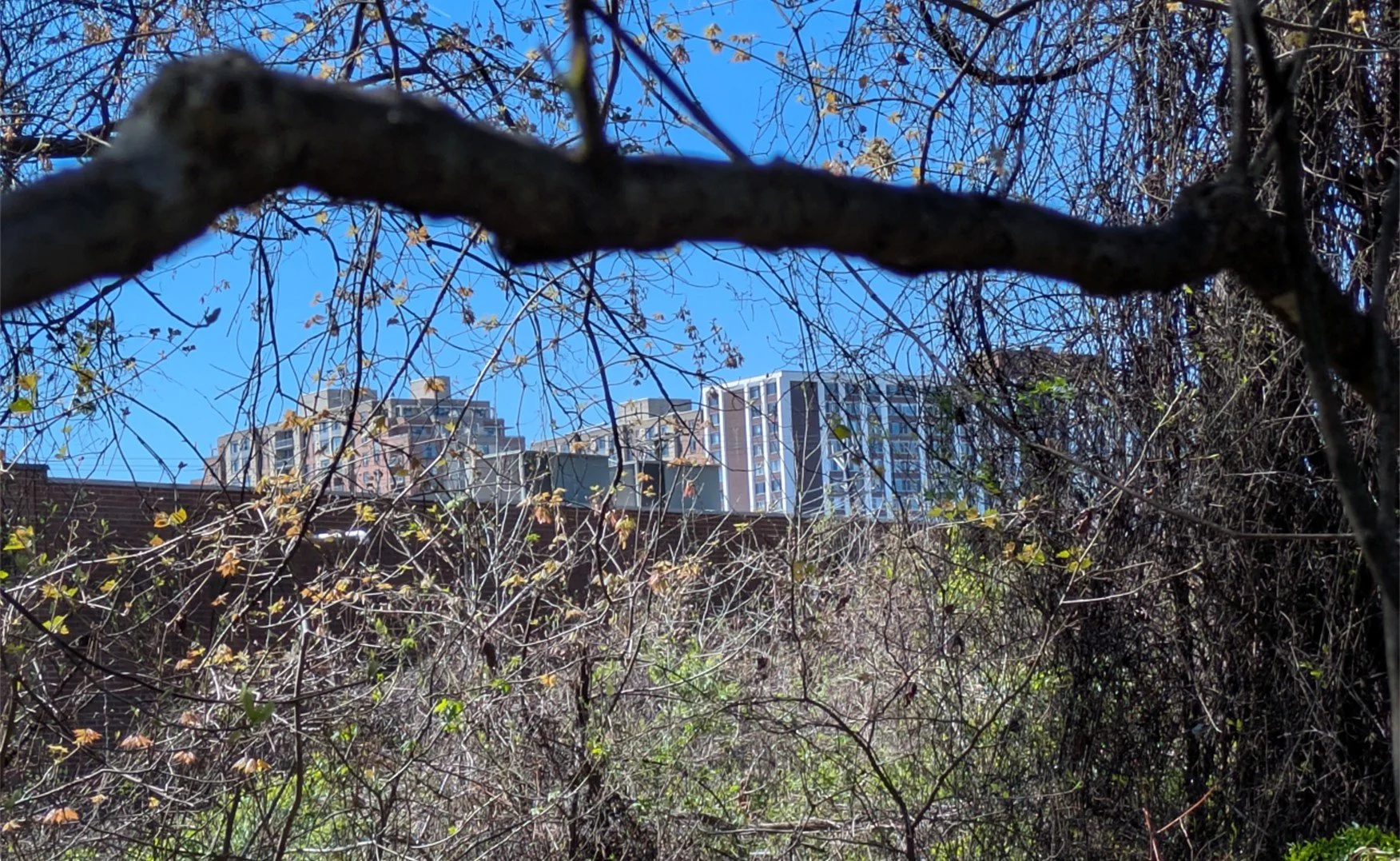
Publisher’s Note: It is our general policy not to disclose the location of homeless encampments. We make exceptions when there is immediate risk to life safety or when an area is well known to the community due to its high visibility or long history. The North Bethesda forests meet all of these criteria.