Lost Knife Road: Transit, Demolition, and Violence in Gaithersburg
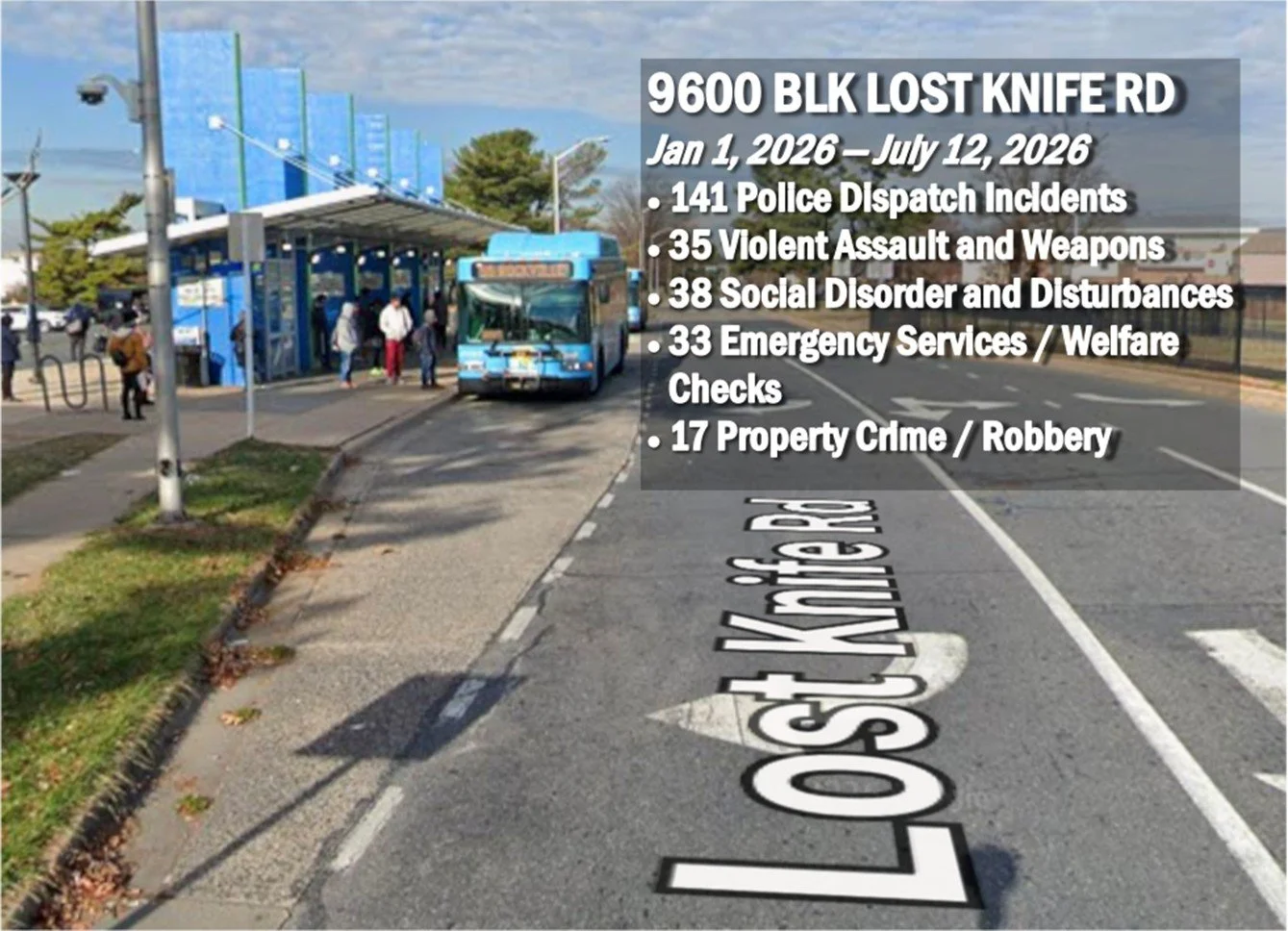
Street View of the Lake Forest Transit Center at 9600 Lost Knife Road, Gaithersburg, MD. Imagery © 2024 Google.
GAITHERSBURG, Md. — A violent 48-hour stretch on a single, highly transient block has exposed a localized public safety crisis that defies broader regional trends.
The escalation peaked on Sunday, July 12 when Montgomery County police responded to reports of an adult male loading a handgun at a bus stop outside the Montgomery Village Plaza shopping center. After clearing the crowded parking lot, officers attempted to de-escalate the situation. The confrontation turned fatal when the suspect’s actions prompted officers to open fire, killing him at the scene. A handgun was recovered, and the Maryland Attorney General’s Independent Investigations Division has since taken over the case.
This fatal shooting occurred just 26 hours after a stabbing on the exact same block. The previous evening, Saturday, July 11, local police and emergency medical personnel treated a male victim suffering from non-life-threatening lacerations before transporting him to a regional hospital. The suspect remains at large, and the motive is still under investigation.
These back-to-back incidents are the latest flashpoints on a single suburban block that stands in contrast to municipal and state safety trends. While overall crime across Maryland has steadily declined over the past two years, the 9600 block of Lost Knife Road has devolved into a hyper-concentrated violent hotspot. A deep dive into 2026 Montgomery County Police Department dispatch logs reveals how a volatile mix of transit design, adjacent commercial demolition, and urban planning failures allowed violence to fester in the shadow of an evolving commercial corridor.
9600 block of Lost Knife Road
The block is defined by a high-volume transit loop on one side and heavy retail zoning on the other. The commercial strip includes the 116,199-square-foot Montgomery Village Plaza, anchored by Patel Brothers Farmer’s Market and Dollar Tree, and the adjacent Montgomery Village Crossing, anchored by an H Mart grocery store.
Directly across the street sits the Lakeforest Transit Center, a major hub for the Ride On bus network and the future Route 355 Bus Rapid Transit (BRT) lines. This layout results in a dense daily convergence of shoppers, transit commuters, and local youth into a single corridor. The constant friction of foot traffic, combined with wide-open parking lots, creates a highly transient environment that presents severe policing challenges.
By the Numbers: 193 Days of Disorder
An analysis of MCPD dispatch logs from January 2 through July 12, 2026, reveals staggering police activity concentrated along the 9600 block’s 1,000-foot-long stretch. Over this 193-day period, officers were dispatched to the block 141 times. The calls break down into a persistent mix of violence, property crime, and social breakdown:
Violent Assaults and Weapons Offenses (35 calls): Physical violence is highly concentrated near the bus stop and shopping plazas. Notable incidents include a March 26 stabbing, an April 9 encounter that resulted in a charge of assault and battery on a police officer, and a May 20 daytime beating.
Social Disorder and Public Disturbance (38 calls): The most frequent source of friction stems from chronic loitering, open-air drinking, and commercial trespassing.
Traffic Collisions and Pedestrian Accidents (18 calls): Heavy congestion has led to multiple commuters being struck by vehicles, hit-and-runs within the transit loops, and wrecks on adjacent arterials.
Emergency Services and Welfare Checks (33 calls): Police are frequently leveraged as default responders, handling 15 psychiatric crises or family disputes alongside 18 general emergency and fire rescue assists.
Property Crime and Robbery (17 calls): This includes 11 counts of retail shoplifting, pickpocketing, and vehicle thefts, alongside 6 armed or strong-arm robberies targeting commuters, including a daytime knife robbery at a local business on June 29.
The data underscores that this is a highly localized issue: 121 of the dispatches occurred directly on the 9600 block of Lost Knife Road and the remaining 20 were clustered tightly at the immediate intersections of Odendhal Avenue and Contour Road.
Statewide, preliminary data from the Governor’s Office of Crime Prevention and Policy indicates Maryland is on pace for historic reductions, including a projected 25 percent drop in homicides. Yet, Lost Knife Road remains mired in persistent violent incidents, in large part due to the specific environmental and structural flaws anchoring crime to this transit corridor.
Perfect Storm: Urban Vacuum and Design Flaws
The safety crisis on the block is driven by a combination of architectural deficiencies and delayed infrastructure updates.
Throughout 2026, the adjacent 1 million-square-foot former Lakeforest Mall has been undergoing active demolition to make way for a mixed-use redevelopment. While the long-term project is promising, the current demolition phase has created a temporary urban vacuum. With large portions of the property boarded up and fenced off, the street has lost its natural "eyes on the street" from retailers and shoppers. This lack of active guardianship, coupled with the concentration of all pedestrian activity and social friction onto the Lost Knife Road side of the area, compounds law enforcement challenges.
Directly adjacent to the retail plazas sits the Cider Mill Apartments, a massive garden-style complex featuring 861 units, 345 of which are income-restricted affordable housing. An open-access layout has courtyards and walkways that cut directly into transit pathways. This design allows illicit activity to spill over easily into residential spaces. Fleeing suspects frequently utilize the complex for cover, as seen during a shootout on March 24, 2026, when a suspect fled the shopping center and fired at officers from within a Cider Mill courtyard.
From a Crime Prevention Through Environmental Design (CPTED) perspective, the block is a failure. The alignment of bus shelters and aging commercial facades creates severe visual blind spots, cutting off natural surveillance between Montgomery Village Plaza store clerks, shoppers, and transit riders. Furthermore, a lack of clear territorial boundaries and poor nighttime lighting facilitate street-level offenses under the cover of darkness.
Transportation officials acknowledge the issue. Montgomery County Transportation Director Chris Conklin noted that the transit hub "doesn't work where it is now," citing its geographic isolation from Maryland Route 355. While the county has finalized a deal to relocate the Lakeforest Transit Center to Russell Avenue and integrate it into the upcoming Bus Rapid Transit network, the new facility will not open until late 2027 or 2028. This delay leaves a flawed, high-volume public space operational during the most disruptive years of the neighboring mall demolition.
The Fix: Targeted Interventions and Rapid Redevelopment
Fixing the corridor requires structural updates rather than temporary police surges. While targeted patrols are deployed after major incidents, long-term safety hinges on reshaping the physical space.
The upcoming relocation of the transit center will eventually divert heavy foot traffic away from the block, replacing the current layout with a modern, open design featuring improved sightlines and integrated security. In the interim, the Maryland State Highway Administration is moving forward with pedestrian safety upgrades along Maryland Route 124. To slow traffic and improve visibility, the state plans to eliminate channelized right-turn lanes, reduce curb radii, install crossing islands, and upgrade street lighting.
Concurrently, the Housing Opportunities Commission is upgrading security infrastructure within the Cider Mill community by installing advanced security cameras, improving courtyard lighting, and increasing private security patrols to better secure residential boundaries.
Ultimately, the corridor’s future is tied to the broader reinvention of the Lakeforest Mall site into a walkable district featuring 1,600 residential units. However, during this multi-year construction transition, municipal leaders must ensure the block does not remain a forgotten transition zone. Without immediate investments in lighting, physical security, and community support, the 9600 block of Lost Knife Road will continue to serve as a stark reminder of how infrastructure gaps can compromise a community.
# # #
Correction: this article was updated to include current tenants of the Montgomery Village Plaza shopping center.