Montgomery County on Pace to Set 20-Year Traffic Fatality Record
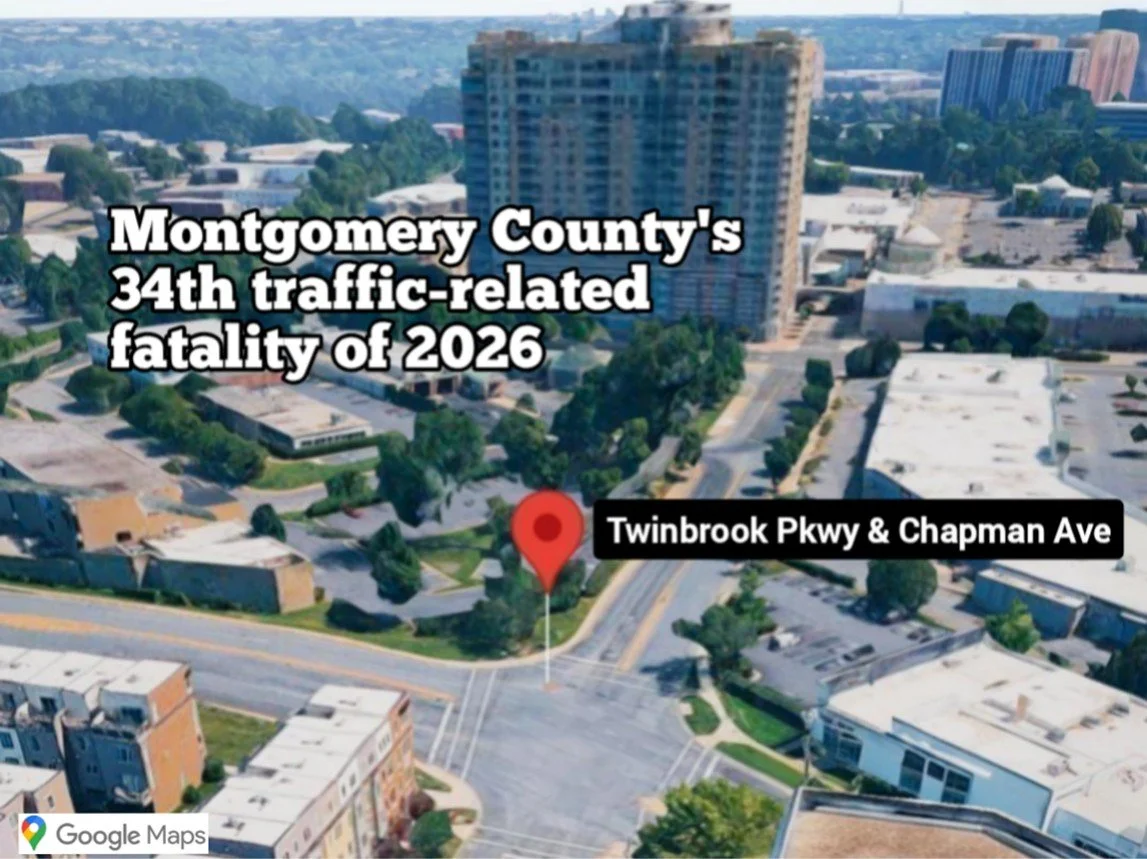
(Photo: Google Maps 3D, with manual text overlay)
Last week we published Why Vision Zero Isn’t Working, a deep dive into why Montgomery County’s Vision Zero initiative is failing to deliver on its promise to eliminate severe and fatal traffic accidents. This morning’s news of another tragic death should serve as an alarm: less than two-thirds of the way through 2026, Montgomery County is on pace to set a 20-year record for annual traffic fatalities.
Our prediction is a straightforward mathematical projection based on state and county data, police logs, and local emergency reports. Over the four-year span from 2022 through 2025, traffic deaths in the county averaged 39 per year, a significant increase from the 33 fatalities recorded in 2016 when Vision Zero was first adopted, but still far lower than the 20-year high of 58 fatalities in 2006. Those numbers come from Montgomery County's Vision Zero reports. State figures may be slightly higher.
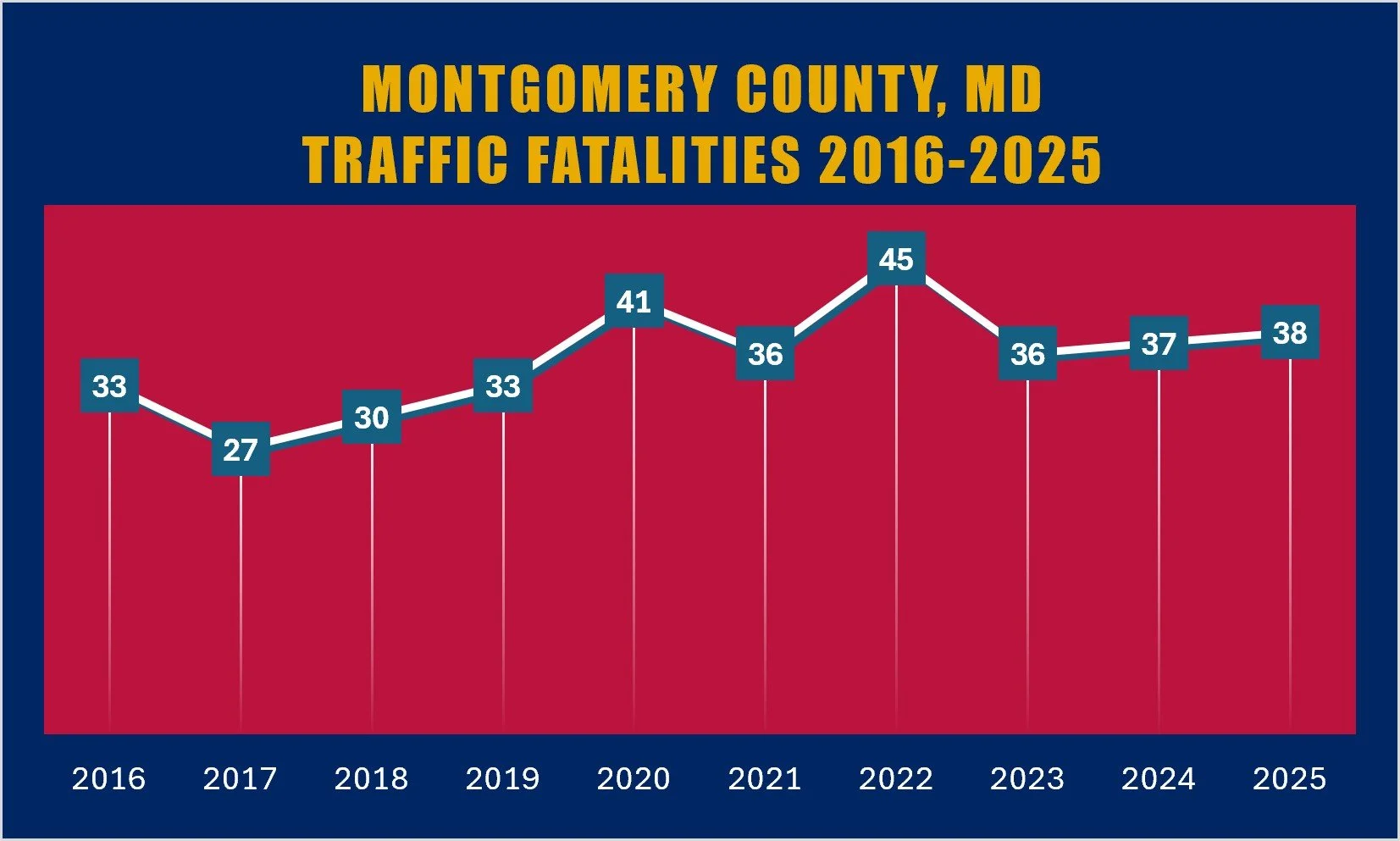
As of August 18, 2026, Montgomery County has already seen at least 34 traffic fatalities. At the current trajectory of roughly 4.5 deaths per month, Montgomery County would reach 54 traffic deaths by December 31. However, Montgomery County historically sees its highest number of fatal crashes in late summer and fall, with October consistently the deadliest month. If that historical seasonal pattern holds in 2026, it is possible Montgomery County will meet or exceed the 2006 high of 58 traffic-related deaths by December 31.
A Devastating 24 Days
A relentless series of tragic collisions spanning every corner of the county has left behind devastated families and heartbroken communities this summer. In the past 24 days, at least five people have lost their lives on Montgomery County roads:
Rockville (August 17): On Monday evening, a mother and her young child were struck by a driver at the intersection of Chapman Avenue and Twinbrook Parkway. The vehicle came to rest on a roadside embankment. Both were transported to hospitals, where the mother succumbed to her injuries while her child survived with non-life-threatening injuries.
Damascus (August 8): A head-on collision in the 24000 block of Ridge Road (MD 27) involving a Ford Transit van and a Chrysler Pacifica killed 67-year-old Harold Christopher Christner of Frederick and sent five others to the hospital.
Germantown (August 4): Shortly before 5:30 a.m., a stolen Kia Optima driven by a 13-year-old boy carrying six other juvenile passengers entered the intersection of Clopper Road and Great Seneca Highway at high speed, slamming into a Toyota Matrix. The driver of the Toyota, 58-year-old father of five William Vance Payne II, was killed instantly on his way to work.
Four Corners (July 30): A Chevrolet Silverado traveling along University Boulevard hit a guardrail, curb, two trees, and a utility pole before overturning onto stopped vehicles at Colesville Road, killing the driver and critically injuring a passenger.
Silver Spring (July 25): Driver John William Stacey was killed in a single-vehicle crash when his vehicle struck a median on New Hampshire Avenue and then hit a tree.
Why aren't county officials sounding the alarm louder? When County Executive Marc Elrich spoke on roadway safety on July 25, he cited 26 fatal traffic crashes, a figure that is not directly comparable to the state’s count of individual deaths. Data from the Maryland Highway Safety Office (MHSO) showed that Montgomery County had already reached 28 or 29 individual deaths by July 25. In his remarks, Elrich recognized that the fatalities are high and show a lot more needs to be done, and then he proceeded to tout the county’s work toward achieving its Vision Zero goal through reduced speed limits and automated traffic enforcement. As we explored in depth last week, despite those efforts, the numbers just keep creeping up.

On August 10, 2026, Elrich was quoted extensively in a county press release about new bicycle infrastructure across the county. He didn’t mention any of the current fatality statistics, nor the fact that despite expanding its network to 112 miles of bike lanes and bike-friendly road shoulders, the post-pandemic period has seen more nonmotorist deaths than the pre-pandemic Vision Zero years.
While the county highlights incremental adjustments like traffic-calming islands and speed bumps that have had a modest impact in a few high-incidence areas, high-speed suburban arterials like Georgia Avenue, Veirs Mill Road, Rockville Pike, and Ridge Road remain fundamentally difficult to reconcile with Vision Zero's goal of eliminating traffic deaths, and this year’s numbers prove it. 2026 is likely to break the 20-year record for local traffic fatalities, solidifying Vision Zero’s legacy in Montgomery County as a tragically flawed policy that never came close to achieving its objective.