Vision Zero Isn’t Working
In February 2016, Montgomery County became one of the first local governments in the United States to adopt “Vision Zero,” an ambitious plan to eliminate traffic fatalities and severe injuries on local roads by 2030. The philosophy was straightforward: traffic deaths should not be accepted as the inevitable cost of modern life, and roads should be designed so that human error does not end in a funeral.
A decade later, it is time to face reality. Vision Zero isn’t working. Montgomery County has made measurable progress in some areas, particularly on its highest-risk roads, but it remains nowhere near its stated goal of zero deaths and serious injuries. The county’s own independent assessment has identified weaknesses in coordination, enforcement, project evaluation, and implementation. The county has not done enough, quickly enough, to make Vision Zero remotely credible.
The annual fatality counts tell the story. County Vision Zero reports count people fatally injured, rather than simply fatal crashes. The numbers don’t lie:
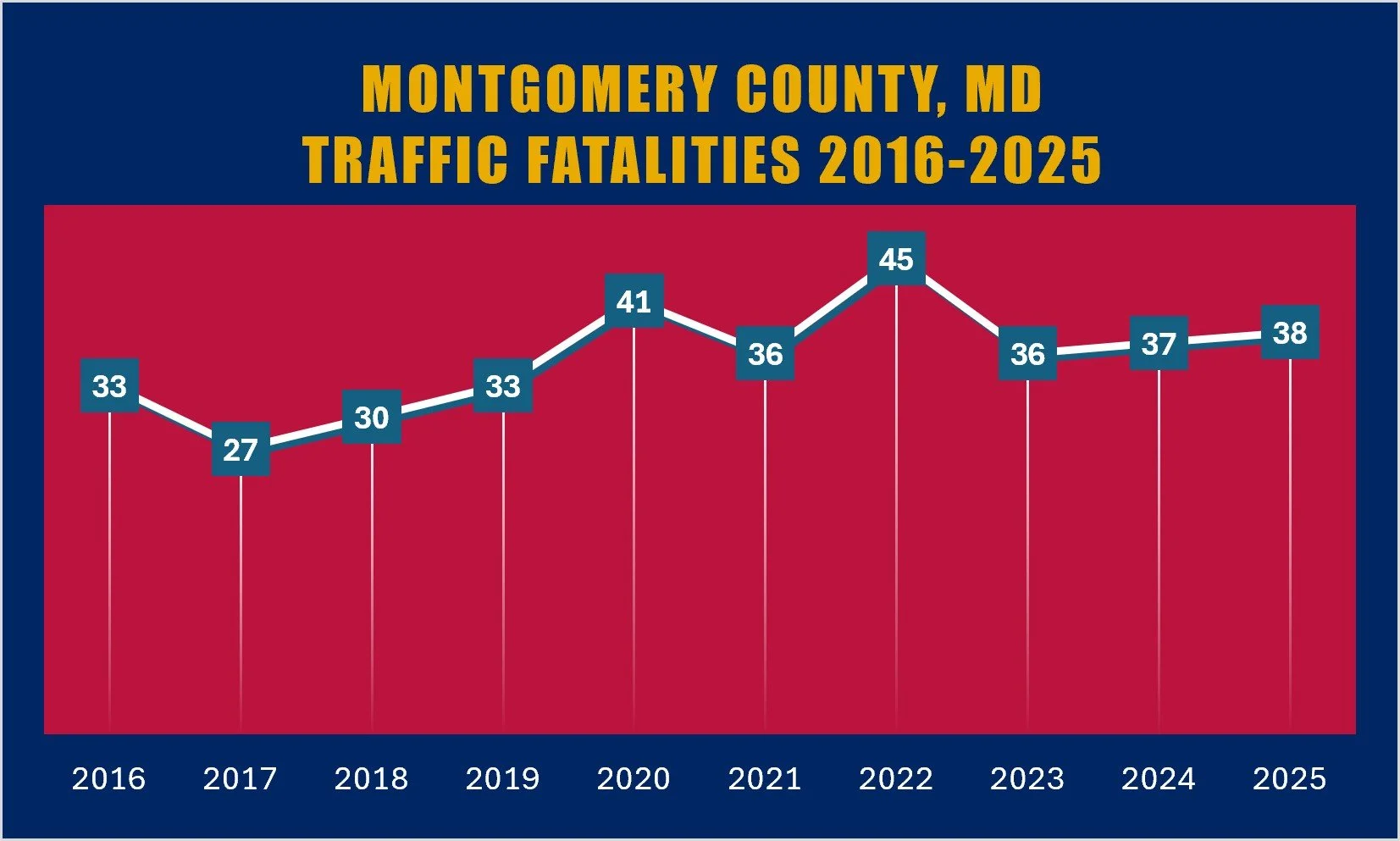
The 2022 total was 36.4 percent higher than 2016. More importantly, the county has not returned to the roughly 33-fatality annual level that characterized 2016–2019. Fatalities alone do not measure roadway safety, and year-to-year comparisons can be distorted by changes in traffic volume and travel behavior. But after 10 years of Vision Zero, 38 people killed in 2025 is plainly inconsistent with a program that is supposed to reach zero by 2030.
The pedestrian and bicycle numbers are especially troubling. From 2016 through 2019, the county recorded 52 pedestrian and cyclist fatalities, an average of 13 per year. In 2022, there were 17 pedestrian and cyclist fatalities; in 2025, there were 18. The post-pandemic period has seen substantially more non-motorist deaths than the pre-pandemic Vision Zero years.
The Problem with Vision Zero
Several factors help explain why the county has not made faster progress. One is the difficulty of changing the behavior of drivers on suburban roads that were designed primarily to move motor vehicles efficiently. Montgomery County has a sprawling network of suburban boulevards engineered decades ago with wide lanes and long sightlines. Drivers tend to select speeds based partly on the physical environment, so simply changing a speed-limit sign does not necessarily produce the desired operating speed.
The county has done more than change signs: its Vision Zero program includes roadway redesign, traffic calming, quick-build projects, automated enforcement, targeted police enforcement, signal changes, pedestrian head starts, and protected bicycle lanes. But the continuing fatality numbers raise a legitimate question about whether engineering and posted-speed changes are being deployed effectively and aggressively enough on the roads where dangerous speeds persist.
Jurisdiction is another obstacle. County Vision Zero materials have found that more than half of serious and fatal collisions occur on state-maintained roads. In other words, Montgomery County cannot unilaterally redesign many of the roads where its most serious crashes occur. That division of responsibility has complicated project design, funding, permitting, and implementation.
At locations where pedestrians have been killed, residents can wait years for physical changes. Veirs Mill Road in Wheaton and Bel Pre Road in Aspen Hill illustrate the frustration. Ghost bikes and roadside memorials accumulate because one death is never enough to spark change. Change happens after multiple people die or suffer serious injury. What happened in Rockville just last year after 11-year-old Summer Lim was hit and killed by a school bus at the corner of Bauer Drive and Russett Road is typical. Another child was seriously injured at the same spot just months before, sparking an outcry from the community for change. A county resident for 50 years whose home is at the intersection told WUSA9 that their family keeps emergency supplies in the front closet because of the number of people who have been hurt at that corner. A half-century of mangled cars and injured pedestrians wasn’t enough. A child had to die before the Department of Transportation finally installed a new three-way stop at the intersection.
The county’s 2023 Pedestrian Master Plan illustrates the challenge of prioritization. It established four broad goals, one of which is pedestrian safety, parallel with others concerning walking rates, connectivity, and equity. It contains a large number of recommendations and key actions. The problem is not that shade trees or other pedestrian amenities are worthless; it is that limited resources require clear prioritization of projects that prevent deaths and serious injuries.
A telling example occurred near the Purple Line station at Takoma-Langley Crossroads. Transportation officials proposed sidewalk construction on residential streets to improve pedestrian access to the station. After substantial neighborhood opposition and funding concerns, the county canceled the project. The episode demonstrates how quickly a safety and connectivity project can collide with neighborhood politics, cost and competing priorities.
Enforcement is a big component missing from the Vision Zero equation. Montgomery County Police have faced staffing and resource constraints that limit proactive traffic enforcement. At the same time, the county has expanded automated enforcement. MCPD’s 2025 report listed 140 speed cameras and 76 red-light cameras.
Automated enforcement has a legitimate safety role, and the county’s independent Vision Zero assessment concluded that the programs should continue. But automated cameras often just deter speeding directly in front of the camera lens and are a poor substitute for active traffic enforcement. A driver who receives a $40 fine in the mail three weeks after driving 38 in a 25-mph zone learns where to slow down, not to slow down all the time. Tickets tied to drivers instead of registered vehicle owners create real deterrents—points on a license that jeopardize the privilege of driving and higher insurance premiums—and are more likely to result in behavioral change.
Progress Exists, but Don't Believe the Spin
County officials’ counterargument to “Vision Zero isn’t working” is that the county is producing measurable improvements in places where the county has concentrated its resources. The High Injury Network represents about 3 percent of the county’s non-interstate road miles but accounts for roughly 41 percent of serious and fatal crashes. In FY2025, serious and fatal crashes on that network were 29 percent below the 2015-2019 pre-pandemic baseline. Countywide, the decline was smaller but still real: serious and fatal crashes in FY2025 were about 5 percent below the same pre-pandemic baseline. Those figures show targeted interventions can work. But that still leaves us far away from reaching zero.
Montgomery County’s Vision Zero work now encompasses sidewalk-building, safety corridors, signal changes, automated enforcement, police enforcement, education, impaired-driving prevention and bikeway projects. The question is whether the resources are being directed toward the interventions most likely to prevent the next death. The county may not know. Its independent Vision Zero assessment, completed in 2025 by outside experts, recommended stronger before-and-after evaluation of safety projects. The county needs to know which interventions actually reduce dangerous behavior and crashes. Likewise, the county needs to know which interventions have unintended consequences, like the ridiculous “speed pillows” installed on MD 198 in Burtonsville last year. The unusually tall, sharp-angled rubber blocks were jarring, causing dangerous sudden braking and damaged suspensions. Rather than reacting quickly to painfully obvious flaws and resident complaints, highway officials said they would study the matter. A few months later, the study was cut short when a plow clearing the infamous 2026 snowcrete storm took out one of the blocks. MDOT removed the other one shortly afterward.
Change the Strategy
Vision Zero was implemented with success in Europe and imported to the U.S. during the Obama administration. The EU added billions of euros and serious coordination to national efforts, making the program continent-wide in 2011. Road deaths have declined 25 percent over the past 15 years, even as car use has grown. More than 900 European cities have made it a year or more with zero traffic fatalities.
In contrast, Vision Zero isn’t working in Montgomery County or virtually anywhere else in the United States. In 2025, The Washington Post examined 27 cities that had been experiencing at least five pedestrian deaths a year before embracing Vision Zero. The analysis found that nearly every one of those cities now has a pedestrian death rate as high as, or higher than, it did when the program was adopted. “Vision Zero’s failures in more than two dozen cities fit a predictable pattern,” the Post reported. “Motorists are hostile to measures that slow traffic and favor pedestrians. Local leaders give token or tepid support. Spending on pedestrian-friendly improvements is not prioritized. The U.S. government, meanwhile, never backed up its pledge with federal action or significant funds.”
That last part is key. The Obama administration’s Department of Transportation announced Vision Zero as a national goal on October 5, 2016. A month later, Donald J. Trump won the presidential election, leaving the federal strategy practically dead on arrival. Four years later, under Joe Biden, federal funds finally began flowing through the $5 billion Safe Streets and Roads for All program and the $15 billion Highway Safety Improvement Program. Four years after that brought another political 180, with federal policy shifting back to prioritizing speed and road capacity over safety.
Time is running out for Montgomery County. Four years remain before the 2030 deadline. The Vision Zero goal absolutely should not be abandoned, but the strategy must become more candid about what has and has not worked, with new aspirational goals that can be celebrated upon actually reaching them.
The county should continue concentrating engineering resources on locations where fatalities and serious injuries repeatedly occur, coupled with more visible and targeted police officer traffic enforcement for speeding, reckless driving, and other behaviors strongly associated with fatal crashes.
The county should also pressure state leaders to explore systemic driver education reforms, such as adding refresher courses or safety assessments to Maryland’s driver’s license renewal cycle, potentially paired with insurance discounts. While this would require state legislation and regulatory action, the idea is worth considering. In the interim, Montgomery County prosecutors and District Court judges could make driver re-education a standard condition of probation or plea agreements for severe and repeat traffic offenders, moving away from relying strictly on ad hoc judicial discretion.
We will not reach zero, and the county needs to stop treating the goal itself as evidence of success. Four years before the deadline, the appropriate benchmark is whether deaths and serious injuries are falling fast enough to make zero remotely plausible. The numbers don’t lie.
Blink and it will be 2030. Montgomery County should stop congratulating itself on incremental progress when zero remains the official goal. Getting decisively below the roughly 33 deaths recorded in the first four years of Vision Zero should be the new 2030 target.
# # #
Editorial note on data: Fatality figures refer to people killed in traffic crashes, not the number of fatal crashes. County and state reporting systems can differ in methodology and timing; the county’s Vision Zero reports are therefore the primary source for the annual series used here. Comparisons involving the High Injury Network use the county’s published 2015–2019 pre-pandemic baseline.