Montgomery County’s East Gude Shelter Fiasco
As part of our Hidden Spaces series about homelessness in Montgomery County, we chronicled an encampment in the woods just off East Gude Drive in Rockville for five months, recording its occupation, eventual abandonment, and cleanup. Those videos were viewed over 150,000 times, prompting more than 1,000 comments. One comment was repeated dozens of times: “Why doesn’t the person go to the Gude Drive homeless shelter?”
There isn’t one. It was closed in 2019.
For nearly three decades, Montgomery County housed its most vulnerable residents at 600 East Gude Drive in Rockville, on top of 120 acres of decomposing municipal waste. County leadership hailed it as a successful public-private partnership. In fact, it was an appalling failure of municipal planning, environmental management, risk assessment, and fiscal stewardship that prioritized cheap public land over basic human safety and dignity. The saga ended with an emergency evacuation driven by low-frequency ground vibrations and explosion risks. The meltdown left the county scrambling to replace lost shelter beds, with the whole fiasco costing more than $50 million.
This is the story of the East Gude Drive human services complex.
Sleeping on a Decaying Dump
From 1964 to 1982, Montgomery County operated the Gude Landfill as its primary municipal solid waste disposal site. Constructed before the enactment of modern environmental protections under the Resource Conservation and Recovery Act (RCRA) and Maryland Department of the Environment (MDE) frameworks, the 120-acre dump was built without an engineered bottom liner, synthetic cap, or leachate collection system. Decaying organic matter buried within the site continuously generated landfill gas (LFG). The mixture consists of 40% to 50% methane by volume, with internal peaks at Gude reaching up to 70%.
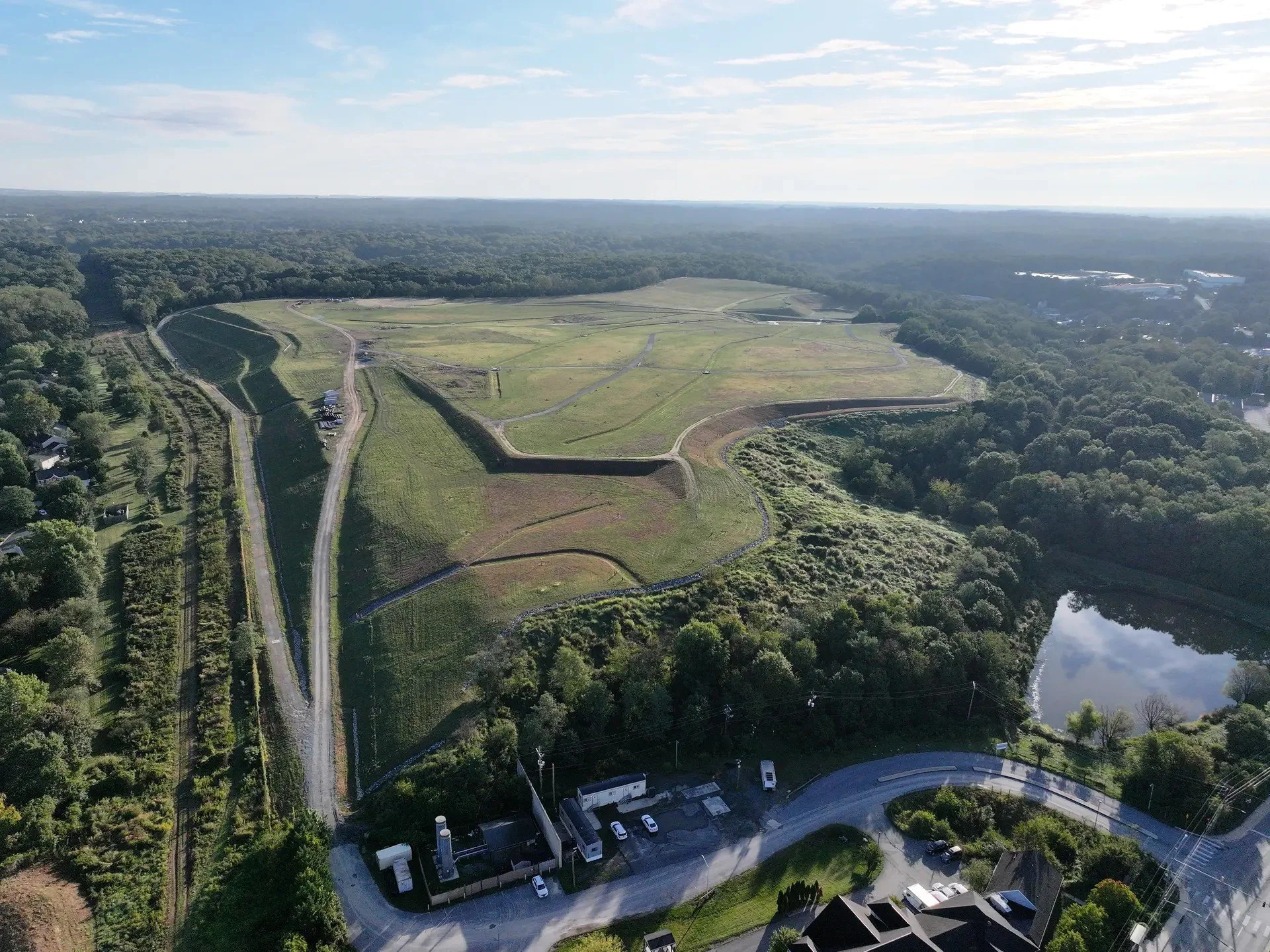
Aerial view of the Gude Landfill site. The roof partly visible in the bottom right is the former men’s homeless shelter. (Photo: Montgomery County, MD Department of Environmental Protection)
Despite knowing that the land was a brownfield site, Montgomery County selected the parcel in the early 1990s as the ideal location for its single adult male emergency shelter operations. The initial setup included three temporary trailers parked at the foot of the landfill slope and two outdoor portable toilets in a side trailer. During winter months, up to 100 unhoused men per night were crammed inside, sleeping on bare floorboards with a single blanket for padding. There were no hot meals or on-site social services.
In keeping with the old adage about who gets to be choosers, county officials ignored the moral and physical hazard of housing men on a landfill and expanded the facility. In November 2000, a permanent, 5,800-square-foot, 100-bed shelter building at 600 East Gude Drive welcomed its first residents. Financed through a $1 million collaboration between county capital funds and private builders through the Home Builders Care Foundation (HBCF), the facility was touted by leadership as a humanitarian breakthrough. In reality, the county had institutionalized the practice of placing its unhoused population on tainted land no commercial developer or residential builder would touch.
Expansion Amid an Environmental Meltdown
As regional housing costs skyrocketed and the county’s population grew, shelter demand quickly outpaced the 100-bed facility. Temporary trailers were brought onto the site. By 2007, the county initiated a $6.6 million campus expansion to construct a permanent 135-bed shelter. The campus would include the Home Builders Care Assessment Center (HBCAC), a new shared-services facility housing administrative offices for the Montgomery County Coalition for the Homeless (MCCH), and two transitional housing programs: Adrianne’s Safe Havens (15 beds) and Chase Partnership House (36 beds).
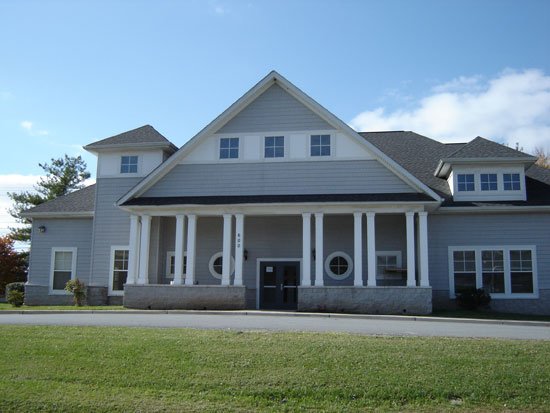
Home Builders Care Assessment Center (HBCAC) Men's Emergency Shelter at 600 East Gude Drive, now closed (Photo: Homeless Shelter Directory)
A review of the approval process for this expansion reveals administrative negligence that is difficult to comprehend. During a mandatory referral review before the Montgomery County Planning Board in November 2007, planners acknowledged that active methane extraction was underway at the former landfill. Despite noting that the county was seeking a contractor to manage the methane issue, the Department of Health and Human Services (HHS) received development waivers to shrink structural setbacks. When the campus was dedicated on June 18, 2009, county leaders praised it as a state-of-the-art success. Underneath the ribbon-cutting ceremony, however, the subsurface toxic stew was bursting for release.
Under Maryland and federal regulations, landfill operators must strictly prevent methane concentrations from exceeding 25% of the Lower Explosive Limit (LEL) inside structures, or 100% of the LEL (5% methane by volume) at property boundaries. To control gas, the county was relying on an aging underground pipe network under negative pressure from industrial blowers, feeding a gas-to-energy plant and flare station.
As the Gude campus was expanding, the methane system was suffering from both natural and policy-made failures. The subsurface collection network had rusted, shifted, and cracked under uneven soil settlement, destroying negative pressure and letting raw methane leak into the surrounding soil. During construction of the Intercounty Connector (ICC) highway, state contractors used the rear of the Gude Landfill as a dumping ground for millions of tons of excess fill dirt. The immense weight compacted underlying waste, disrupted existing gas extraction channels, and created soft, pressurized underground gas pockets. Methane began migrating laterally toward East Gude Drive.
Methane seeps, localized brush fires, and recurring indoor LEL gas alarms became commonplace. To suppress the sickening stench wafting over campus grounds and adjacent public spaces, site managers hung fragrance-crystal-filled socks every 20 feet along the perimeter fence line. It was perfume on a lipsticked pig.
By 2013, the Maryland Department of the Environment (MDE) stepped in, issuing a formal Consent Order against Montgomery County for widespread groundwater contamination and illegal off-site methane migration. The county agreed to an Assessment of Corrective Measures, selecting a $28.7 million remediation plan. As all that was happening, hundreds of homeless men and human service workers continued living and working directly inside the hazard zone.
CDC Intervention and Emergency Evacuation
Just one year before the COVID-19 crisis, the Gude landfill site collapsed. Mechanical issues cascaded through the landfill gas extraction and flaring plant. As equipment misfired, low-frequency ground vibrations began radiating through the soil, traveling directly into the foundation of the 600 East Gude Drive complex. Buildings shook continuously. Indoors, staff and shelter residents experienced unrelenting physical shaking, foul gas odors, and the constant threat of explosive gas accumulation. In February 2019, MCCH deemed its administrative offices unsafe, and staff retreated to leased commercial space at 405 East Gude Drive. As ground vibrations persisted, officials finally ordered the emergency evacuation of the Home Builders Care Assessment Center in May 2019. Over 135 residents were abruptly uprooted.
In June 2019, Montgomery County and MCCH requested an emergency site evaluation from the National Institute for Occupational Safety and Health (NIOSH), a division of the Centers for Disease Control and Prevention (CDC), to evaluate indoor air toxicity, explosive gas thresholds, and vibration hazards. Unable to guarantee structural stability or toxicological safety, county leadership permanently abandoned the 600 East Gude Drive complex. After investing tens of millions over nearly thirty years, the county wrote off the campus as an unlivable waste.
Pandemic-Fueled Crisis and $20 Million Replacement
The emergency abandonment of 600 East Gude Drive threw Montgomery County’s homeless safety net into severe turmoil. The sudden closure eliminated 135 emergency beds and 51 transitional beds right before the 2019–2020 hypothermia season and just six months before the first cases of COVID-19 would make the evening news.
To avoid leaving hundreds of men on the street, the county negotiated an emergency lease with the City of Rockville for a municipal building at 6 Taft Court. The building was an ill-suited, retrofitted office structure, and some supportive services and medical infrastructure were lost. The arrangement collapsed with the arrival of the COVID-19 pandemic in early 2020. When public health officials imposed mandatory social distancing, capacity at 6 Taft Court was reduced to just 93 beds. With average single adult shelter demand ranging between 300 and 400 individuals per night, officials were faced with an immediate humanitarian crisis. To compensate, Montgomery County spent millions commandeering public recreation centers and leasing commercial hotel rooms.
The meltdown at Gude Drive, exacerbated by the pandemic, was a significant factor leading to a complete shift in county policy. Prior to COVID-19, the county operated on a seasonal model, providing expanded bed capacity primarily during winter months. Now County Executive Marc Elrich and the County Council formally abolished seasonal sheltering, committing to a 24/7/365 non-congregate model with integrated medical and job-training services.
To implement this model and permanently replace Gude Drive, the Department of General Services spent $20 million to purchase and convert a two-story commercial office building on 2.7 acres at 11600 Nebel Street in North Bethesda. The Nebel Street Shelter officially opened on March 7, 2022. The 200-bed facility finally replaced the capacity lost at Gude Drive, offering year-round beds, medical suites, case management offices, and dining spaces.
Meanwhile, the county was forced to carry out the delayed environmental remediation of the Gude Landfill. The county spent $28.7 million to construct a geosynthetic "toupee" cap across 100 acres using 5 million square feet of liner to seal off methane seeps and leachate generation. Completed in 2025, the capped landfill is slated for conversion into a public park featuring a disc golf course and dog park. How the county can remain so optimistic about the future of a property that has been bleeding residents’ wallets and health for thirty years is hard to fathom.
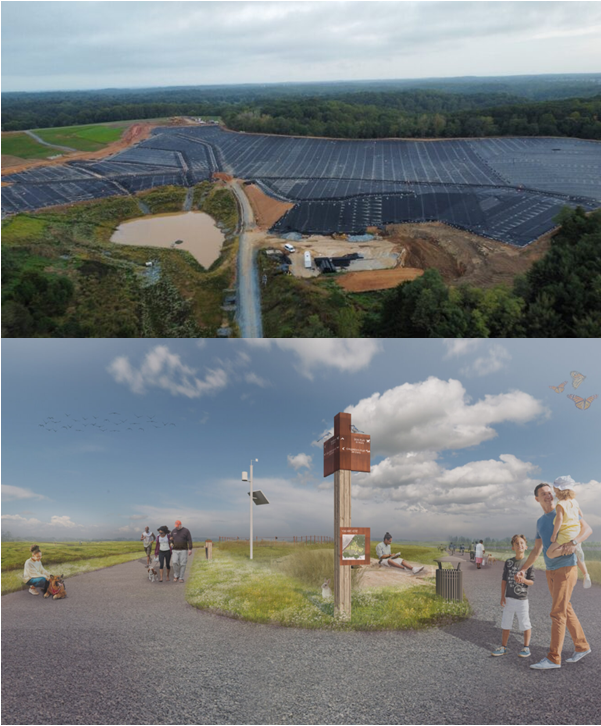
Top: In 2025, the landfill was closed with a geosynthetic cover system utilizing 5 million square feet of 50-mil polyethylene and 10 million square feet of geotextile (Photo: AGRU America, Inc.)
Bottom: Montgomery County plans to open the landfill site as the “Gude Landfill Passive Public Park” in 2027, as shown in this master plan rendering (Photo: Floura Teeter Landscape Architects)
For decades, county leadership operated with no compunction about placing its most vulnerable residents in a literal dump. Fiscally, the strategy was disastrous. Over $7.6 million in public and charitable dollars invested in the 2000 and 2009 Gude Drive construction projects was completely written off when the campus was evacuated. Emergency relocations, hotel leases during the COVID-19 pandemic, and the $20 million purchase of Nebel Street raised the eventual cost far beyond what a proper, safe site acquisition would have cost initially. The county put off years of necessary maintenance, overburdened its own system with ICC fill dirt, and then spent $28.7 million to cap the landfill after state regulators forced its hand through a Consent Order.
When the nearest neighbor is a 120-acre field burping 70% methane, there are no NIMBYs. The East Gude Drive fiasco is a sobering example of how political convenience can lead to preposterous planning, land-use negligence, fiscal wastefulness, and a callous disregard for basic human decency.