Park Trail Clear-Cutting Sparks Community Pushback After Years of Silence
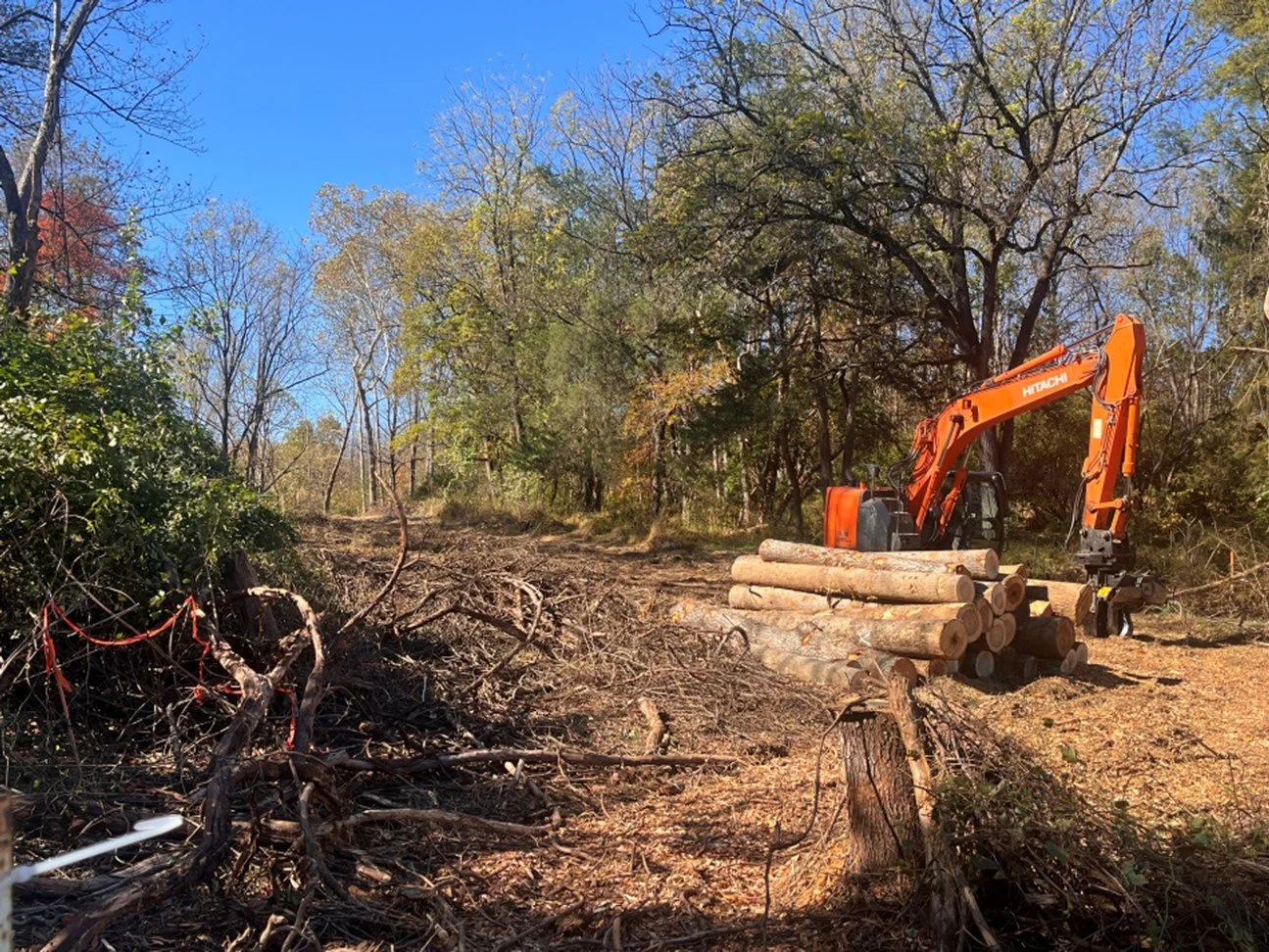
Construction has begun on the North Branch Trail Extension Project (photo courtesy of Todd Kushner)
Heavy equipment has carved a 20- to 30-foot corridor through woodland along Lake Frank’s Lakeside Trail in Rock Creek Regional Park, felling mature trees as construction of a hard-surface hiker-biker path advances. Regular trail users first spotted demarcation activity in late August. Mid-September postcards from the Maryland-National Capital Park and Planning Commission announced that work would begin in October. The trail is now closed.
One Manor Lake resident counted 98 trees cut along the first third of the route, making a total of roughly 300 a reasonable estimate of forest loss. A walk along the path by Montgomery Fix confirms those estimates. Nearby residents, including members of the Manor Lake Civic Association, describe the launch as abrupt and lacking meaningful recent community input. Many note that the Planning Board decided to move forward with construction funding in January 2026 yet chose not to notify neighbors in advance, unlike the approach taken with the nearby Lake Frank Tributary Stream Restoration and Outfall Stabilization project, which Parks staff briefed at a recent MLCA general meeting.
The friction has deep roots. In spring 2009, Manor Lake residents noticed survey flags along the Lakeside Trail. The civic association board pointed out that it had not been informed of public meetings and pressed for briefings. Meetings followed in September 2009 and March 2010. At the time, Montgomery Parks pledged to keep the association informed of future public sessions. That earlier engagement produced changes to the preferred alignment and mitigation conditions, including screening plantings and stormwater measures.
Opinions inside Manor Lake and nearby neighborhoods remain mixed. Some residents worry a paved trail will alter the quiet, natural character of the Lake Frank area. Others say shared hiker-biker paths reduce safety and comfort for pedestrians when cyclists travel at speed. A number have asked whether a separate natural-surface loop could be created around the lake for walkers who prefer not to share pavement with bikes. Parks officials state that the current design, approved in an amended facility plan in November 2017, addressed community concerns raised at that time. They have not, however, presented residents with details of the final plan or explained which specific concerns were resolved and how.
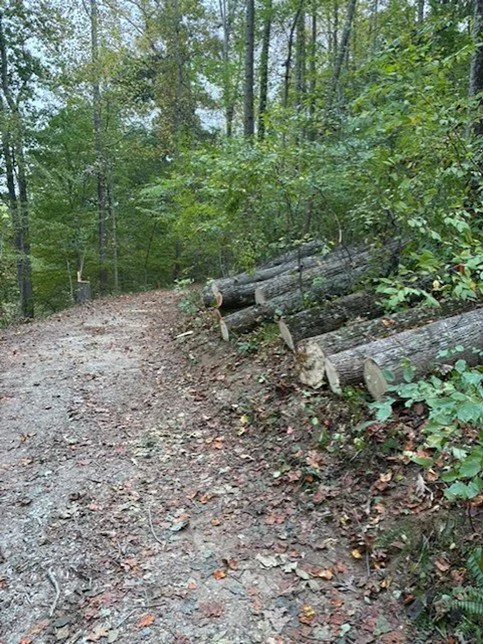
Neighbors say as many as 300 trees will come down. About 100 are already felled. (photo courtesy of Todd Kushner)
The project itself traces a long planning arc. A continuous hard-surface trail through the North Branch stream valley appeared in county bikeway plans as early as 1978 and was reconfirmed in subsequent master plans. Federal involvement began with the 2006 Intercounty Connector Record of Decision, originally aimed at removing abandoned asphalt parking lots near Lake Frank. Planners later redirected those stewardship funds toward a trail connector. The Planning Board approved a mandatory referral in 2010, a full facility plan in 2013, and the 2017 amendment that shifted the trailhead and refined a bridge crossing.
After years of regulatory reviews and cost increases, the Maryland Department of Transportation State Highway Administration authorized bidding in late 2025. When bids exceeded available money, the County Council approved a $2.9 million special appropriation in February 2026, bringing the total budget to $8.172 million. Nearly half comes from a federal Transportation Alternatives Program grant. Those federal dollars require adherence to shared-use path standards, including a continuous hot-mix asphalt surface, maximum 5 percent grades, and related design rules. Parks officials say substituting crushed stone or gravel would violate the grant terms and force the loss of about $4 million, effectively ending the project. Temporary clearing widths of 20 to 30 feet are needed for grading, drainage, and equipment. A steel bridge and modern stormwater facilities form part of the design. After construction, Parks plans to plant roughly 110 native nursery trees and remove two aging asphalt parking lots near the lake as partial environmental offsets.

The central complaint is the near-decade gap. Officials treat the 2008–2017 outreach as sufficient. Demographic turnover means many current households were not present for those discussions. The September postcards arrived only weeks before machinery arrived. Residents argue that a project dormant for nine years and then accelerated with new public money should have triggered a fresh round of community briefings before land clearing began.
Manor Lake Civic Association leaders have urged concerned residents to contact elected officials. They recommend reaching out to state Sen. Ben Kramer, who has said he will look into the matter; Councilmember Natalie Fani-González, who voted for the 2026 funding and has been active in the community; Councilmember Will Jawando, a member of the Planning, Housing, and Parks Committee and a candidate for county executive; and Councilmember Andrew Friedson, who chairs that committee.
Parks has declined requests to halt work. Construction is projected to finish in fall 2027, followed by replanting. The cleared corridor now stands as the most visible outcome of decisions made years earlier, funded to completion this year, and launched with minimal contemporary notice. Whether additional community engagement, design clarifications, or further mitigation follow remains an open question for the neighborhoods that border the lake.