Let’s Remove Our Own Snow
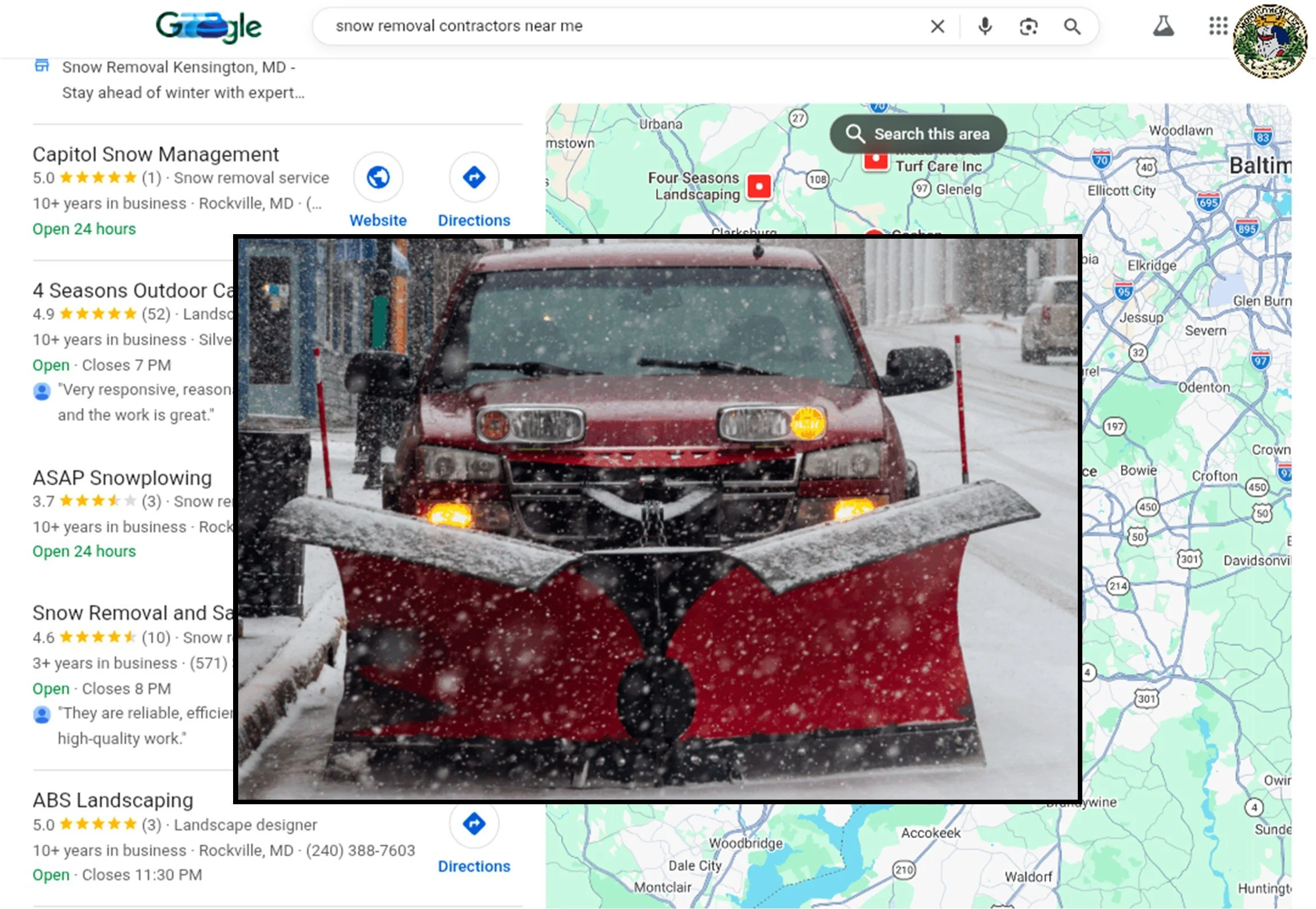
Photo Montage: background, Google search; center, 4.0 International
It was five days after the January 24–25 snowstorm before I was finally able to get my car out and search for food, drink, entertainment, and the other necessities a modern hunter-gatherer requires to get through the week. When I did make it out, I immediately noticed something. Regardless of size, nearly every shopping center parking lot I visited had already been plowed.
The storm dropped roughly 6 to 11 inches of snow across Montgomery County, an amount that is disruptive but not unprecedented. Comparable storms occurred in 2010, when two back-to-back blizzards delivered more than two feet of snow, and again during the 2015–2016 winter, which included a historic January blizzard. Still, for a region that typically sees a handful of modest storms each winter, last January’s storm brought enough accumulation to test the county’s snow-removal system.
Public frustration has followed. In response, multiple members of the County Council have called for hearings and reviews of the county’s snow-removal performance, including Councilmembers Andrew Friedson and Will Jawando, with a public discussion involving the full Council leadership yesterday. The focus has been on understanding what went wrong and how the county can do better next time.
That instinct toward process improvement is understandable. But it avoids a more fundamental question: should Montgomery County be responsible for clearing all residential snow at all? And if so, to what extent?
Major thoroughfares—Georgia Avenue, Rockville Pike, East-West Highway—are clearly shared infrastructure and should remain a county responsibility. The case is much less clear for hundreds of miles of low-volume residential streets, some serving only a handful of homes.
Several U.S. cities have already answered this question differently. Boulder, Colorado, for example, generally does not plow most residential streets. The reasoning is straightforward. Clearing every small street requires a large fleet, significant staffing, and ongoing maintenance costs for equipment that may be used intensively only once every few years. That fleet also carries environmental consequences like fuel consumption, emissions, and storm-water impacts that run counter to stated climate goals.
There is also a customer-service reality. Under the current system, residents have exactly one provider for snow removal: the county. Dissatisfaction leads to a call to 311 or a council office, not to a competing service. By contrast, shopping centers, office parks, and private communities hire private snow-removal contractors. If one company cannot respond quickly, another can. Pricing is explicit, accountability is clearer, and results often arrive sooner.
This difference helps explain why commercial areas were largely cleared while many residential streets remained impassable days later.
The equity question should be addressed directly rather than left implied. Expecting the county to provide full residential snow removal in affluent communities such as Bethesda, Chevy Chase, Potomac, and Poolesville, regardless of cost, raises the question of whether public resources are being allocated efficiently. If the county’s goal is to ensure basic mobility and safety, it may make more sense for public efforts to prioritize arterial roads and assistance for residents who lack the means to arrange private snow removal, rather than universally subsidizing a service that many households could reasonably handle themselves.
Relieving the county of the obligation to clear every residential street, particularly for rare, high-impact storms, deserves serious consideration. For five-year or ten-year snow events, centralized management and large-scale deployment have proven costly without producing results that meet public expectations. A more limited, targeted approach may ultimately serve residents better than attempting to do everything, everywhere, all at once.
Montgomery Fix is a platform for diverse perspectives. The opinions, beliefs, and viewpoints expressed by the various authors on this site do not necessarily reflect the opinions, beliefs, and viewpoints of the Publisher.